
Most lists of real estate SEO keywords are one long column: “homes for sale”, “realtor near me”, “real estate agent”, and two hundred more. They look useful. They are also hard to act on, because they mix up people who want completely different things.
This list is sorted by who is searching and what they want. Under each group you’ll find keyword patterns you can copy, the kind of page that should target them, and a note on how hard they are to rank for.
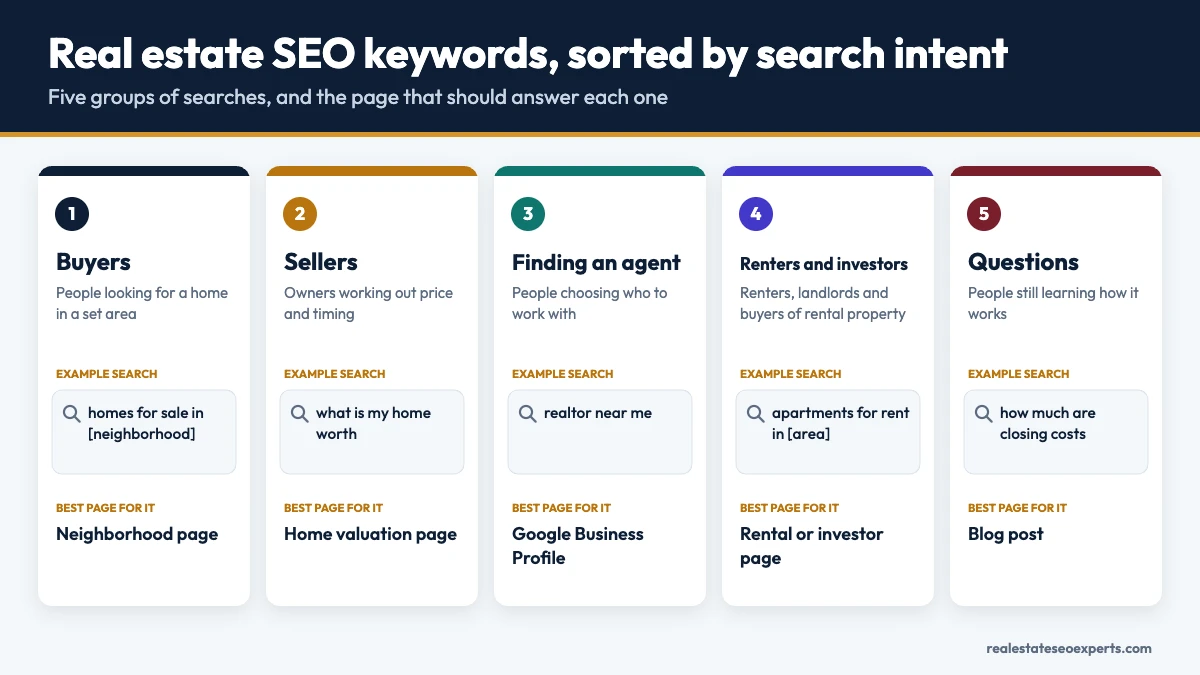
Why a flat keyword list doesn’t help
Take three searches. Someone typing “homes for sale in [city]” wants to look at houses. Someone typing “how much is my house worth” is thinking about selling. Someone typing “real estate agent salary” wants a job.
One page can’t serve all three, and one of them will never be your client. A flat list hides that. It also tempts you to chase whichever phrase has the biggest number next to it, which is usually the one you are least likely to win.
You won’t find search volumes here. Volumes change by city and by month, and a national number tells you very little about your own market. Check your area in a keyword tool before you commit to anything.
How to use this list
The keywords are patterns. Wherever you see [city], [neighborhood] or [ZIP], put in the places you work. “Homes for sale in [neighborhood]” becomes a different keyword in every area you cover, and each one needs its own page.
Three rules will save you time:
- One main keyword per page. If two pages chase the same phrase, they compete with each other.
- Match the page to the search. Listing searches need listings. Questions need a written answer.
- Start small. A neighborhood keyword you can win is worth more than a city keyword you can’t.
Buyer keywords
Buyers make up most of the search demand in real estate. These are also the searches where the big portals are strongest, so the narrower your phrase, the better your odds.
Broad buyer searches
- homes for sale in [city]
- houses for sale [city]
- real estate [city]
- condos for sale in [city]
- new homes in [city]
These are the hardest keywords on this page. Zillow, Realtor.com and the other portals usually hold the top results, and a single agent’s site rarely moves them. Keep a city page on your site, because visitors expect one. Don’t judge your SEO by whether it ranks first.
Narrow buyer searches
- homes for sale in [neighborhood]
- [number]-bedroom houses for sale in [neighborhood]
- homes for sale near [school name]
- homes with a pool in [city]
- condos under [price] in [city]
- townhomes for sale in [ZIP]
- waterfront homes in [area]
- new construction homes in [suburb]
This is where a local site can win. Fewer people search each phrase, but the person who does knows what they want. Each of these needs a page of its own, with listings and something a portal doesn’t have: what the streets are like, what the HOA charges, where the school boundary runs.
Page type: neighborhood pages and filtered listing pages.
Seller keywords
There are fewer seller searches than buyer searches, and they are worth more to most agents. A listing gives you a sign in the yard, a commission, and often a buyer or two on top.
- how much is my house worth
- home value [city]
- sell my house in [city]
- best time to sell a house in [city]
- listing agent in [city]
- how to sell a house fast
- cost of selling a house in [state]
- should I sell my house now
Sellers read more than buyers do before they contact anyone. They want to know what the house is worth, what selling costs, and whether now is a sensible time. A page that answers one of those questions honestly, with local detail, does well here.
A caution on “how much is my house worth”. The instant-estimate tools own that search, and you are unlikely to outrank them with a form. A written page on what drives prices in your area, with recent sales you can talk about, gives you a better chance.
Page type: a home valuation page, a “selling in [city]” guide, and blog posts for the questions.
Agent-finding keywords
These come from people who have decided to use an agent and are choosing one. They are the closest thing in real estate to a ready customer.
- realtor near me
- real estate agent in [city]
- best realtor in [city]
- top real estate agents [neighborhood]
- buyer’s agent [city]
- listing agent near me
- [your name] realtor
- [your brokerage] reviews
Most of these show a map with three businesses at the top. That map is driven by your Google Business Profile, your reviews, and how close you are to the searcher, more than by your website. If you want these searches, start with real estate local SEO.
Don’t skip your own name. Search it and see what comes up. If the first results are portal profiles and an old brokerage page, you have work to do before anything else on this list. Our Realtor SEO agency page covers that problem in detail.
Page type: your Google Business Profile, your home page and your about page.
Rental, investor and property management keywords
Not every real estate business sells houses. These groups search differently, and mixing them into a sales site confuses both the visitor and Google.
Renters
- apartments for rent in [city]
- houses for rent in [neighborhood]
- pet-friendly apartments [city]
- [number]-bedroom apartments near [landmark]
Page type: availability and floor plan pages. See apartment SEO services for how those sites are built.
Investors
- investment property in [city]
- multifamily for sale [city]
- best neighborhoods to invest in [city]
- rental yield [city]
Investors compare cities and numbers. Pages with rents, prices and plain reasoning do better with them than pages full of photos.
Owners looking for a manager
- property management company in [city]
- property management fees [city]
- property manager near me
These come from owners, and they need service and fees pages of their own. Our property management SEO page explains how owner searches differ from tenant searches.
Question keywords for blog posts and AI answers
Questions are the easiest real estate keywords to rank for. They have a second use as well: AI tools such as ChatGPT and Google’s AI Overviews build their answers from pages that respond to a question clearly.
- how much do I need for a down payment in [state]
- is [neighborhood] a good place to live
- what are closing costs in [state]
- how long does it take to buy a house
- what does a buyer’s agent do
- is it a good time to buy a house in [city]
- how do property taxes work in [county]
- renting vs buying in [city]
Write one post per question. Put a direct answer in the first two or three sentences, then explain. A short, plain answer at the top is the part that gets quoted, in a featured snippet or in an AI reply. That is the idea behind AEO for real estate.
These searchers are early. Most won’t call you this month. They will remember who gave them a straight answer, and some of them will come back when they are ready.
Page type: blog posts and FAQ sections.
Keywords to leave alone
Some phrases have plenty of searches and no customers. Leave them out of your plan.
- real estate agent salary
- how to become a real estate agent
- real estate license [state]
- real estate classes online
- real estate jobs near me
- real estate CRM
- real estate photography prices
The people behind these are agents, students and vendors. Ranking for them brings visits that never turn into a client, and it blurs what Google thinks your site is about.
Skip city names where you don’t work, too. A page for a town you have never sold in has nothing real to say, and Google is good at spotting pages built from a template with the place name swapped.
How to choose which keywords to target first
A long list is only useful once it has an order. This is the order we use with new clients.
- Your own name and your brokerage’s name. If you don’t rank first for yourself, fix that before anything else.
- Agent-finding keywords in your home area, through your Google Business Profile.
- Three or four neighborhood keywords where you have sold homes and can write from experience.
- Seller questions for those same neighborhoods.
- Buyer questions and general questions, one post at a time.
- City-wide terms, last. They take the longest and depend on everything above.
Before you write a page, look at the search results for its keyword. If the first page is all portals and national sites, pick a narrower phrase. If you see other local agents and a few thin pages, you have a real chance.
Give it time. Most campaigns need three to six months before results are steady, and city-wide terms take longer. Our real estate SEO strategy guide walks through the wider plan.
Common mistakes
- Putting twenty keywords on one page and hoping it ranks for all of them
- Building a page for every town in the county, with the same text and a different place name
- Writing for the keyword and forgetting the reader, so the page says “homes for sale in [city]” nine times and nothing useful
- Ignoring seller keywords because buyer searches look bigger
- Never checking which searches the site already appears for
Frequently asked questions
How many keywords should a real estate website target?
One main keyword per page, plus a few close variations. A solo agent might start with ten to fifteen pages. The number of pages matters less than whether each one has a clear job.
Should I target “homes for sale in [city]”?
Have a page for it, because visitors expect one. Don’t make it your main goal. Portals hold the top of that search in most cities, and neighborhood pages will bring you leads sooner.
Where do I find search volumes for my area?
Any keyword tool will give you estimates, and Google Search Console shows the real searches your site already appears for. Treat tool numbers as rough guides. For neighborhood terms they are often too low to register, even when the searches are real.
Do I need different keywords for AI search?
Mostly the same ones, phrased as questions. People ask AI tools full questions, so pages that answer a question plainly tend to be the ones that get cited.
Where to go from here
Pick five keywords from this list that match the work you already do, and check that each has a page. Most agent websites haven’t done that much.
If you’d like a second opinion, our free SEO audit shows which of these searches you already appear for and which are missing. It comes back within 6 to 12 hours. You can also see what’s included in our real estate SEO services.
Want a second pair of eyes on your site?
Send us your website and we will check it by hand. The free audit comes back within 6 to 12 hours, and plans start from $150 a month.