
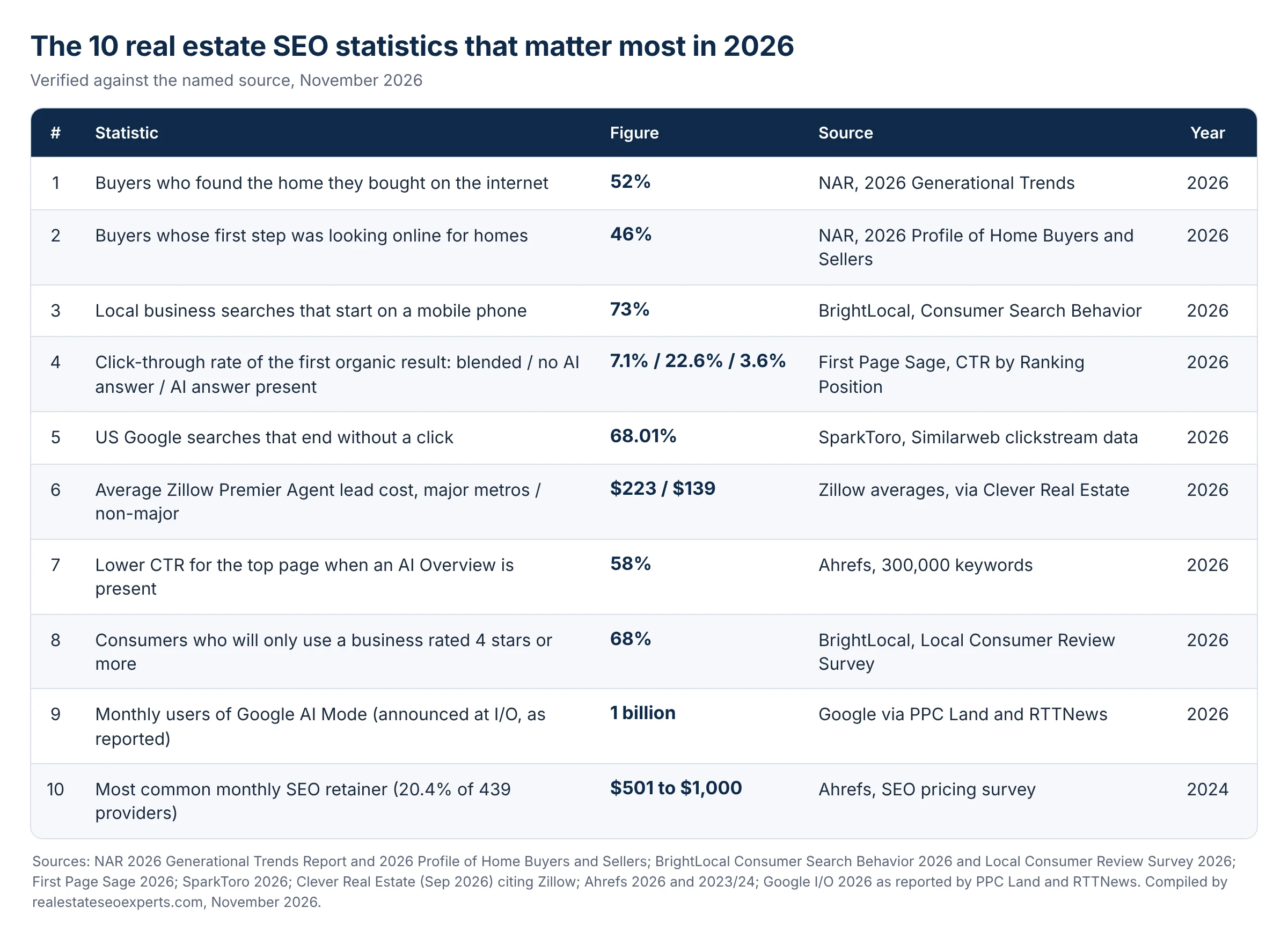
If you only remember five real estate SEO statistics this year, make it these: 52% of buyers found the home they bought on the internet and 46% started their search online (NAR 2026 Generational Trends); 73% of local searches now start on a phone (BrightLocal 2026); the top organic result’s blended click-through rate has fallen from 39.8% to 7.1% in a year because AI answers now sit above it, and it still gets 22.6% when no AI answer is shown (First Page Sage 2026); a Zillow Premier Agent lead averages $223 in major metros (Clever Real Estate, citing Zillow); and 68% of US Google searches end without a click (SparkToro 2026). Everything below is built on the same standard: a number, the year it describes, a link to the source we read this week, and one sentence on what it means for an agent or a broker.
Most statistics pages in this niche recycle each other, and a lot of the numbers they pass around have no traceable origin (we explain which ones we threw out in the methodology section at the end). This roundup uses primary sources wherever one exists: NAR’s 2026 Profile of Home Buyers and Sellers and 2026 Generational Trends report, Zillow’s SEC filing and its own consumer research, Google’s earnings remarks, BrightLocal’s 2026 surveys, First Page Sage, Backlinko, SparkToro, Ahrefs and Semrush. Where a figure comes from a secondary source that names its primary, we say so. If you want the detailed cost math behind the portal numbers, our Zillow leads vs SEO cost per closing comparison and real estate SEO cost guide do that work; this page is the reference sheet.
The 10 real estate SEO statistics that matter most, at a glance
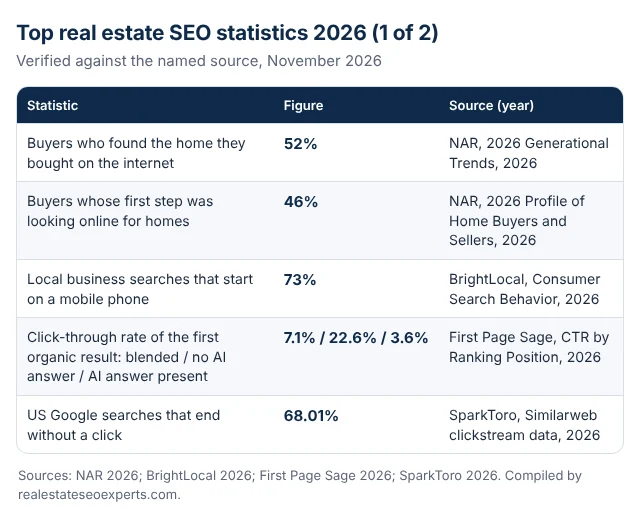
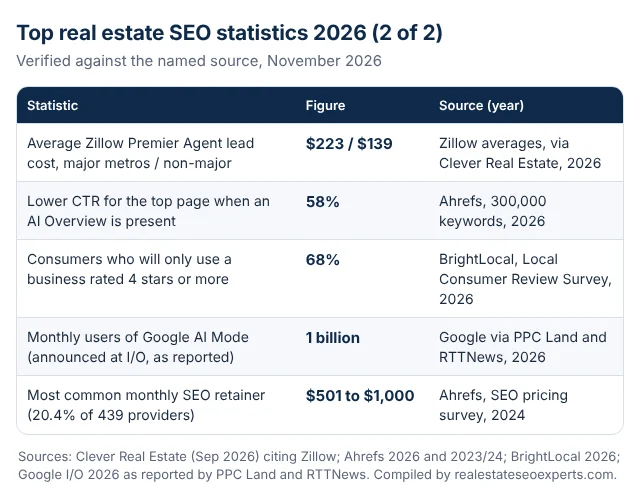
These ten are the numbers we would put in front of a broker who has fifteen minutes. Each appears again below with its source link and context.
How buyers and sellers search for homes and agents
NAR surveys recent buyers every year, and the 2026 Generational Trends report (buyers who closed between July 2024 and June 2025, 6,103 responses) is the most detailed public release of that data. NAR’s 2026 Profile of Home Buyers and Sellers, published on 10 November 2026, updates the headline agent-use numbers. We quote both and say which is which.
- 46% of buyers took their first step in the home search by looking online for properties for sale, and 20% started by contacting an agent (NAR, 2026). Nearly half of your future clients meet a listing, a portal or a website before they meet any agent. The website that shows up at that first step gets the first conversation.
- 52% of buyers found the home they eventually purchased on the internet; 27% found it through their agent (NAR, 2026). The internet is now the single largest discovery channel for the actual purchase, roughly double the agent’s share. Listing pages that rank, load fast and answer questions are a sales tool, not a brochure.
- 70% of buyers used a mobile or tablet search device during their search; 85% used a real estate agent and 52% used an online video site as an information source (NAR, 2026). Phones and video are standard parts of a search, which is why Google judges your site on its mobile version and why listing video keeps buyers on your pages.
- 10 weeks is how long the typical buyer searched before purchasing (NAR, 2026). That is the window in which your content, your retargeting and your follow-up have to keep showing up. A buyer who finds you in week one can be gone by week ten if nothing brings them back.
- 56% of buyers said finding the right property was the most difficult step; the next hardest, paperwork, was named by 18% (NAR, 2026). Search pages that make finding the right property easier (neighborhood guides, filtered listing pages, honest pros and cons) answer the pain point buyers themselves rank first.
- 81% of buyers who used the internet rated listing photos very useful, followed by detailed property information at 77%, floor plans at 57%, agent contact information at 44%, virtual tours at 38% and neighborhood information at 34% (NAR, 2026). Build listing and area pages around these six elements in this order. Photos and detail win; a virtual tour helps but is not the first thing to spend on.
- 43% of buyers found their agent through a referral from a friend, neighbor or relative; 15% used an agent they had worked with before; 6% found their agent through a website without a specific reference; and 11% made first contact through an inquiry on a third-party website (NAR, 2026). Referral is still the biggest channel, but the two web channels together (website plus third-party inquiry) now add up to 17% of first contacts, which is more than the share who met an agent at an open house.
- 74% of buyers interviewed only one agent before deciding who to work with (NAR, 2026). Three buyers in four hire the first agent they seriously talk to. Being the agent they find when they search is most of the battle; there is rarely a shortlist.
- 90% of buyers purchased through an agent or broker, the highest in four decades, and 92% of sellers used an agent, an all-time high (NAR, 2026). The agent is not being disintermediated by search. Buyers search online, then hire a professional. SEO’s job is to make sure the professional they hire is you.
- 5% of sellers sold for sale by owner, a historic low, and 22% of buyers were first-time buyers, up slightly from a record low of 21% (NAR, 2026). A shrinking FSBO share means more listings go through agents, and a small first-time-buyer pool means repeat and move-up buyers (median age 62) dominate the searches you are competing for.
- 66% of recent sellers chose their agent through a referral or by reusing an agent they had worked with before (NAR, 2026). On the listing side, search is still a minority channel. A seller-facing SEO program works best as a supplement to a referral engine, targeting home valuation and “sell my house” queries rather than trying to replace word of mouth.
Zillow’s own buyer research tells the same story from a different angle. In its Consumer Housing Trends Report 2025 (surveyed April to September 2025), 84% of buyers used an agent, 79% installed a real estate app during the process, and 33% of buyers first found their agent online against 30% through a referral, with real estate websites and apps alone accounting for 22% of agent discovery. Zillow’s survey design differs from NAR’s (it asks about every resource used, not one first step), which is why its agent-discovery split leans more digital. Both are worth citing; just do not mix numbers from the two in one sentence.
Local search, mobile and reviews
Real estate is a local service, so local search behaviour matters as much as home search behaviour. BrightLocal runs two separate 2026 consumer surveys that are worth knowing: one on channels (1,227 US consumers who searched for a local business in the last three months) and one on reviews (1,002 US adults). For how this plays out on a Google Business Profile specifically, our Google Business Profile guide for real estate agents goes through Google’s own rules.
- 73% of local business searches start on a mobile phone; 19% start on a computer and 8% on a tablet (BrightLocal, 2026). Your local pages are judged on a phone screen first. A slow mobile IDX site is a local ranking problem as well as a user problem.
- 52% of local searches start on Google Search and a further 9% start on Google Maps (BrightLocal, 2026). Six in ten local searches begin on a Google property. Your website and your Business Profile are the two places Google can send them.
- 84% of consumers searched online for a local business in the last three months (BrightLocal, 2026). Searching for a local professional is routine behaviour, not an edge case, and an agent is exactly the kind of local service people look up.
- 23% of consumers used an AI tool in their most recent local search, and 31% use AI tools for local business recommendations at least monthly (BrightLocal, 2026). AI assistants are now a real, if minority, discovery channel for local services. The pages and profiles AI tools cite are the same ones that rank in classic search, so one program covers both.
- 97% of consumers read online reviews for local businesses, and 41% always read them when browsing (up from 29%) (BrightLocal, 2026). Reviews are read almost universally. An agent with twelve reviews and a competitor with ninety are not competing on equal terms, however good the website.
- 68% of consumers will only use a business rated four stars or higher, up from 55% a year earlier, and 31% now require 4.5 stars or more (BrightLocal, 2026). The bar is rising fast. A 4.2 average that was fine two years ago now loses a third of prospects before they call.
- 74% of consumers look for reviews written in the last three months, and 32% look for reviews from the last two weeks (BrightLocal, 2026). Review recency is a ranking and conversion factor. Ask for a review after every closing, not in an annual batch.
- 89% of consumers expect business owners to respond to reviews, and 81% expect that response within a week (BrightLocal, 2026). Replying to every review, including the bad ones, is now table stakes for a local service business.
- 49% of consumers trust online reviews as much as personal recommendations from friends or family, and Google’s share as a review source fell from 83% in 2025 to 71% in 2026 (BrightLocal, 2026). Reviews still carry near-referral weight, but consumers are spreading their review reading across more platforms, so an agent’s reputation now needs to hold up beyond Google alone.
Portals and the cost of paid leads
These figures explain why so many agents look at SEO in the first place: the portals own the audience, and renting a slice of it is getting more expensive. For the full cost-per-closing comparison, read our Zillow leads vs SEO cost per closing analysis; the numbers here are the inputs.
- 215 million average monthly unique users visited Zillow Group’s apps and sites in Q3 2026, down 3% year over year, with 2.3 billion visits in the quarter, down 5% (Zillow Group, 2026). Zillow is still by far the largest real estate audience in the US, but it is no longer growing. The portal’s traffic ceiling is where an agent’s own search visibility starts to matter more.
- 77% of average monthly unique visitors in the real estate category went to Zillow in Q3 2026, according to Comscore as cited in Zillow’s results (Zillow Group, 2026). Three in four portal visitors are on Zillow. Competing with that head-on is pointless; ranking for the local and informational queries portals handle badly is not.
- $724 million was Zillow Group’s Q3 2026 revenue, of which residential (mainly Premier Agent) was $419 million, down 4% from a year earlier, while rentals grew 26% to $220 million (Zillow Group, 2026). The agent-advertising business is shrinking while rentals grow. Expect continued pressure on Premier Agent pricing and more pushes toward the commission-share Preferred model.
- $223 is the average Zillow Premier Agent lead cost in major metro areas and $139 in non-major metros, according to Zillow’s own published averages as reported by Clever Real Estate (Clever Real Estate, 2026). At these averages, a single month of a serious Premier Agent budget costs more than a year of an entry-level SEO plan. The question is which one still produces leads in month thirteen.
- $450 to $500 per lead is what agents in the most competitive markets report paying for Zillow leads, with most leads published in the $20 to $60 range (Clever Real Estate, 2026). Lead price tracks competition in your ZIP code, which is exactly where organic rankings are hardest to buy and most valuable to own.
- 15% to 40% of the commission is the success fee in Zillow’s Preferred (formerly Flex) program, with a flat 40% on seller-originated connections, as Clever reports from Zillow’s help center and pricing pages (Clever Real Estate, 2026). A commission-share model removes upfront cost but caps your margin on every portal deal for as long as you stay in the program.
- 1% to 3% is the conversion rate measured sources report for purchased internet leads (HousingWire, 2020), which at $223 per lead works out to roughly $7,433 per closing at 3% and $22,300 at 1% (Clever Real Estate, 2020). This is the number to put next to your average commission. The conversion figure is dated, so treat the range as a sanity check rather than a forecast.
- 2.3 out of 5 is Zillow Premier Agent’s rating on G2 across 56 reviews (G2, 2026). Agent sentiment about the product is poor even though usage is high. People buy it because the audience is there, not because they like it.
- $102.51 was the median cost per lead for real estate search advertising on Google, with a 7.61% click-through rate, a $3.22 cost per click (up 27% year over year) and a 3.70% conversion rate, across 894 US campaigns from April 2025 to March 2026 (LocaliQ, 2026). Paid search is cheaper per lead than Zillow but its click prices rose by more than a quarter in a year. Organic rankings are the one channel whose cost per click does not rise with competition.
Click share and ranking position: what changed in 2026
This is the section where most statistics pages are years out of date. The famous ‘position one gets 39.8% of clicks’ figure is from First Page Sage’s 2025 report; its 2026 report, based on 1,184 domains, 3.67 billion impressions and 41.2 million clicks between March and August 2026, shows a very different picture once AI answers are counted. The table separates the blended figure from pages with and without an AI answer, because that distinction is the whole story.
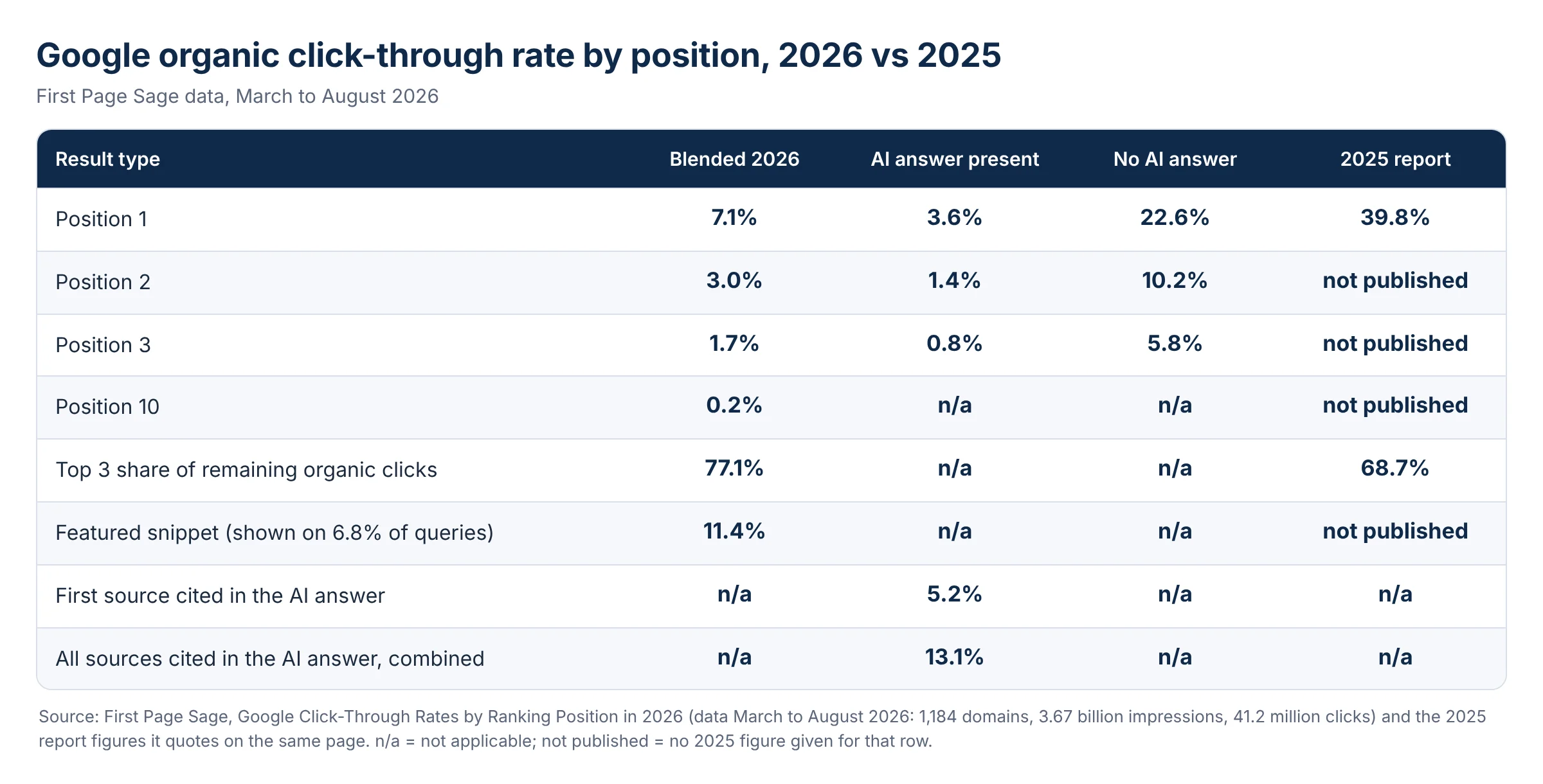
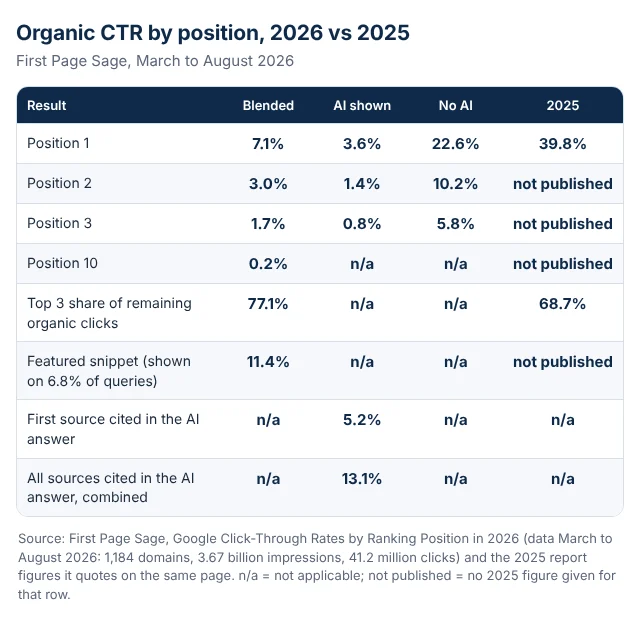
- 7.1% is the blended click-through rate for the first organic result in 2026, down from 39.8% in First Page Sage’s 2025 report; when no AI answer is shown the first result still earns 22.6%, and when an AI answer is present it earns 3.6% (First Page Sage, 2026). Ranking first still pays, but mostly on queries Google does not answer itself. Real estate listing and local queries are among the least likely to carry an AI answer, which is why they remain worth fighting for.
- 77.1% of the remaining organic clicks go to the top three results in 2026, up from 68.7% in 2025; position two earns 3.0% blended and position three 1.7% (First Page Sage, 2026). The clicks that survive AI answers concentrate even harder at the top. Page one is not the goal any more; the top three is.
- 11.4% is the click-through rate of a featured snippet, but snippets now appear on only 6.8% of queries; the first source cited inside an AI answer earns 5.2%, and all cited sources together earn 13.1% (First Page Sage, 2026). Being the cited source inside Google’s AI answer is now worth more than most positions below three. Clear, factual, well-structured passages are how you get there.
- 27.6% is the average click-through rate of the first organic result in Backlinko’s study of about four million search results, with the top three results taking 54.4% of clicks and only 0.63% of searchers clicking anything on page two (Backlinko, 2025). Different data set, same shape: a steep curve where page two might as well not exist. Backlinko’s figures predate the 2026 AI-answer rollout, so treat them as the pre-AI baseline.
- 10x more likely to be clicked is the first organic result compared with the tenth, and moving from position two to position one produces 74.5% more clicks on average (Backlinko, 2025). The jump from second to first is the single most valuable move in SEO, and it is usually won on content depth and links rather than technical fixes.
- 68.01% of US Google searches ended without a click in the first four months of 2026, up from 60.45% in 2024 (the two years use different clickstream panels, so the comparison is approximate) (SparkToro, 2026). Two searches in three never leave Google. Your Business Profile, your review snippets and the facts Google lifts from your pages are doing work even when nobody clicks.
- 92.3% of the top-ranking domains in a Semrush study had at least one backlink, and more than half of the sites with no backlinks never reached page one over 13 months (Semrush, 2023). A real estate site with zero referring domains is not going to rank for competitive local terms however good the content. Local links (sponsorships, press, associations) are not optional.
Our own reading of these numbers: the drop in position-one click-through rate is not a reason to stop doing SEO, it is a reason to choose queries more carefully. Transactional and local queries (“homes for sale in”, “realtor near me”, a neighborhood name plus “condos”) are where no-AI-answer behaviour still dominates and where 22.6% at position one is realistic. Broad informational queries (“how to buy a house”) are where the 3.6% figure applies, and those were never the queries that produced clients. This is also why real estate SEO timelines have not shortened: the valuable rankings are the competitive ones.
Agent websites, content and where leads actually come from
NAR’s technology research is the only large annual survey of what agents themselves use and what produces leads. Two editions are relevant: the 2025 REALTORS Technology Survey (1,241 responses, fielded July 2025) and the 2026 Technology Report (about 1,200 agents).
- 26% of REALTORS use a personal website with IDX, according to the 2026 Technology Report, which lists it among the tools agents use most (NAR, 2026). Roughly three agents in four do not have an IDX site of their own, which is why the ones who do, and who fix the usual IDX ranking problems, face thinner competition than they expect. Our IDX website SEO guide covers those problems.
- 39% of REALTORS said social media provided their highest-quality leads, followed by a CRM at 23% and the local MLS at 17% (NAR, 2025). Agents credit social media, not their website, for lead quality. Our reading: that reflects where agents put effort, not where buyers search. Only 26% even have an IDX site to generate website leads from.
- 79% of REALTORS use eSignature tools, 75% use social media and 75% use drone photography or video, the three most-used technologies (NAR, 2025). Drone and video assets are already being produced by three quarters of agents; most of it never reaches a website page that could rank. Repurposing is free content.
- $50 to $500 per month is what about half of agents budget for technology, with 22% spending more than $500 and 18% less than $50 (NAR, 2026). Most agents’ total tech spend is below the price of a single Zillow lead in a major metro. An SEO plan from $150 a month sits inside that budget, which is the point of pricing it that way.
- 20% of a typical REALTOR’s business came from repeat clients and 21% from referrals by past clients, with median gross income of $58,100 and ten transactions in 2024 (NAR, 2025). Repeat and referral business is about 41% of the typical agent’s deals. The other 59% has to come from somewhere, and at ten transactions a year each additional closing from search is a 10% lift in income.
- 12 years is the typical REALTOR’s experience, up from 10 a year earlier, with 74% very certain they will stay in the industry at least two more years (NAR, 2025). The agents left in the market are experienced and committed, which means the competition for rankings in most metros is more durable than it was during the 2021 influx.
AI search: the numbers Google has actually published
Most AI search statistics in circulation are estimates. The ones below come from Google’s own earnings remarks, from two studies with published methodology, and, for the I/O 2026 figure, from trade press reporting Google’s announcement, since Google’s own I/O post could not be retrieved this week. We flag that one accordingly. If this is the part of the market you want to act on, our real estate AI SEO service is built for it.
- 2 billion monthly users is where Google said AI Overviews stood in July 2025, across more than 200 countries and territories and 40 languages (Google, 2025). AI Overviews are not an experiment; they are the default experience for most of Google’s users. Any real estate query that is informational will sooner or later carry one.
- 10% or more is the increase in Google usage for the types of queries that show AI Overviews, according to Google’s internal data from September 2024 to April 2025 (Google, 2025). Google says AI answers make people search more, not less. More queries with fewer clicks per query is the environment agents now compete in.
- 1 billion monthly users is the figure Google gave for AI Mode at I/O in May 2026, with query volume reported to have more than doubled every quarter since launch (as reported by PPC Land and RTTNews; AI Mode had 100 million monthly users in the US and India in July 2025) (PPC Land, 2026). AI Mode went from launch to a billion users in about a year. Its answers draw on the same web index as classic search, so the pages that rank are the pages it cites.
- 3x longer than traditional searches is the average AI Mode query, and one in five AI Mode searches globally uses voice, images or documents (Google, 2026). Buyers are asking full questions (“three-bedroom homes under 600k near good schools in north Austin”) rather than typing two keywords. Pages that answer specific, detailed questions are the ones AI Mode has to reach for.
- 58% lower is the average click-through rate for the top-ranking page when an AI Overview is present, in Ahrefs’ 2026 re-run of its study (300,000 keywords, December 2023 versus December 2025); the 2025 version of the same study found a 34.5% drop (Ahrefs, 2026). The click penalty from AI Overviews nearly doubled in a year. The response is to rank for the queries that do not trigger them and to be the cited source on the ones that do.
- 71% growth in the share of commercial-intent search results carrying an AI Overview between November 2025 and April 2026, while the share on transactional queries fell 5%, across more than 600,000 US keywords (Semrush, 2026). AI Overviews are spreading into “best” and “compare” queries but retreating from pure buying queries. For agents, that means neighborhood and “best agent” content gets summarized while listing searches stay click-driven.
- 23% of REALTORS use AI daily, and 75% of those who use AI write listing descriptions with it (NAR, 2026). Three quarters of AI-using agents are generating the same kind of listing copy from the same tools. Distinctive, locally specific descriptions are becoming a differentiator again.
- 41% of REALTORS used AI or generative AI tools in 2025, with ChatGPT the most-used tool at 58% of AI users, and 32% had not actively tried AI at all (NAR, 2025). Adoption is real but uneven. The agent who uses AI to speed up research while keeping a human voice on the page is in a minority that search engines and readers both reward.
What SEO costs: the only large survey with published numbers
Agency price lists are not statistics. The one survey of SEO providers with a published sample is Ahrefs’ poll of 439 agencies, freelancers and consultants (published December 2023, updated August 2024). Our real estate SEO cost guide translates these into what a realistic agent plan should include; the raw figures are here.
- $501 to $1,000 per month is the most common SEO retainer, chosen by 20.4% of providers, and 68.8% of all providers charge $2,000 a month or less (Ahrefs, 2024). Most SEO work is sold for under $2,000 a month. Anyone quoting an agent $5,000 a month is in the top third of the market and should be able to show why.
- $75 to $100 per hour is the most common hourly rate (24% of providers), and $2,501 to $5,000 the most common per-project fee (21.2%) (Ahrefs, 2024). A one-off audit and fix project in the low thousands is normal pricing, which is a reasonable way to test an agency before committing to a retainer.
- $3,209 is the average monthly retainer charged by agencies against $1,348 for freelancers, which Ahrefs summarizes as agencies charging 138% more; 57.4% of agencies charge over $1,000 a month compared with 32.2% of freelancers (Ahrefs, 2024). You pay for process, reporting and redundancy with an agency. For a single-agent site, a specialist freelancer or a niche agency with fixed plans (ours start at $150 a month, see our pricing page) usually makes more sense than a generalist agency retainer.
If you are weighing any of these costs against your current lead spend, the fastest way to get a real number for your own site is a free real estate SEO audit: we check the twelve things that decide whether a site can rank and tell you what it would take.
How to cite these statistics
Cite the original source, not this page. Every statistic above names its publisher and year and links to the page we read. A good citation reads: “52% of buyers found the home they purchased on the internet (National Association of REALTORS, 2026 Home Buyers and Sellers Generational Trends Report).” If you reuse the at-a-glance table image, credit the sources listed in its caption and link to this page as the compilation. Please do not round or combine figures from different surveys: NAR’s 90% agent use (2026 Profile) and Zillow’s 84% (Consumer Housing Trends 2025) measure different things from different samples, and both should keep their own attribution.
Methodology: what we included, what we excluded and why
Every number on this page was checked against its source during the week of publication (17 and 18 November 2026). We included a statistic only if we could read it on a primary source (the publisher’s own report, filing or blog) or on a secondary source that names and links its primary. Where only the secondary was available, we say “as reported by”. Years refer to the period the data describes or the report edition, whichever the source states.
We excluded several numbers that appear on competing statistics pages. The “13 billion real estate searches per year on Google” figure is attributed by LocaliQ to a third-party blog with no visible methodology, so it is out. The widely quoted “complete Google Business Profile is 2.7x more likely to be considered reputable” claim could not be found on any live Google page. “Organic search gets 73% of clicks” (BrightEdge, 2022) and “the top organic result gets 19x the clicks of the top paid result” (First Page Sage, 2023) are both pre-AI-answer figures that their own publishers have since superseded, so we left them out rather than present them as current. Vendor estimates of real estate cost per lead by channel without a named sample were excluded. We also dropped the 2025 “100% of buyers used the internet” statistic because the 2026 NAR report no longer publishes that exhibit, and we could not confirm it on NAR’s own pages this week.
Two caveats on the numbers we did keep. The 1% to 3% purchased-lead conversion rate is from a 2020 HousingWire piece and is the oldest figure here; we kept it because Clever’s cost-per-closing math depends on it and no newer measured source exists. The AI Mode one-billion-user figure comes from trade press reporting Google’s I/O 2026 announcement, because Google’s own post could not be fetched; we would normally require the primary and have flagged it in the text.
Frequently asked questions
What percentage of home buyers start their search online?
46% of buyers took their first step by looking online for properties for sale, and 20% started by contacting a real estate agent, according to NAR’s 2026 Profile of Home Buyers and Sellers. The 2026 Generational Trends report gives the same 46% and adds that 52% of buyers found the home they eventually bought on the internet.
Is real estate SEO still worth it now that AI Overviews reduce clicks?
Yes, with a narrower target list. First Page Sage’s 2026 data shows the first organic result earns 22.6% of clicks when no AI answer appears and 3.6% when one does. Listing, local and “near me” queries are the least likely to carry an AI answer and the most likely to produce a client, so a real estate SEO program focused on those still works. Broad informational queries are where the click losses are concentrated.
How much does a Zillow lead cost compared with SEO?
Zillow’s published averages, as reported by Clever Real Estate in 2026, are $223 per lead in major metros and $139 elsewhere, with agents in the hottest markets reporting $450 to $500. At a 1% to 3% conversion rate that is roughly $7,400 to $22,300 per closing. Ahrefs’ pricing survey puts the most common SEO retainer at $501 to $1,000 a month, with 68.8% of providers charging $2,000 or less. Our Zillow leads vs SEO post works the cost per closing through for both.
What share of Google searches end without a click?
68.01% of US Google searches ended without a click in the first four months of 2026, according to SparkToro’s analysis of Similarweb clickstream data, up from 60.45% in 2024 on a different panel. For local businesses, including agents, much of that zero-click activity lands on a Google Business Profile, which is why the profile and the website have to be optimized together.
How many real estate agents have their own IDX website?
26% of REALTORS use a personal website with IDX, according to NAR’s 2026 Technology Report. Social media (75%) and eSignature (79%) are used far more widely. In the 2025 Technology Survey, 39% of agents said social media produced their best-quality leads, against 23% for a CRM and 17% for the local MLS.
Which real estate SEO statistics are safe to quote in a listing presentation?
Stick to the NAR figures, which are drawn from a 6,103-response survey with published methodology: 52% of buyers found their home online, 70% used a mobile device, 81% rated photos very useful and 74% interviewed only one agent. Name the report and the year. Avoid unsourced figures such as “13 billion real estate searches a year”, which we could not trace to a primary source.
Sources: NAR, Top 10 Takeaways from the 2026 Profile of Home Buyers and Sellers (Nov 2026), NAR, Buyers and Sellers Rely on Agents More Than Ever (Nov 2026), NAR, 2026 Home Buyers and Sellers Generational Trends Report, NAR, 2026 Generational Trends Report (full PDF), NAR, Generational Trends press release (Apr 2026), NAR, The Tech Real Estate Agents Rely On Most in 2026, NAR, 2025 REALTORS Technology Survey (PDF), NAR, 2025 Member Profile: Income Steady Even as Market Slows, Zillow, Consumer Housing Trends Report 2025: Buyers, Zillow Group, Q3 2026 results (SEC Form 8-K exhibit, Nov 2026), Clever Real Estate, How Much Are Zillow Leads? (updated Sep 2026), G2, Zillow Premier Agent reviews (Nov 2026), LocaliQ, Real Estate Search Advertising Benchmarks 2026, BrightLocal, Consumer Search Behavior 2026: Channels, BrightLocal, Local Consumer Review Survey 2026, First Page Sage, Google Click-Through Rates by Ranking Position in 2026, Backlinko, Google CTR study (updated Apr 2025), SparkToro, In 2026 Less Than One Third of Google Searches Still Send a Click (Jun 2026), Semrush, Top 106 SEO Statistics (2023), Semrush, AI Overviews Commercial Search Study (Jul 2026), Ahrefs, AI Overviews Reduce Clicks by 58% (2026 update), Ahrefs, AI Overviews Reduce Clicks by 34.5% (2025), Ahrefs, SEO Pricing: 439 People Polled, Google, Alphabet Q2 2025 earnings call CEO remarks (Jul 2025), Google, AI in Search: Going Beyond Information to Intelligence (May 2025), Google, Alphabet Q3 2026 earnings call CEO remarks (Oct 2026), PPC Land, Google I/O 2026 coverage (May 2026), Nasdaq / RTTNews, Google Introduces AI-Enhanced Search Features at I/O 2026 (May 2026).
Want to know which of these numbers apply to your site?
Our free audit checks the twelve things that decide whether a real estate site can rank, including the local and listing queries where organic clicks still happen, and tells you what it would take. No sales call required, and our plans start from $150 a month.