
Search “homes for sale in” plus the name of almost any American city, and the top of the page looks the same: Zillow, Realtor.com, Redfin, Homes.com, perhaps Trulia. An agent’s own website, if it appears at all, is somewhere on page two.
Agents tend to react in one of two ways. Some decide SEO is pointless and put the whole budget into buying leads from the portals that outrank them. Others spend a year trying to beat Zillow for the city name and get nowhere.
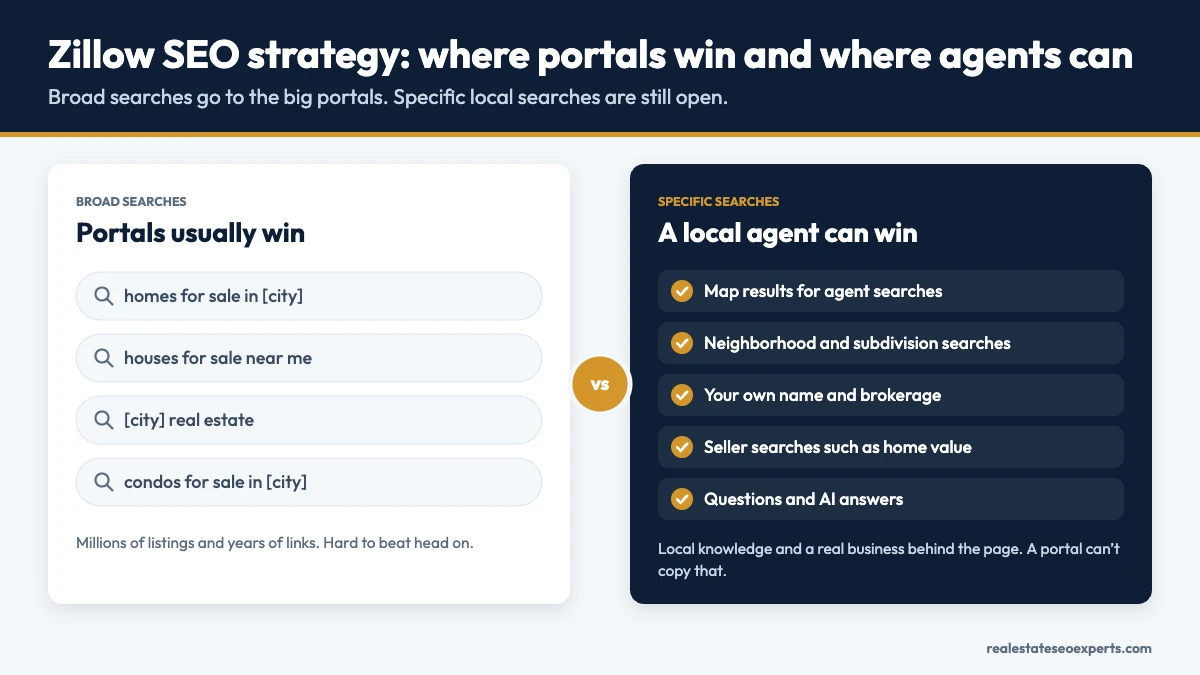
Both are mistakes. You are not going to outrank Zillow for “homes for sale in [city]”, and you don’t need to. There are other searches, often better ones, where a portal is weak and a local agent is strong. A sensible Zillow SEO strategy is about choosing those.
Why Zillow wins the broad searches
It helps to see why the portals win, because the same reasons show where they can’t.
A portal has a page for nearly every home, street, ZIP code and city in the country, and each page links to others. That scale turns the whole site into one huge, tightly connected resource on a single subject.
News sites, blogs, government pages and ordinary people have linked to the portals for years. Those links are one of the strongest ranking signals Google uses, and no single agent can match that volume.
Many people also type “zillow” straight into Google. That brand recognition tells Google the site is exactly what searchers want when they look for homes.
And listings update constantly, with price changes and status changes flowing in from many sources, so the content never goes stale.
Against that, an agent’s site with thirty pages and a handful of links has no chance on a broad search. Spending your budget there is like opening a corner shop and trying to beat the supermarket on price.
Where Zillow is weak
Scale is also the portals’ limit. A site with a page for everything can’t say anything particular about any one place.
Look closely at a portal’s neighborhood page. It has listings, a map, some numbers pulled from public data, and maybe a paragraph that reads as if a template wrote it. It doesn’t know that the east side of the main road floods in a wet spring, that the HOA changed its rental rules last year, or that the school boundary splits one street down the middle.
A portal also isn’t a person. It can’t be the agent someone hires. When a searcher wants a human being, with a search like “best realtor in [neighborhood]” or “listing agent near me”, Google shows local businesses and a map. The portals are present through their agent directories, but they don’t own that space the way they own listing searches.
And portals don’t answer many questions well. Their content is built around listings. Someone asking “is [neighborhood] a good place to live” or “what are closing costs in [state]” often lands on a smaller site that took the trouble to answer.
You can test this yourself. Search for one of your neighborhoods plus “homes for sale” and open the first portal result. Then ask what a buyer who is new to the area still wouldn’t know after reading it. That gap is your page.
Five places an agent can compete
1. The map results
“Realtor near me” and “real estate agent in [city]” show a map with three businesses above the normal results. Those places go to Google Business Profiles, and a portal can’t hold one for your town. Your category, your reviews, your photos and your distance from the searcher decide whether you appear. This is the fastest win available to most agents, and it is the core of real estate local SEO.
That profile is worth completing properly. Google’s own 2023 research found a fully filled out Business Profile makes a business 2.7 times more likely to be seen as reputable, 70% more likely to get a visit, and 50% more likely to be considered for a purchase.
2. Neighborhood searches
“Homes for sale in [neighborhood]” is narrower than the city search and far less contested. Portals still appear, but a detailed local page can sit beside them and sometimes above them. The smaller and more specific the area, the better your odds.
3. Your own name
When someone searches “[your name] realtor”, they have usually been referred to you or seen your sign. The top result should be your own site. For many agents it is a portal profile with competitors’ ads on it. Winning your own name is the first job, and we explain how on our Realtor SEO agency page.
4. Seller searches
Portals are built for buyers. Searches such as “sell my house in [city]”, “listing agent [neighborhood]” and “best time to sell in [city]” have less portal content behind them. A clear page for sellers, with your recent sales in the area, can rank where a buyer page never would.
5. Questions and AI answers
Buyers and sellers ask full questions, to Google and more and more to AI tools such as ChatGPT. Those tools build answers from pages that state things plainly. A local agent who writes a direct answer to a local question can be the source they quote, and portals rarely write that kind of page. Our list of real estate SEO keywords has a section of question patterns to start from.
Build a neighborhood page Zillow can’t copy
The neighborhood page is the best tool an agent has in any Zillow SEO strategy, so it’s worth getting right. Here is what goes on a strong one.
- A plain opening: two or three sentences on where the neighborhood is and what kind of homes it has.
- What it’s like to live there: traffic at school pickup, where people walk their dogs, which streets are quiet. These are things you only know from being there.
- Housing in detail: typical styles, ages and lot sizes, and what sells quickly versus what sits.
- Prices in words: a range and a sentence on direction, updated every few months. Use figures you can source from your MLS, and say when you last updated them.
- Schools and commute: named schools with the boundaries explained, and honest drive times at rush hour.
- Costs people forget: HOA fees, special assessments, flood insurance.
- Current listings, pulled from your feed, so the page always has something to look at.
- Your record in the neighborhood: homes you have sold there, if you have them.
- A short FAQ with the five questions buyers ask you most about the area.
That comes to 800 to 1,200 words that nobody else can write, because nobody else has your notes. It takes an afternoon. Do one for each area where you want listings, and resist doing twenty thin ones. Six good pages beat forty that differ by a place name.
Link every listing you take in the area to its neighborhood page, and link the page back to the listings. Our post on SEO for real estate listings explains why that pairing works. There is more on location pages in our guide to getting more property buyers from Google.
Should you still pay for Zillow leads?
That is a business decision at the heart of your Zillow SEO strategy, and it doesn’t have to be all or nothing.
Portal leads arrive quickly. You pay, and the phone rings this month. The drawbacks are that the cost recurs for as long as you want leads, the same enquiry may go to other agents, and the day you stop paying, the leads stop.
Those costs are well documented. Zillow’s own published averages put Premier Agent leads at $223 each in major metros and $139 elsewhere, and HousingWire reported in September 2025 that leads from other portals typically run $20 to $60, though hot markets can push that figure to $450 or $500. Zillow Preferred, formerly Flex, charges a 15 to 40% success fee of commission on top, or a flat 40% on seller connections, according to Zillow’s own 2026 Help Center. Clever Real Estate’s 2026 calculation puts the real cost at roughly $7,433 per closing at a typical 3% lead-to-close rate, or $22,300 at a 1% rate.
SEO is the reverse. It is slow at the start, and it costs the same each month whether the phone rings or not. But the pages you build stay, and an enquiry from your own site comes to you alone.
For most agents a sensible plan is to keep whatever portal spend is paying for itself, start SEO alongside it, and shift budget as leads from search grow. Cutting the portals off on day one leaves a gap that SEO won’t fill for months. Our pricing page compares the two in more detail.
A simple way to decide is to work out what each closed deal costs you from each source over a year. Count the fees and your time. If portal leads close at a cost you’re happy with, keep them. If they don’t, that money is your SEO budget.
Keep your portal profiles working for you
Competing with Zillow in search doesn’t mean ignoring it. Clients who find you on Google will often look you up on a portal before they call, the way they would check reviews for a restaurant. Three things are worth an hour of your time:
- Make sure your name, phone number and brokerage match your website and your Google profile exactly.
- Ask a few past clients to review you there as well as on Google.
- Link from the profile to your own website, so a visitor who wants more ends up on a page you control.
A realistic timeline
Expect results in roughly this order.
- In the first month or two, your name and your Business Profile improve. These move fastest because competition is lowest.
- By months three to six, neighborhood pages begin to rank and bring their first enquiries, and map visibility widens.
- After six months, seller pages and question posts add up, and search becomes a steady share of your leads.
City-wide listing searches are left off this timeline on purpose. If one of your pages reaches page one for them eventually, treat it as a bonus.
Every market is different. A new domain in a large metro will be slower than an established site in a small town.
Common mistakes
These are the mistakes that most often derail an otherwise solid Zillow SEO strategy.
- Judging SEO by the city-wide search alone
- Copying portal-style pages with nothing local on them
- Sending all your ad traffic to a portal profile, which builds their brand and does nothing for yours
- Leaving your Zillow and Realtor.com profiles out of date. You may not love the portals, but clients read those profiles, so keep your details and reviews current.
- Stopping after three months, just before neighborhood pages usually start to move
Frequently asked questions
Can a small real estate website ever outrank Zillow?
A workable Zillow SEO strategy wins specific searches, yes: your name, a small neighborhood, a local question, a seller search. For broad city-level listing searches, almost never.
Is Zillow my competitor or my partner?
Both. It competes with you for search traffic, and it is also where many clients will check your reviews. Keep your profile accurate and build your own site at the same time.
Do I need IDX listings on my site to compete?
They help, because visitors expect to see homes. They won’t rank without extra work, since every other site has the same listings. What ranks is the original content around them.
How much does this kind of SEO cost?
It depends on your market and how many areas you want to cover. Our plans start at $150 a month with flexible payment terms.
The short version of a Zillow SEO strategy
Leave the city name to the portals. Go after the map, your neighborhoods, your own name, sellers and questions. Those are the searches where being a real person in a real place is an advantage.
If you’d like to see where you stand, our free SEO audit shows which of these searches you appear for today. It is emailed within 6 to 12 hours.
Sources: lead-cost figures come from Clever Real Estate and HousingWire’s reporting on Zillow Premier Agent pricing, and the Google Business Profile data is from Google’s 2023 research.
Want a second pair of eyes on your site?
Send us your website and we will check it by hand. The free audit comes back within 6 to 12 hours, and plans start from $150 a month.