
SEO for real estate listings usually starts with the same frustrated thought: I have forty listings on my website, so why does none of them show up on Google?
That frustration lines up with where buyers actually start looking. NAR’s 2025 buyer survey found that 46% of buyers began their home search online in 2025, so a listing page that never shows up is invisible to nearly half the market before an agent gets a call.
The short answer is that your listing pages are probably copies. The same address, the same photos and the same description sit on Zillow, Realtor.com, your brokerage’s site and every other agent’s IDX feed. Google sees dozens of identical pages and picks one or two to show. It usually picks the biggest site.
That matters more than it sounds. Semrush’s 2023 compilation of ranking data found that fewer than 1% of searchers click through to page two of Google results, so a listing page that doesn’t get picked for page one might as well not be indexed.
Listing pages aren’t a lost cause, though. A listing page has to offer something the copies don’t. This post covers what that is, what to fix on the page itself, and when the effort isn’t worth it.
Why SEO for real estate listings is hard to get right
Three things work against them.
Most agent websites pull listings from the MLS through an IDX feed, and the description on your page is word for word the one that sits on thousands of other pages. Google has no reason to prefer yours.
A listing might stay active for only a few weeks, and pages often need longer than that to earn a ranking. By the time one starts to climb, the home is usually already under contract.
Some IDX setups also load listings inside a frame, or on a subdomain that belongs to the IDX company. In those cases the pages aren’t really part of your website, and any ranking they earn doesn’t help you.
You can check the last one quickly. Open a listing on your site and look at the address bar. If the domain changes to something other than yours, the feed is framed or hosted elsewhere. Ask your provider whether they offer a version that puts listings on your own domain.
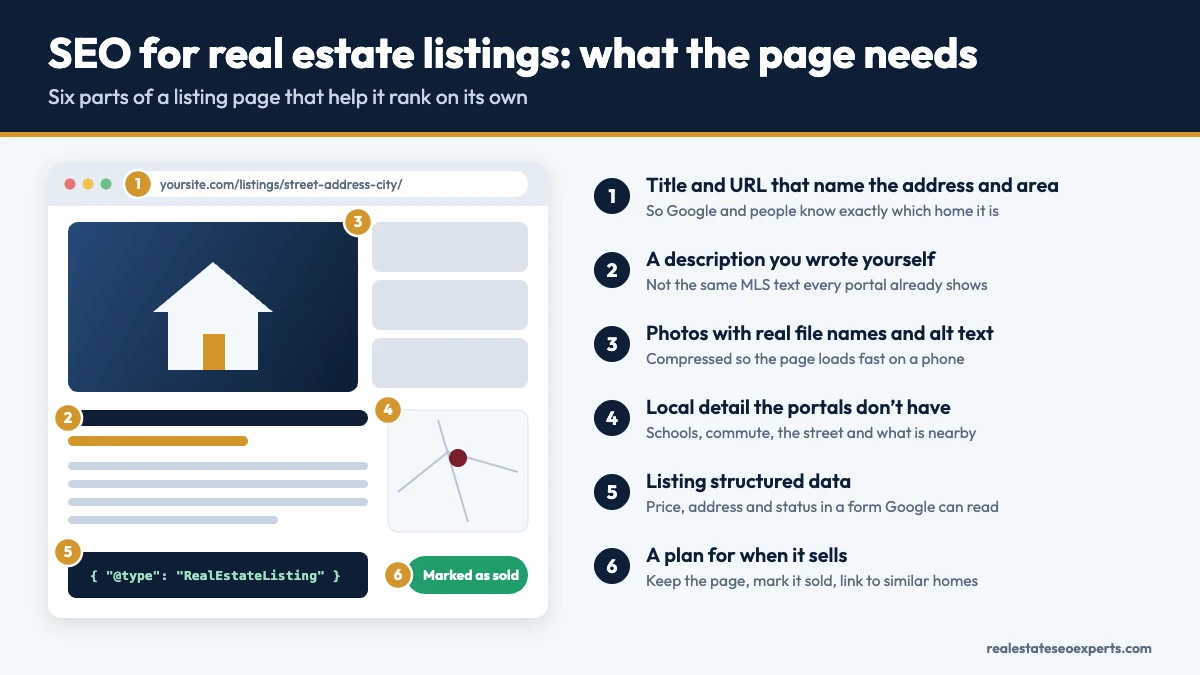
Write your own description
This is the fix that matters most, and the one almost nobody does.
MLS remarks are written for other agents and for a character limit. “Stunning 4BR/3BA in desirable Oakwood! Won’t last!” tells a buyer very little, and it tells Google nothing it can’t get from a thousand other pages.
For your own listings, write a second description for your website. It doesn’t have to be long. Around 200 to 300 words is plenty if it covers things the remarks leave out:
- What the street and the block are like
- How far it is, on foot or by car, to the things people ask about: schools, the station, the nearest grocery store
- What has been updated and when: roof, kitchen, heating
- What the seller liked about living there
- What the home offers, described by features and location
Be careful with that last point. In the US, fair housing rules apply to listing descriptions. Describe the property and the location, and leave out the kind of buyer you imagine. “Two minutes from the elementary school” is fine. “Perfect for young families” can get you into trouble.
Here is the difference in practice. The MLS version reads: “Updated 3BR ranch, new roof 2024, fenced yard, close to shopping.” A website version might begin: “This three-bedroom ranch sits on the quiet end of Maple Street, where the road stops at the park gate. The sellers replaced the roof in 2024 and redid the kitchen two years before that. The elementary school is a seven-minute walk with no main road to cross.” It is the same house, on a page only you have.
You can’t rewrite other agents’ listings in the feed, and you don’t need to. Do it for the listings that are yours. Those are the ones you want found under your name.
Titles and URLs
The default title on many IDX pages is the MLS number or just the address. Both waste the most visible line in a search result.
A better pattern puts what a buyer would type first:
- 3-Bedroom Home for Sale in Oakwood, [City] | 412 Maple Street
- Condo for Sale Near [Landmark] | 88 River Road, Unit 5
The same goes for the URL. A person can read /listing/412-maple-street-oakwood/ and has no idea what /listing?mls=7734519 is.
Keep titles under about 60 characters where you can, so they aren’t cut off in search results. If your system builds titles from a template, ask whether the template can be edited. Many can, and that fixes every listing at once.
The meta description is worth a line too. Left blank, Google pulls whatever text it finds, often the first words of the MLS remarks. Write one sentence with the bedrooms, the area and one thing that sets the home apart.
Photos
Photos are most of what a buyer looks at, and most of the weight on a listing page.
NAR’s 2025 survey of home buyers and sellers backs that up: 81% of buyers rated photos “very useful” when evaluating a home online, more than any other feature, with detailed property information close behind at 77% and floor plans at 57%.
- Rename files before you upload them. “412-maple-street-kitchen.jpg” says more than “IMG_4471.jpg”.
- Write alt text for each photo that describes what is shown: “Kitchen with island and gas range at 412 Maple Street”.
- Compress the images. A gallery of forty full-size photos can make a page crawl on a phone, and many buyers won’t wait.
- Put the best exterior shot first. It is usually the image that appears when the page is shared.
Alt text has a second job. It helps listing photos appear in Google Images, where plenty of home searches begin.
Captions help as well. A line under a photo, such as “The back yard faces south and gets sun until evening”, is original text that no feed has. It is also the kind of detail buyers ask about at showings.
Add what the portals don’t have
A portal page has the facts: price, beds, baths, square footage. It has them for every listing in the country, so it can’t say much about any one of them. This is your opening.
It’s worth the effort for where clicks actually land, too. Organic listings get 73% of all clicks on a search results page, well ahead of the much smaller share paid listings pick up (BrightEdge, 2022, as compiled by Semrush). A listing page that ranks organically captures that traffic directly, instead of renting it through a portal.
Things you can add that a portal can’t:
- A short video walk-through that you narrate
- A floor plan
- Your own notes on the neighborhood, linked to your neighborhood page
- Recent comparable sales nearby, with a sentence on how this home compares
- Answers to questions buyers have already asked at showings
The link to your neighborhood page matters more than it looks. Listings come and go, but the neighborhood page stays. Each listing that links to it, and is linked from it, makes that permanent page stronger. Over time the neighborhood page is the one that ranks, and it sends visitors to whatever you have listed there. We build these as part of real estate content SEO.
Structured data for real estate listings
Structured data, also called schema, is code that labels the parts of a page for search engines: this is the price, this is the address, this is the number of bedrooms.
For a listing page the useful types are RealEstateListing for the page, a residence type such as SingleFamilyResidence or Apartment for the property, and Offer for the price. Many IDX plugins add some of this for you. You can check by pasting a listing URL into the Schema Markup Validator at validator.schema.org.
Schema won’t lift a duplicate page above a portal. What it does is remove guesswork, and that matters more as AI tools start answering property questions directly. A page whose facts are labelled is easier for them to read and to cite. We cover that side under real estate AI SEO.
What to do when a listing sells
Most sites delete the page or let it return an error. That throws away whatever the page has earned.
Better options, in order of preference:
- Keep the page live and mark it as sold. Add the sale date if you’re allowed to show it, and a line such as “Looking for something similar in Oakwood?” with a link to current listings.
- If the page must come down, redirect it to the neighborhood page, so visitors and any links land somewhere useful.
- As a last resort, let it return a proper “gone” or “not found” status. Never leave a page up that says “listing not found” while telling Google everything is normal, because Google will keep visiting it.
Sold pages have a use of their own. A set of sold listings in one neighborhood, each with your description, is proof that you work there. Sellers look for that.
Check your MLS rules first. Some boards limit how long sold data can be shown or say what must be removed.
When listing pages aren’t worth the effort
Be realistic about where your time goes. If you take five listings a year, writing a custom page for each is an afternoon’s work and worth doing. If you run a brokerage site with three thousand feed listings, rewriting them is impossible, and you shouldn’t try.
In that case put the effort into pages that last: neighborhood pages, building pages for condos, and school-area pages. Let the feed listings serve visitors who are already on your site, and make sure they don’t flood Google with thin duplicates. Your developer can handle that with canonical tags, or by keeping low-value filter pages out of the index. That is routine work in real estate website SEO.
The rule of thumb: put work into the listings that are yours, and keep the feed listings tidy.
Common mistakes
These show up again and again in SEO for real estate listings audits:
- Copying the MLS remarks and adding a paragraph of keywords at the bottom
- Using the same title pattern for every page, with only the MLS number changed
- Uploading photos straight from the camera at full size
- Deleting sold listings the day they close
- Building a separate page for every filter combination, such as beds, baths and price, with nothing unique on any of them
- Forgetting to link listings to the neighborhood page
Frequently asked questions
Can my listing page outrank Zillow for the address?
Sometimes, for the exact address, if your page has original content and the portal pages are bare. It is far from guaranteed. A more reliable goal is ranking your neighborhood page and your own name.
Does IDX hurt SEO?
IDX doesn’t hurt a site, but it rarely helps without extra work. Feed listings are duplicates by nature. The value comes from what you add around them.
How long should a listing description be?
For your own listings, 200 to 300 words of original text is a good target. Length matters less than saying things the MLS remarks don’t.
Should sold listings stay on my site?
Yes, where your MLS rules allow it. Mark them clearly as sold and link them to current listings in the same area.
Do I need a separate page for every listing?
Each listing should have its own URL, yes. What you don’t need is a separate indexed page for every search filter. Listings get pages. Filter combinations mostly shouldn’t.
Next step
Good SEO for real estate listings comes down to a handful of habits, not a one-time trick. Pick your newest listing and give it the full treatment: your own description, a proper title, renamed photos and a link to its neighborhood page. Then watch it in Google Search Console for a month. Our real estate SEO checklist covers the other pages on your site.
If you want to know how your listing pages look to Google right now, our free SEO audit checks indexing, duplicates and speed, and comes back within 6 to 12 hours. You can also read how listing work fits into our wider real estate SEO services.
The buyer behavior numbers above come from the National Association of Realtors’ 2025 Profile of Home Buyers and Sellers, and the search click numbers come from Semrush’s 2023 roundup of SEO statistics.
Want a second pair of eyes on your site?
Send us your website and we will check it by hand. The free audit comes back within 6 to 12 hours, and plans start from $150 a month.