
The ten warning signs that matter most before you sign with a real estate SEO agency are: a ranking guarantee, methods the agency will not explain, your domain, hosting or Google accounts registered under the agency’s name, links it buys or builds in bulk, city pages that are one template with the place name swapped, no real estate work it can show you, reports that count rankings instead of calls and enquiries, a contract you cannot leave, content produced in volume with nobody reviewing it, and a price that does not match the work it describes. Every one of them can be tested before any money moves, most in under ten minutes, and this post gives you the test for each, the answer a good agency gives, what a fair contract contains, and the questions to take into the sales call.
Two things before the list. We are a real estate SEO agency, so we have an interest in how you choose; read this with that in mind. And this post names no firms and implies none. It is about practices, drawn from Google’s published policies, from the way proposals and contracts in this niche are commonly written, and from our own judgment as practitioners. Where something is our opinion rather than a documented fact, we say so. If you are at the earlier stage of comparing agencies that pass, our guide to vetting the best real estate SEO agencies has a nine check scoring sheet for that. This post is about the firms that should never reach the scoring sheet, and if you are still deciding whether to hire anyone at all, start with the DIY versus agency breakdown instead.
How to weigh the ten signs
Not every red flag means the same thing, and treating them all as deal breakers will leave you with nobody to hire. We sort them into three groups, and the grouping is our judgment rather than anything Google publishes.
Stop signs are the ones where the damage lands on an asset you will still own after the agency is gone: a ranking guarantee (because it tells you how the agency sells), ownership of your domain or Google accounts, bought or bulk links, and doorway style city pages. A manual action from bought links or a lost domain can take longer to repair than the engagement lasted, so no strength elsewhere offsets these.
Fix it in writing signs are the ones a contract can cure if the agency agrees: unexplained methods, lock in terms, and a price that does not match the scope. If the agency will put the fix in the agreement, proceed. If it will not, you have learned what you needed to.
Ask one more question signs are the ones where a decent agency may simply have given a lazy answer: thin real estate experience, ranking only reports, and content volume with no review step. Push once. The second answer usually settles it.
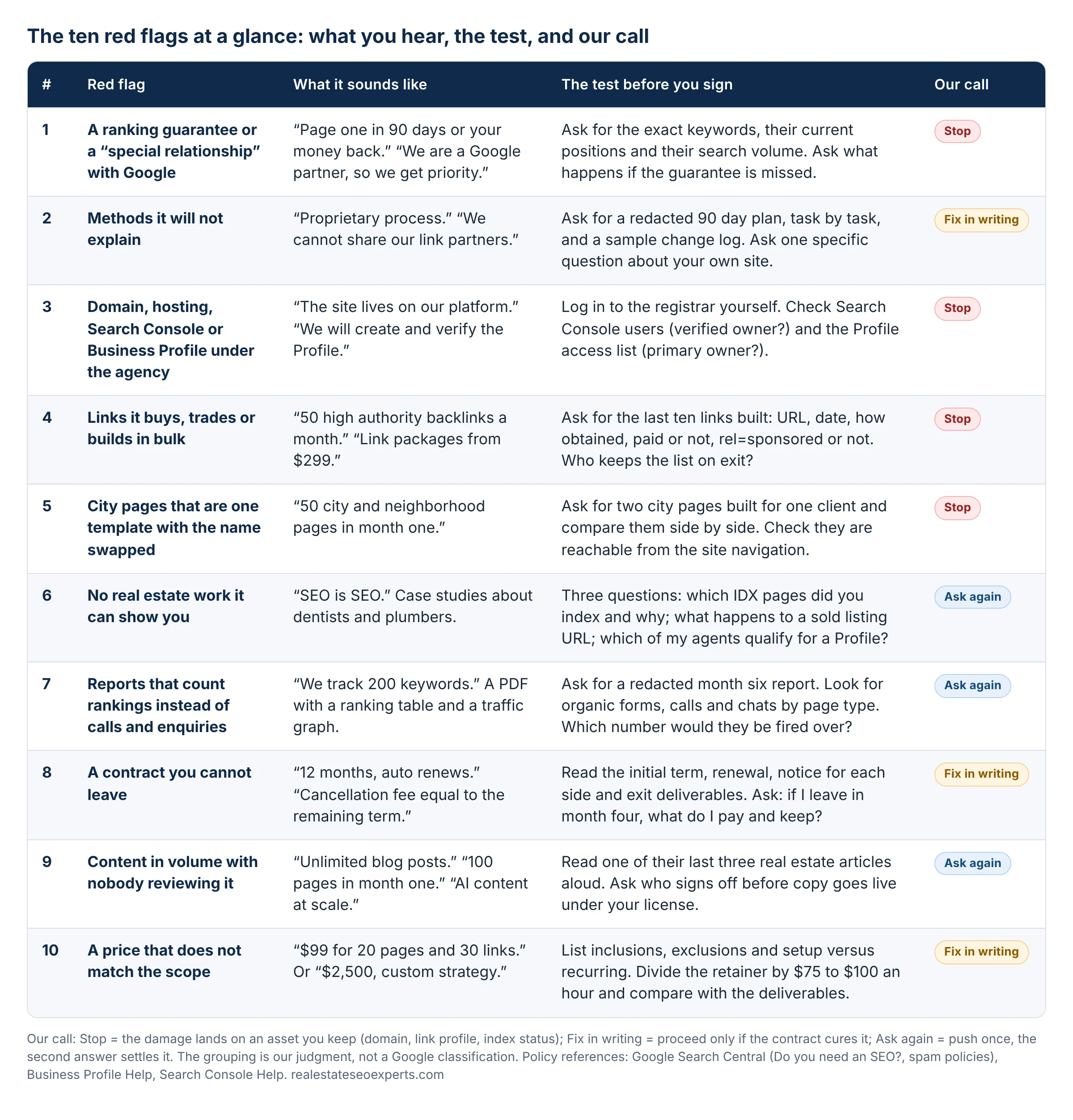
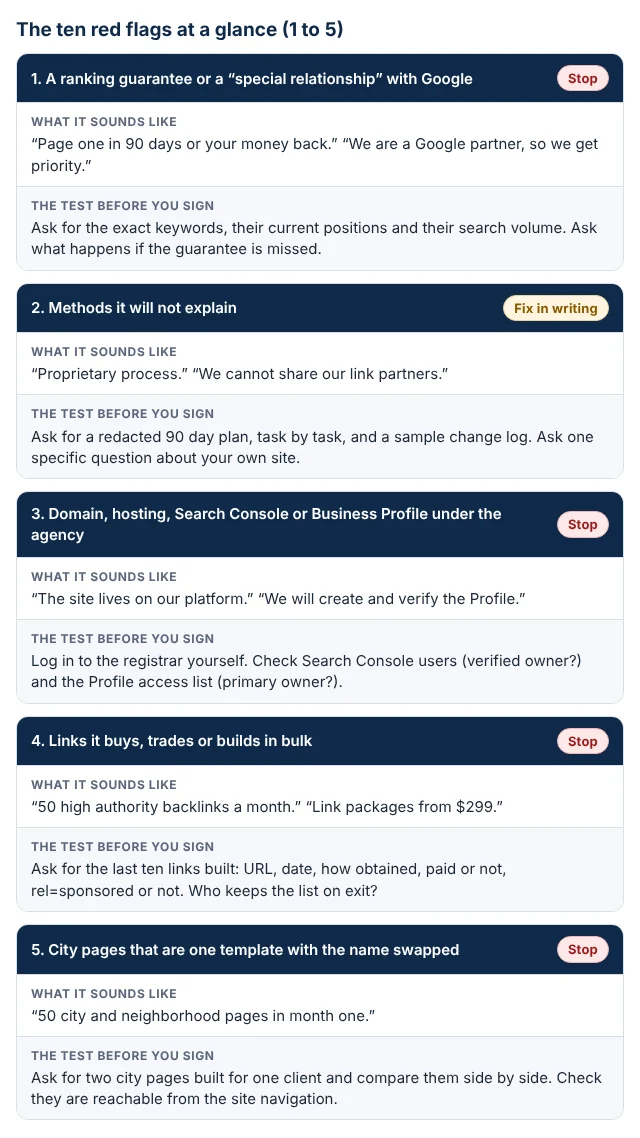
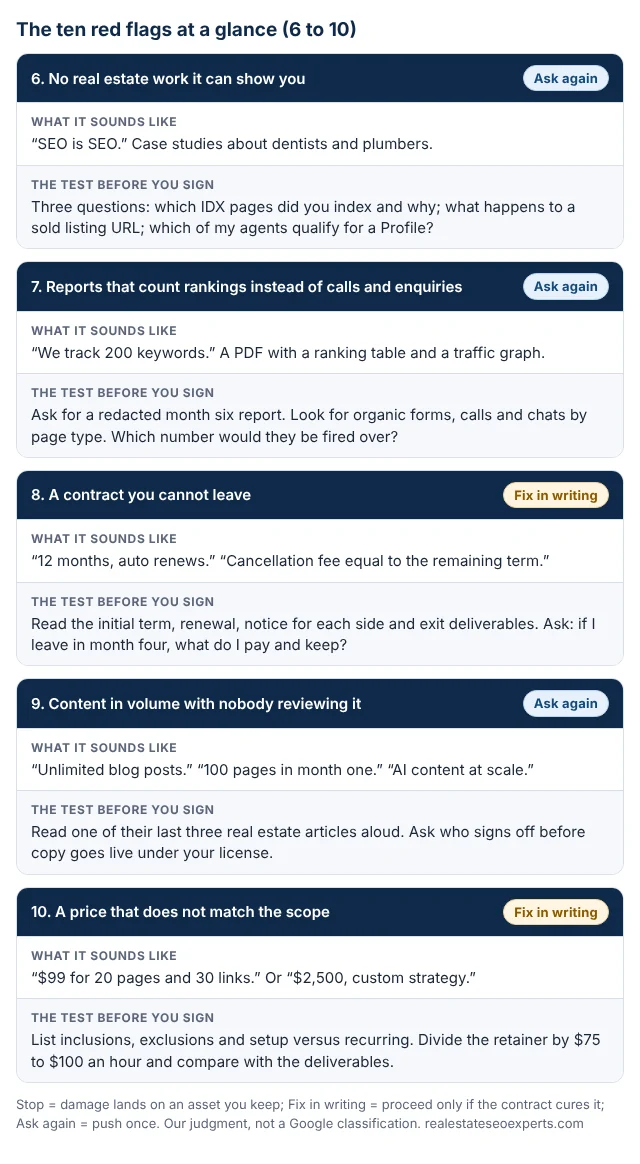
The ten red flags, with the test for each
1. A ranking guarantee, or a special relationship with Google
What it sounds like: “page one in ninety days or your money back”, “guaranteed top three for homes for sale in your city”, “we are a Google partner, so we get priority”.
Why it matters: Google’s own guidance for people hiring an SEO is blunt. “No one can guarantee a #1 ranking on Google.” The same page says to “Beware of SEOs that claim to guarantee rankings, allege a ‘special relationship’ with Google” or offer a priority submission, and adds: “If they guarantee you that their changes will give you first place in search results, find someone else” (Google Search Central, Do you need an SEO?). A guarantee is not evidence of confidence. It is a pricing decision: the agency has worked out that enough clients will not claim, or that the guaranteed terms are easy enough (your own name, a street with no searches) that the promise costs nothing. The Google Partners badge, where it appears, belongs to the Google Ads program and says nothing about organic search.
The test: ask for the exact keywords the guarantee covers, the current ranking for each, and the monthly search volume the agency believes each has. Then ask what happens if the guarantee is missed. A refund clause tells you the churn is priced in; a “free month” tells you the guarantee is a retention tool.
A good answer: a range, not a promise. The agency names the page types it expects to rank first (usually the Business Profile and a handful of neighborhood pages), the months in which it expects to see movement, and the leading indicators it will show you before leads arrive. Our own view of a realistic schedule is in how long real estate SEO takes, and any agency should be able to give you something comparable for your market.
2. Methods it will not explain
What it sounds like: “proprietary process”, “our secret sauce”, “we cannot share our link partners”, “trust us, it works”.
Why it matters: Google’s hiring guidance says to “Be careful if a company is secretive or won’t clearly explain what they intend to do”, and goes further: “If an SEO has FTP access to your server, they should be willing to explain all the changes they are making to your site.” One of the questions it suggests asking is whether the agency will share every change it makes and the reasoning behind it (Google Search Central). The reason is liability. The same page notes that you are responsible for the actions of companies you hire, and if a contractor builds something on your site that breaks Google’s spam policies, the consequence lands on your domain, not theirs.
The test: ask for a redacted ninety day plan from a current client, listed task by task, and a sample of the change log the agency keeps. Every competent agency keeps one, because it needs it to debug its own work. Then ask one specific question about your own site, such as which of your listing or search pages should be indexed and why. A firm that will not answer a specific question before you sign will not answer it after.
A good answer: a plan with named tasks and the pages they touch, a change log you can see at any time, and a willingness to say “we do not know yet” where the audit has not been done. Agencies are entitled to protect their internal templates and pricing. What they do on your site is yours to know.
3. Your domain, hosting, Search Console or Business Profile registered under the agency
What it sounds like: “we will set everything up for you”, “the site lives on our platform”, “we will create and verify the Business Profile”, “we will add you to Search Console later”.
Why it matters: this is the red flag that costs the most when it is missed, because you only discover the price on the day you try to leave. Google’s account roles make the correct arrangement clear. In Business Profile, a manager has “mostly the same access to the profile as owners”, with one exception: “they can’t add or remove users or remove the profile” (Google Business Profile Help). That is exactly the access an agency needs, and nothing more. In Search Console, a verified owner is “Someone who verified ownership of the property using a token to prove ownership”, and Google warns that “As long as a user’s verification token remains for a property, a deleted owner can re-verify ownership of the property” (Search Console Help). So an agency that verified your property with its own token keeps a way back in until that token is removed from your site. Google also notes that a new Business Profile owner or manager has to wait seven days before managing some features, including transferring primary ownership, which is one more reason to settle ownership at the start rather than at the exit.
The test, which takes about five minutes: log in to the domain registrar yourself; if you cannot, you do not control the domain, whatever the invoice says. Check whose card pays for hosting. Open Search Console, go to settings and the users list, and confirm you are a verified owner, not a user. Open the people and access list of your Business Profile and confirm you are the primary owner. Open Analytics and confirm you hold account level administrator rights. Any gap is a condition of signing, not a task for month two. Google’s hiring page adds a sensible default for the audit stage: “only grant read access to Search Console (at this stage, don’t grant them write access)”.
A good answer: “Everything is registered to you. We take manager access on the Profile, delegated owner or full user access in Search Console, and editor access in Analytics, and you can remove us in one click.” One nuance: website platforms that bundle hosting, IDX and a CRM legitimately own their stack, and that can be a fair trade for a solo agent. The question for them is different: what leaves with you, in what format, and within how many days.
4. Links it buys, trades or builds in bulk
What it sounds like: “fifty high authority backlinks a month”, “guest posts on DA 50 plus sites”, “our private network”, “link packages from $299”.
Why it matters: Google defines link spam as “the practice of creating links to or from a site primarily for the purpose of manipulating search rankings” and lists buying or selling links, automated link building and low quality directory links among the examples. Paid placements are allowed only when they are “qualified” with rel=”nofollow” or rel=”sponsored”, which also means they pass no ranking value, which is the opposite of what the package is selling (Google spam policies). The enforcement end is described in the Manual actions report: “Google has detected a pattern of unnatural, artificial, deceptive, or manipulative links pointing to your site”, and “This can result in some or all of your site getting a manual action” (Search Console Help, Manual actions). The agency moves on. The manual action stays with your domain.
The test: ask for the last ten links the agency built for any client, each with the URL, the date, how it was obtained, whether money changed hands, and whether paid placements carry rel=”sponsored”. Then ask who keeps the full link list if you leave. Agencies that earn links can answer in detail because every link took work to get. Agencies that buy them answer in volumes and metrics.
A good answer: slow and specific. Local press coverage of a market report, a sponsorship of a youth league with a link from the club’s site, a lender or inspector partner page, a chamber of commerce directory, a neighborhood association newsletter. Expect single digits a month and be glad of it. Google’s hiring page carries one more line worth remembering when a proposal includes a link to the agency’s own site: “You should never have to link to an SEO.” What a realistic program looks like is on our real estate link building page.
5. City pages that are one template with the name swapped
What it sounds like: “we will launch fifty city and neighborhood pages in month one”, “our page generator covers every suburb in your county”.
Why it matters: Google’s spam policies describe doorway abuse as “when sites or pages are created to rank for specific, similar search queries”, pages that “lead users to intermediate pages that aren’t as useful as the final destination”, and the examples include multiple pages aimed at specific regions or cities that funnel visitors to a single page (Google spam policies). A neighborhood page that could describe any suburb in America once the name is changed is that page. Even where it escapes enforcement, it does not convert, because a buyer who has lived in the area for ten years can tell in one paragraph that the writer has not.
The test: ask for two city pages the agency built for the same client. Put them side by side and swap the place names in your head. If the pages are now identical, you have seen your deliverable. Then check whether those pages are reachable from the site’s navigation or exist only for search engines, which is the second half of Google’s description.
A good answer: fewer pages, each built from things only a local would know and from data the agency can refresh: school boundaries, commute times, price bands by property type from MLS data, current inventory, the agent’s own transactions in the area, and photographs the agent took. Ten pages like that beat fifty templates, in our judgment and in Google’s own description of what it demotes.
6. No real estate work it can show you
What it sounds like: “SEO is SEO”, case studies about dentists and plumbers, a real estate page on the agency site with no client examples behind it.
Why it matters: real estate has three problems general agencies have not met. IDX feeds create thousands of near duplicate listing and search pages, and deciding which should be indexed is the central technical decision on an agent site. Listings close, so URLs die every week. And Google treats individual agents as a special category for Business Profiles: its guidelines list “insurance or real estate agents” among individual practitioners who can hold their own profile, while “Sales associates or lead generation agents for corporations aren’t individual practitioners” and “aren’t eligible for a Business Profile” (Google Business Profile guidelines). An agency that offers to put “Realtor” and your city into the profile name is describing a suspension; the same guidelines list service information and location information among the things that are not permitted in a business name and say that adding them “could result in the suspension of your Business Profile”.
The test: three questions. On the last IDX site you worked on, which search and listing pages did you let Google index, and how did you decide? What happens to a listing page URL when the property closes? Which of the people on my team are eligible for their own Business Profile, and what name will you give it? If the agency also offers to “generate” reviews, ask how; the FTC’s 2024 rule on fake reviews prohibits “providing compensation or other incentives conditioned on the writing of consumer reviews expressing a particular sentiment” and lets the agency “seek civil penalties against knowing violators” (FTC, August 2024).
A good answer: a live client site where you can see the indexing decisions in Search Console or in the page source, a clear policy for sold listings (redirect to the nearest live page, or a sold page that stays useful), and a profile plan that names which agents qualify and why. The right answers to all three questions are laid out in our guides to IDX website SEO and Business Profiles for real estate agents, so you can check what you hear against them.
7. Reports that count rankings instead of calls and enquiries
What it sounds like: “we track two hundred keywords”, “your visibility score is up 34 percent”, a monthly PDF with a ranking table and a traffic graph and nothing else.
Why it matters: a ranking is an input, and it is worth less than it was. First Page Sage’s 2026 study of 1,184 domains puts the blended click through rate of the first organic position at 7.1 percent, and 3.6 percent when an AI answer is present, against 22.6 percent when there is none (First Page Sage, September 2026). An agency can show you a rising ranking chart for twelve months while the phone stays quiet, and the report will be accurate. A real estate campaign exists to produce enquiries from buyers, sellers, landlords and tenants, and the report should count them.
The test: ask for a redacted report from month six of a current client, not month one. Look for form submissions, tracked calls and chat starts attributed to organic search, split by page type (neighborhood pages, listing pages, blog, home page), and for any note on lead quality fed back from the client’s CRM. Then ask one question: which number in this report would you expect to be fired over?
A good answer: leads by source and page type on page one of the report, with rankings in an appendix, and an honest paragraph about attribution limits, because agents mix portal leads, referrals and organic enquiries and no tracking setup separates them perfectly. The mechanics are not exotic: call tracking on the site number, event tracking on forms, and a source field in the CRM. An agency that cannot describe that setup has not run it.
8. A contract you cannot leave
What it sounds like: “twelve month minimum, renews automatically for twelve”, “cancellation fee equal to the remaining term”, “ninety days notice in writing”, “content is licensed to you for the duration of the agreement”.
Why it matters: a long term is not wrong in itself, because SEO needs uninterrupted months to work. The problem is a term that does the job results should be doing. When the exit is expensive, the agency’s incentive to perform in month seven falls, and when the content is licensed rather than owned, every page you paid for leaves with the agency. Asymmetry is the tell: a contract that lets the agency end the relationship on thirty days notice while holding you to ninety was written for one side.
The test: read four clauses before anything else. The initial term. The renewal mechanism. The notice period for each party. What you keep on exit, and when you receive it. Then ask the agency one question in plain words: if I decide to leave in month four, what do I pay and what do I keep?
A good answer: an initial term of three to six months, then month to month; thirty days notice that works the same in both directions; and an exit clause that hands over the site files, database, content, redirect map and link list within a stated number of days. Our opinion on term length: a longer commitment should buy you something, such as a lower rate or a review clause at month six, and the right length is the one you could afford to be wrong about.
9. Content produced in volume with nobody reviewing it
What it sounds like: “unlimited blog posts”, “a hundred pages in month one”, “AI powered content at scale”, a writer who has never been to your market and a plan with no review step.
Why it matters: Google’s spam policies define scaled content abuse as “when many pages are generated for the primary purpose of manipulating search rankings and not helping users”, and the examples include using generative AI tools to produce many pages without adding value for users (Google spam policies). Google’s separate guidance on AI generated content says that its systems reward quality regardless of how content is produced, and that using automation primarily to manipulate rankings is a spam policy violation (Google Search Central Blog, February 2023). The tool is not the problem. The absence of a person who knows the market and checks the facts is. In real estate there is a second cost: everything is published under your license, so a sentence that describes the ideal buyer rather than the property is a fair housing exposure, and a writer who has not heard of the issue should not publish under your name unsupervised.
The test: ask for the last three articles published for a real estate client and read one aloud. Does it name real streets, real price bands, real dates? Could a local tell it was written by someone who has been there? Then ask who signs off before anything goes live under your name, and whether you are part of that step.
A good answer: fewer pieces tied to the pages that produce leads (neighborhood, listing and service pages before blog posts), a named writer or editor, a review step that includes you, and a plain statement of where AI tools are used in the workflow and where a person takes over. That answer is consistent with Google’s position and with what buyers will actually read.
10. A price that does not match the scope
What it sounds like, in two versions: “$99 a month for twenty pages, thirty backlinks and Business Profile management”, or “$2,500 a month, custom strategy”, with nothing underneath either number.
Why it matters: both versions hide the same thing, which is how many hours of skilled work you are buying. Ahrefs’ survey of 439 SEO providers found the most common retainer band is $501 to $1,000 a month, chosen by 20.4 percent of respondents, that agencies charge $3,209 a month on average, that 68.8 percent of providers charge $2,000 a month or less, and that the most common hourly rate is $75 to $100 (Ahrefs, updated August 2024). Divide any retainer by a rate in that hourly band and you have a rough hour count. If the deliverables listed would take forty hours and the retainer buys ten, the gap is filled by templates, bought links or offshore volume, whatever the proposal says. If the retainer is large and the deliverables are a phrase, you cannot tell what month four contains.
The test: ask the agency to list what the retainer includes each month, what it excludes (paid ads, development work, link placements that carry a fee), and what is one time setup versus recurring. Then do the hours math in front of them. We publish our starting point for independent agents, and how that number is built is on our pricing page, which you are welcome to hold up against anyone else’s quote. The full hours model, and what is worth paying for at each budget, is in our real estate SEO cost guide, so we will not repeat it here.
A good answer: an itemised scope with exclusions, a separate setup line, and a sentence about what changes if your budget changes. Cheap is not the red flag. Cheap with a long deliverable list is.
What a fair contract contains
Our view of a fair real estate SEO agreement, offered as an opinion from inside the industry and not as legal advice, comes down to eight things. Ownership: the domain, hosting, Business Profile, Search Console, Analytics and every piece of content are registered to or owned by you, and the agency holds manager or delegated access that you can revoke. Scope: a monthly list of deliverables with named exclusions, and a setup line separated from recurring work. Reporting: what is reported, when, and that it includes enquiries and calls attributed to organic search, not rankings alone. Link policy: no paid links unless marked rel=”sponsored”, no automated link building, and a complete list of every link delivered, handed over on exit. Term and notice: an initial term you can justify, then month to month, with the same notice period for both sides. Exit: site files, database, content, redirect map and link list delivered within a stated number of days, at no extra fee. Prohibited tactics: a clause that names Google’s spam policies and makes the agency liable for a manual action caused by its work. Compliance: fair housing review of copy and ads, and your license disclosure where your state requires it.
If a proposal in front of you is missing more than two of these, send it to us before you sign. Our free SEO audit covers your site, and we will tell you plainly whether the plan attached to it fits, including when the honest answer is that you do not need an agency yet.
Questions for the sales call
Carry these into the call and write the answers down as you hear them, because recollections blur after the third pitch. The table gives each question, what a good answer sounds like, and the answer that should end the conversation. Google’s own list of questions to ask an SEO, including “What’s your experience in my industry?” and “How can I expect to communicate with you?”, is a useful appendix to it (Google Search Central).
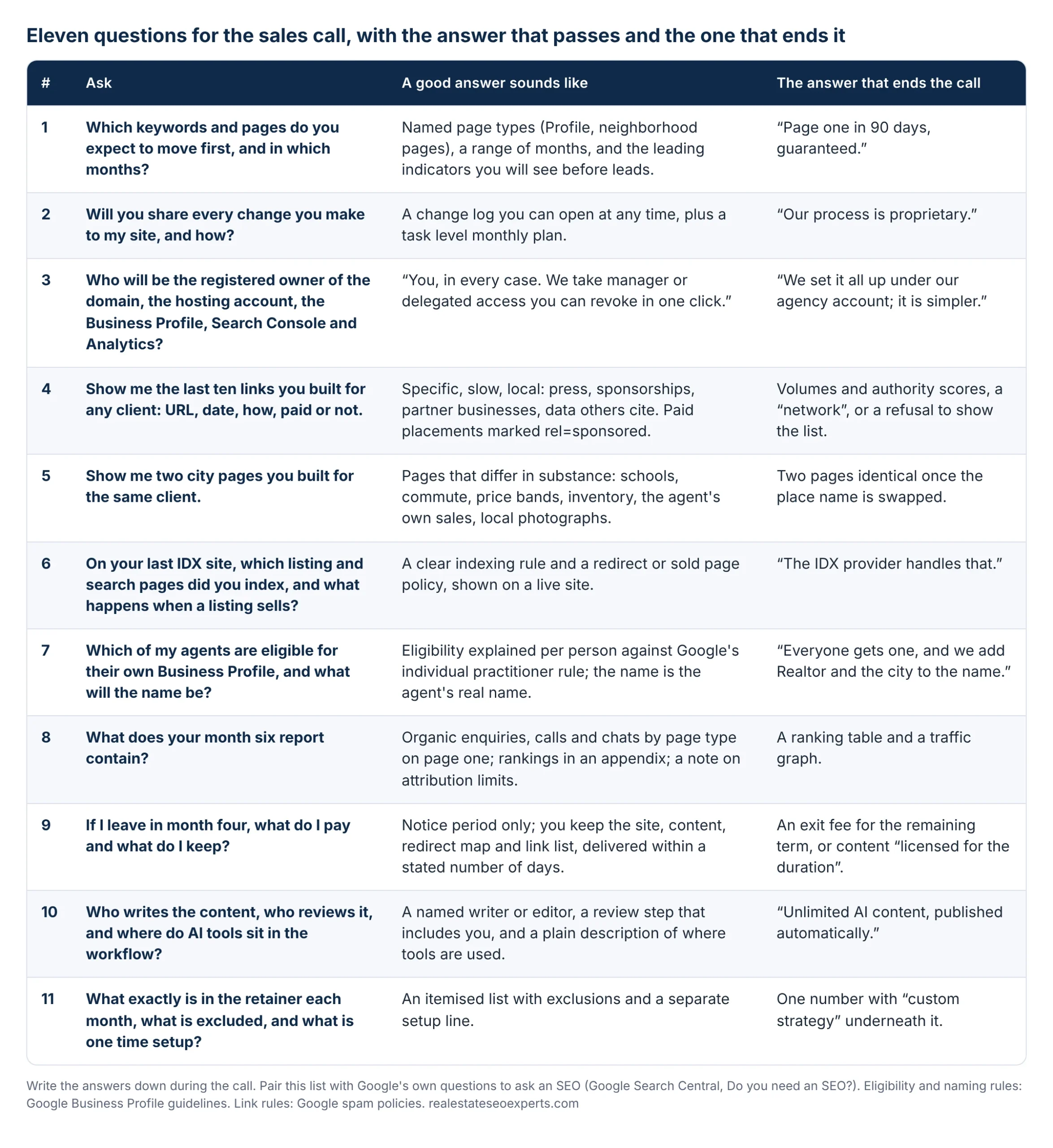
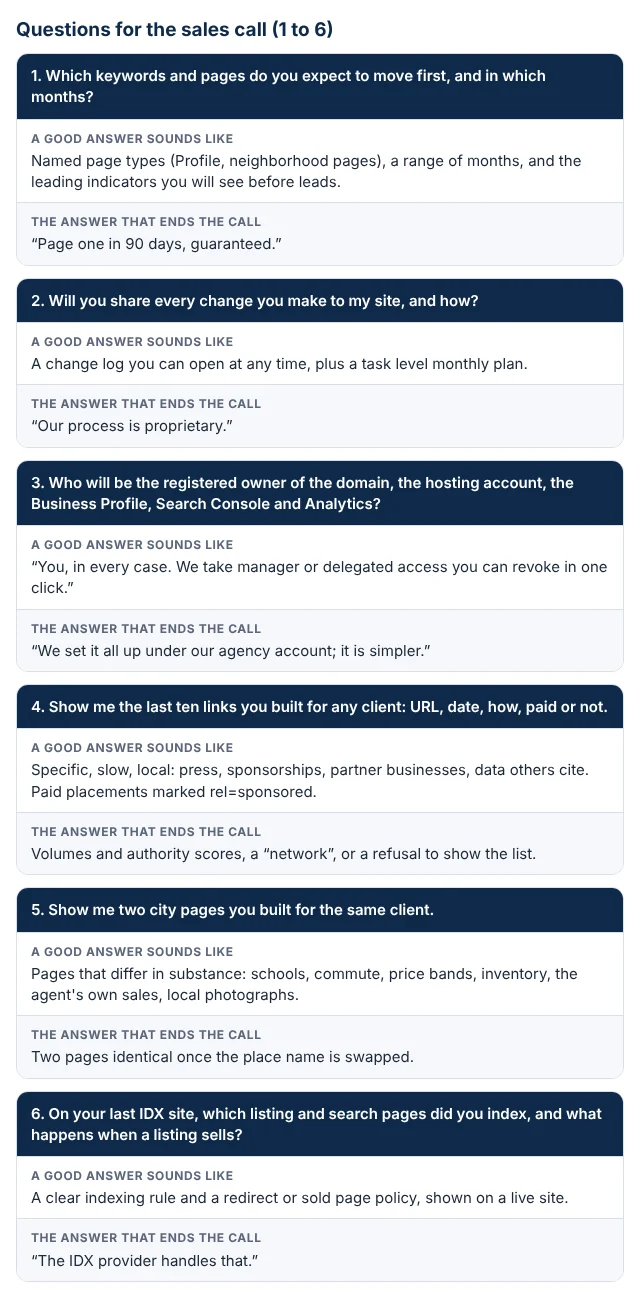
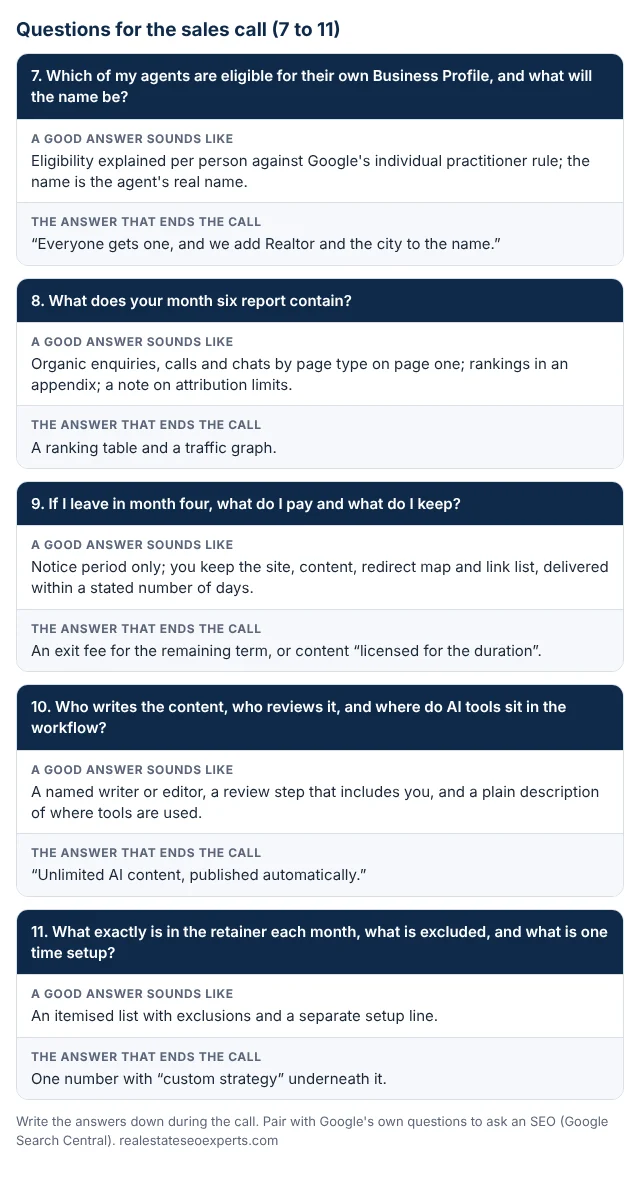
When a red flag is not one
Some things that look like warning signs are normal, and mistaking them for red flags will cost you good agencies. A six month initial term is standard and reasonable. An agency asking for access to Search Console, Analytics and the Business Profile is doing its job; the flag is ownership, not access. An agency that uses AI tools somewhere in its workflow is like every other business in 2026; the flag is the missing reviewer. A specialist with a small portfolio may be a better choice than a large generalist with a hundred logos, because the three questions in red flag six matter more than the logo count. And an agency that declines to take you on at a budget below its floor is being honest with you, which is worth more than a yes.
The mistakes buyers make most often, in our view, are the mirror image. Choosing on price alone. Mistaking a website platform for an SEO agency, then being surprised at what stays behind. Signing before the ownership check is done because “we can sort that out later”. Not keeping the proposal, so that there is nothing to hold the contract against when the two differ. And skipping the reference call to a client who left, which is the only reference the agency did not choose.
Frequently asked questions
What is the biggest red flag when hiring an SEO agency?
In our judgment, ownership. An agency that registers your domain, hosts your site on an account you cannot access, or verifies your Business Profile and Search Console under its own identity holds your business visibility hostage from day one, whether or not it intends to. Google’s account roles make the fix simple: the agency needs manager or delegated access, never ownership. Guarantees and bought links are close behind, because both end in damage you inherit.
Can an SEO agency guarantee first page rankings?
No. Google’s hiring guidance states “No one can guarantee a #1 ranking on Google” and tells you to find someone else if an agency guarantees first place. Guarantees that do exist are either priced in (the agency expects most clients not to claim) or attached to terms with no competition, such as your own name. Ask for the exact keywords, their current positions and their search volumes, and the guarantee usually disappears.
Should an SEO agency own my domain or my Google Business Profile?
No. You should be the registrant of the domain, the account holder for hosting, the primary owner of the Business Profile, a verified owner in Search Console, and an administrator in Analytics. Give the agency manager access to the Profile, delegated owner or full user access in Search Console, and editor access in Analytics. If the agency verified Search Console with its own token, have that token removed from your site when the engagement ends, because Google allows a deleted owner to re-verify while the token remains.
How do I check whether an SEO agency buys links?
Ask for the last ten links it built for any client, with the URL, the date, how each was obtained, whether money changed hands and whether paid placements are marked rel=”sponsored”. Specific, slow answers (local press, sponsorships, partner businesses) indicate earned links. Answers in volumes and authority scores, or a refusal to show the list, indicate bought ones. Google’s spam policies treat buying links for ranking purposes as link spam, and the manual action lands on your site.
Is it a red flag if an SEO agency uses AI to write content?
Not by itself. Google says its systems reward quality regardless of how content is produced and that using automation primarily to manipulate rankings violates its spam policies. The red flag is volume with no review: a hundred pages in a month, no named writer or editor, and no step where someone who knows your market checks facts and fair housing language before copy goes live under your license.
How long should a real estate SEO contract be?
Our opinion: an initial term of three to six months, then month to month, with thirty days notice for both parties and a clear exit clause. SEO needs uninterrupted months to work, so a short initial term is reasonable. A twelve month minimum with automatic renewal and an exit fee is the contract doing the work that results should do, and a longer term should buy you something in return, such as a lower rate or a performance review at month six.
Sources: Google Search Central, Do you need an SEO? (updated June 2026), Google Search Central, Spam policies for Google web search (updated August 2026), Search Console Help, Manual actions report, Search Console Help, Managing owners, users, and permissions, Google Business Profile Help, Manage your Business Profile owners and managers, Google Business Profile Help, Guidelines for representing your business on Google, Google Search Central Blog, Google Search’s guidance about AI-generated content (February 2023), First Page Sage, Google click-through rates by ranking position (September 2026), Ahrefs, SEO pricing survey of 439 providers (updated August 2024), Federal Trade Commission, final rule banning fake reviews and testimonials (August 2024). All sources were read on November 20, 2026.
Have a proposal in front of you?
Send it to us before you sign. We will run the ten tests above against it and your site, and tell you plainly whether it fits, including when the answer is that you do not need an agency yet. Plans start from $150 a month.