
Should you do your own real estate SEO or pay an agency to do it? The honest answer rests on four things you can measure this week: the hours you can protect every month, the technical state of the website you are working with, who already holds page one in your market, and what an hour of your time earns when it is spent with clients instead. Agents with more time than budget should start on their own. Agents with more budget than time should get help. Most agents are somewhere in between, and for them the right arrangement is usually a split, not a subscription.
This post walks through the decision with sourced numbers: what DIY actually covers and the hours it takes, what agencies charge according to the largest published survey of SEO pricing, the portal lead math that both routes are competing against, and a four question test at the end. One thing to know before you read on: we are a real estate SEO agency, so we have an interest in one of these answers. We have tried to offset that by sourcing every number, marking our own estimates as estimates, and being specific about the cases where you should not hire us or anyone else.
The short answer
DIY real estate SEO works when the job is local and relationship driven: your Google Business Profile, reviews, neighborhood pages written from what you actually know, and keeping your details consistent across the portals and directories. Hiring makes sense when the job is technical, slow or unforgiving: IDX and listing page structure, site speed, schema, link building, and the month after month consistency that rankings are built on. The deciding constraint is rarely skill. It is time, and whether your market leaves a part time effort any room.
The demand side is not in question. In the National Association of Realtors’ 2025 Profile of Home Buyers and Sellers, every surveyed buyer used the internet during their search and 46 percent started there, ahead of the 20 percent who started by contacting an agent (NAR, 2025). The question is only who does the work of showing up.
What you can genuinely do yourself
A useful share of real estate SEO needs no special training, only steady hours. These five jobs are the DIY core. The time figures are our own estimates from doing this work for clients, not survey data, so treat them as a planning guide.
Claim and run your Google Business Profile. Categories, service area, photos, posts, and answers to the questions people leave. Two to three hours to set up properly, then about an hour a month. For most agents this is the highest return hour of the month, because the Profile feeds the map results where ready to act buyers and sellers look first. What the full version of this work involves is on our real estate local SEO page.
Ask every client for a review, and reply to all of them. About an hour a month, and it is discipline rather than skill. Nobody can do this better than you, because the request lands best in the week after closing, from the person who did the deal.
Write one real neighborhood page at a time. Three to four hours for a page that says what only you know: which streets flood after a hard rain, where the school boundary actually runs, what sold last quarter and why it went over asking. One honest page a month beats twelve templated ones. Google’s spam policies treat near identical area pages as doorway abuse, not a content strategy, so volume without substance works against you.
Answer real client questions in short posts. Two to three hours each. The questions you answered on the phone this week are the list: property tax reassessment, what a flood zone letter means, whether to sell before buying in your market. These are also exactly the passages AI search tools lift answers from.
Keep your name, brokerage and phone consistent everywhere. The portals, the state licensing lookup, the directories that matter. Three to four hours once, then an hour or two whenever you change brokerage. Tedious, free, and a quiet drag on local rankings when it is wrong.
If you want the full list in working order, our 44-point real estate SEO checklist walks through all of it step by step.
Where DIY runs out of road
The ceiling is not intelligence. It is specialization and cadence, and in real estate it shows up in four places.
Listing and IDX pages. This is the most real estate specific problem and the one DIY guides skip. An IDX feed in an iframe gives Google nothing to index, while a badly integrated one floods the index with thousands of near duplicate filter URLs that bury your real pages. The fixes involve canonical tags, crawl rules and decisions about which pages deserve to exist, and getting them wrong is worse than not touching them. Our guide to SEO for real estate listing pages shows what the work looks like. Most of it is one time work, which matters for the hiring decision: this can be a project, not a retainer.
Link building. More than half of sites with no backlinks never reach page one, in Semrush’s analysis of its own data (Semrush, 2023). Links come from local press, sponsorships, market data people want to cite, and slow outreach, and almost nobody does slow outreach at 9pm after showings. What a realistic program involves is on our real estate link building page.
Schema and AI search. A growing share of the searches your clients run end in an AI generated answer rather than a list of links. Being quotable there takes a consistent business identity across the web, structured data that says who you are and where you work, and content written so a direct answer can be lifted from it. It is teachable, but it is new enough that most of the advice agents find is already out of date. Our AI SEO for real estate page covers the workstream.
The cadence problem. Rankings are built on months of uninterrupted work, and your best months in real estate are exactly the months the website gets nothing. DIY efforts we audit show the same shape over and over: a burst of activity in January, silence by April, a confused look at the traffic chart in September. The work is not hard. Protecting the hours is.
What each route costs, with sources
Hiring. Ahrefs polled 439 SEO providers for its pricing survey, last updated in 2024. Local SEO retainers average $1,557 a month, the most common retainer band across all SEO services is $501 to $1,000 a month, and the most common hourly rate is $75 to $100 (Ahrefs SEO pricing survey). A single market agent sits at the local end of that range; a brokerage that needs listing architecture and suburb level coverage climbs toward the overall agency average of $3,209. For calibration, our own plans start at $150 a month for independent agents, with everything above that quoted after an audit. How the number is built is on our pricing page.
DIY. The cash cost can stay near zero. Google Search Console and the Business Profile are free, and they are enough tooling for the first six months of local work. A professional research tool is optional at this stage; the entry plan of one of the two standard tools runs $129 a month (Ahrefs Lite, October 2026). The real cost is hours. Our estimate from doing the work: eight to twelve hours a month to run the DIY core at a pace that moves anything, every month, for at least a year.
The number both routes answer to. Purchased leads set the bar. Zillow’s published averages put a Premier Agent lead at about $223 in major metros and $139 elsewhere, and reported conversion on purchased leads runs 1 to 3 percent, a figure that traces to a 2020 HousingWire piece and should be treated as rough (Clever Real Estate, updated September 2026, citing Zillow). Run that out and one closing from bought leads costs roughly $7,400 at the optimistic end and over $22,000 at the pessimistic one. That is the comparison that matters. If ten hours a month of your time, or a few hundred dollars of retainer, produces organic leads that close for less than that, the SEO route is winning, and unlike the portal spend it compounds. The framing is our analysis; every input in it is published.
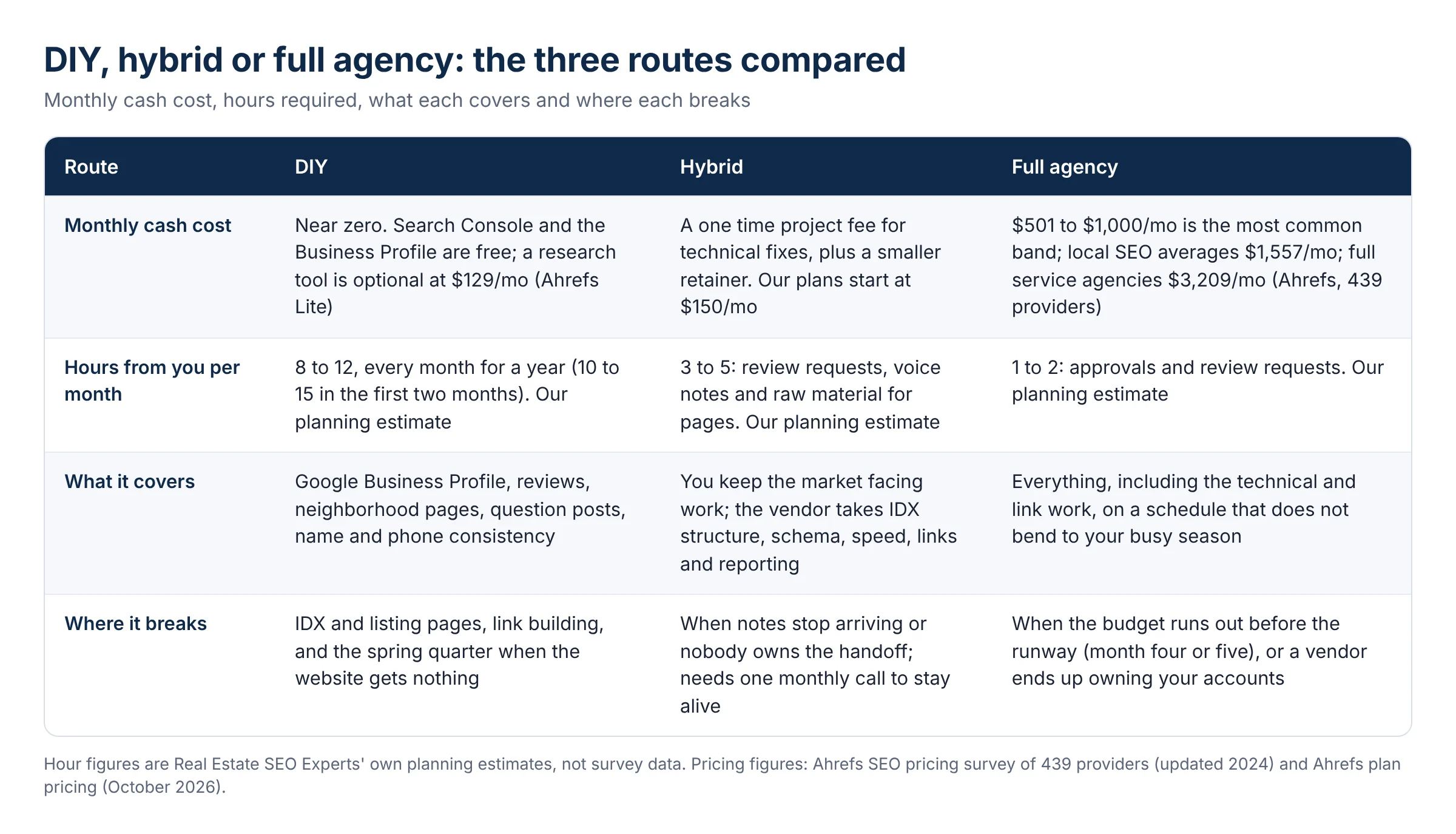
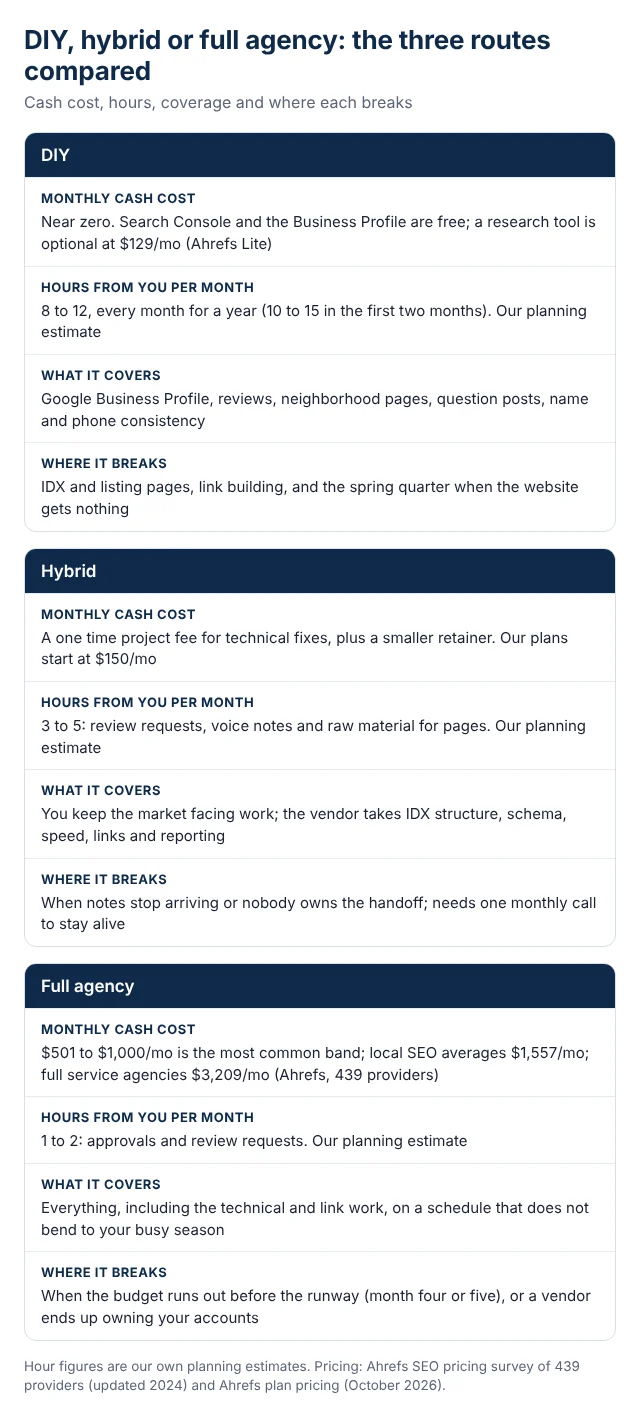
The four question test
Answer these honestly and the decision mostly makes itself.
1. Can you protect eight to twelve hours a month for a year, including your busiest quarter? Protect, not find. The hours have to survive spring listings and a December closing rush. If the answer is no, DIY produces a half built asset: a decent Profile, three neighborhood pages and a blog that stopped in month four. Half built assets still lose to portals.
2. Is the site technically sound, and do you own it? Open Search Console and compare pages indexed against pages in your sitemap, then check where your listings actually live. If the listings sit in an iframe, or the index is full of filter URLs, there is technical work before content matters, and that work is a poor fit for DIY. Ownership matters even more: if the domain, hosting or Business Profile is registered to a former vendor or a franchise, fix that before anyone spends money, because work on accounts you do not control is work you lose. The twelve checks we run before taking on a client show how to find all of this out in an afternoon.
3. Who holds page one in your market? Search your main area terms and look at what comes back. If positions one through five below the portals are local brokerages with ordinary sites, a consistent DIY effort has room. If every result is a national portal or a two hundred agent brokerage with a decade old domain, a part time effort will not move, and the right play is narrower: a suburb, a property type, a niche where page one is winnable.
4. Do you have the runway? Our view from engagements, stated as opinion: meaningful rankings for area terms take four months to two years, and nobody serious promises faster. Google’s own advice for hiring an SEO is blunt: “No one can guarantee a #1 ranking on Google,” and if someone guarantees first place, “find someone else” (Google Search Central). Whichever route you pick has to be affordable through the flat months in the middle, in cash or in patience.
Four yes answers: start DIY and reassess in six months. Time fails but budget exists: hire, and keep the client facing work for yourself. The site or ownership question fails: fix that first, as a project, before any retainer. Runway fails: do not start either route, because a campaign abandoned at month five is the most expensive version of SEO there is.
The hybrid split that actually works
The most durable arrangement we see is not either or. You keep the work that depends on knowing the market. The agency or freelancer takes the work that depends on knowing Google.
You keep the Business Profile and the review flow, because the request for a review belongs to the person who closed the deal. You keep supplying the raw material for neighborhood pages: an agency can structure and polish your notes, but it cannot know that the arena traffic ruins Tuesday evening showings or which builder’s 2019 phase has the drainage problems. The agency takes IDX and site structure, schema, speed, keyword mapping, link building and the reporting, and it turns your notes into pages on a schedule that does not bend to your busy season.
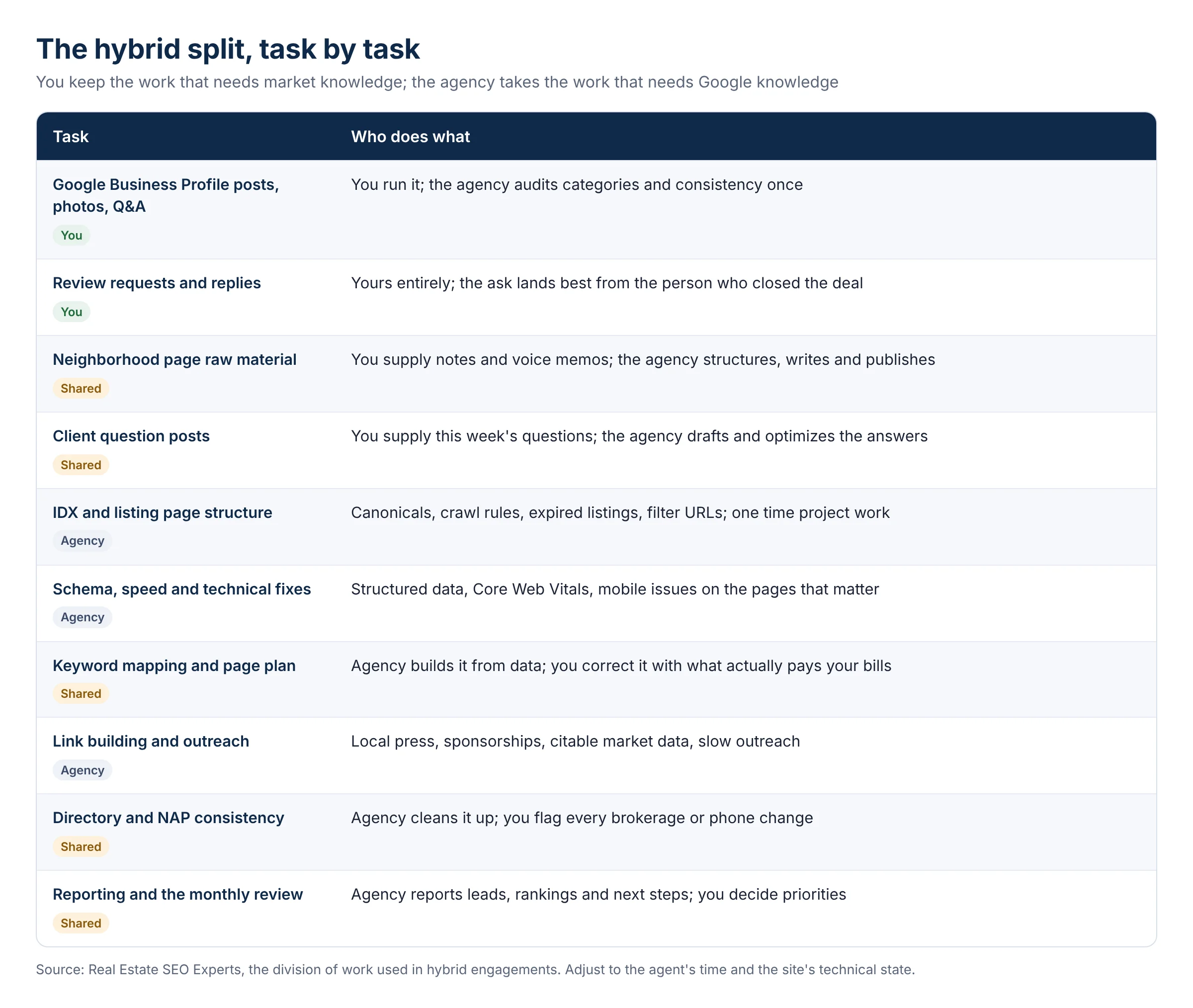
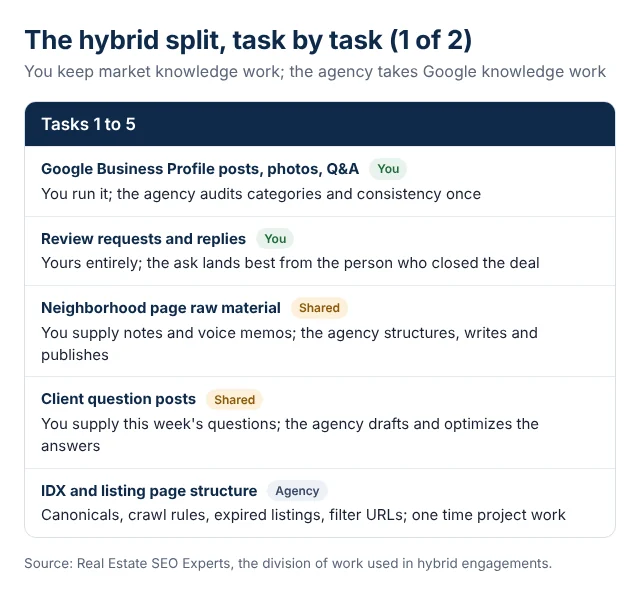
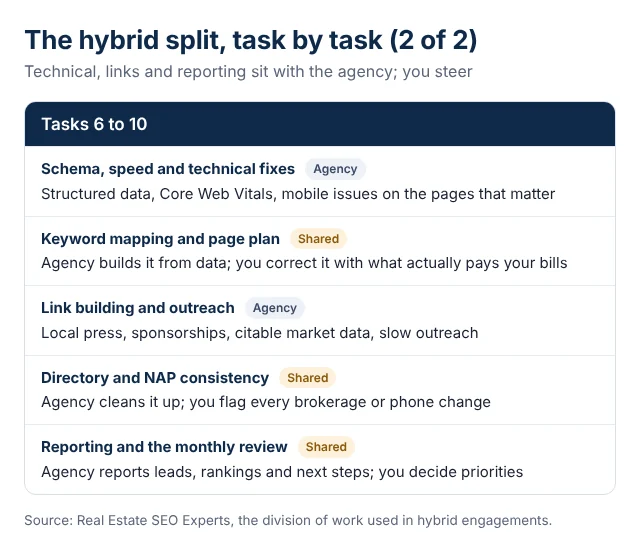
The hybrid also fixes the cadence problem. In spring your contribution drops to review requests and voice notes, theirs does not change, and the site keeps moving while you sell.
Whichever route you take, own everything
Domain registrar, hosting, Search Console, Analytics, Business Profile: all of it registered to your accounts, with any vendor added as a user, never the reverse. Google’s hiring guidance is worth reading in full before signing anything, and two lines carry most of it: “Be careful if a company is secretive or won’t clearly explain what they intend to do,” and “You should never have to link to an SEO” (Google Search Central, Do you need an SEO?). Ask any agency you are vetting for client references, and ask the references whether they kept their rankings after leaving. We made ownership check two of twelve in our intake audit because, in our experience, it is the most common good reason to delay spending money on SEO at all.
When you should not hire anyone, including us
A few situations where the honest advice is to keep your money.
A brand new agent with no closed transactions should not buy SEO. Your first deals come from people who already know you, not from queries, and you do not yet have the reviews, the photos or the neighborhood stories that SEO is made of. Set up the Business Profile, collect your first reviews, write one page about the area you know best, and revisit the question after a year.
A budget without runway is the same answer. If the money runs out at month four, the campaign ends before the compounding starts and the spend is mostly wasted. Save until the runway exists.
A site you do not own, on a platform you rent from a franchise or a lead vendor, is a fix first situation. So is a planned brokerage switch or a market move within the year, because much of the local work would need redoing.
Our free SEO audit is built to catch exactly these cases, and it can end with us telling you not to spend money on SEO yet. It has before.
Frequently asked questions
Can real estate agents do their own SEO?
Yes, for the local core: Google Business Profile, reviews, neighborhood pages, question and answer content, and directory consistency. Those need time and market knowledge, not training. The ceiling arrives at technical work (IDX and listing page structure, schema, site speed) and link building, where mistakes are expensive and progress needs tools and repetition.
How many hours a month does DIY real estate SEO take?
Our estimate from doing the work: ten to fifteen hours a month for the first two months while the Profile, directories and first pages get set up, then eight to twelve hours a month to keep a pace that moves rankings. These are planning figures from our own client work, not survey data. The commitment that matters is the twelve month one, not the monthly one.
How much does it cost to hire a real estate SEO agency?
Across all industries, local SEO retainers average $1,557 a month and the most common retainer band is $501 to $1,000, per Ahrefs’ survey of 439 providers (updated 2024). Real estate agents at a single market scale sit at the lower end; brokerages needing listing architecture climb well above it. Our plans start at $150 a month, and anything above that is quoted after a free audit rather than from a rate card.
Can AI tools replace an SEO agency?
They shrink the gap, and they have made DIY more feasible than it was a few years ago: drafting, research and technical checking all go faster. What they do not replace is judgment that depends on your market and on experience: which pages deserve to exist, how your IDX should be structured, which links are worth pursuing and which will hurt, and what not to publish. They also create a new job rather than removing one, because showing up accurately in AI generated answers is now its own workstream.
Should a brand new agent pay for SEO?
Usually not in year one. The sphere, the Business Profile and the first reviews produce the early deals, and a new agent has little of the material that strong local pages are built from. The exception is a new team or brokerage entering a market with budget and a multi year horizon, where starting the technical and content foundation early is cheaper than retrofitting it.
Sources: Ahrefs, SEO pricing survey of 439 providers (updated August 2024), Ahrefs, plan pricing (October 2026), Google Search Central, Do you need an SEO?, NAR, Highlights from the 2025 Profile of Home Buyers and Sellers, Clever Real Estate, How much are Zillow leads (updated 14 September 2026), Semrush, SEO statistics compilation (2023).
Not sure which route fits your market?
Tell us about your site, the hours you can protect and the market you work, and we will say which route we would pick, including the cases where the answer is to not hire anyone yet. Plans start from $150 a month.