
Which real estate SEO agency is best? The one that passes nine checks you can run yourself before you sign: it has done IDX and listing work it can show you, it leaves your domain, hosting and Google accounts registered to you, it reports leads and not only rankings, it publishes or quotes prices without a sales call first, it offers a contract you can leave, it can describe how it earns links without breaking Google’s spam policies, it writes content a buyer would read, it gives references who will take your call, and it answers Google’s own hiring questions without flinching. This guide gives you those checks in detail, a scoring sheet you can fill in during the sales calls, and a list of agencies that publicly specialise in real estate SEO, compiled from their own websites and shown in alphabetical order with no ranking.
One disclosure before anything else. We are a real estate SEO agency, so we have an interest in how you choose. We have tried to offset that in three ways: the framework comes first and the list comes second, every agency in the list including us is described only with facts published on its own site, and we make no claims about anyone’s results, prices or quality, ours included. If you want to know whether to hire anyone at all, our DIY versus agency breakdown covers that question and this post does not repeat it.
Why the usual “best agencies” lists cannot do the choosing for you
We read the top results for this query before writing. Every list we found ranks its own publisher first. Some disclose a method and some do not, and none of them covers the things that decide whether a real estate engagement works: who ends up owning the website, how listing pages are handled, whether leads are tracked at all, what the contract says about leaving, and how the links get built. That is not an accusation, it is just what those pages are for. A list written by a vendor is a sales page with competitors on it. Treat ours the same way, and use the framework to make the decision.
A short definition to anchor the rest: a real estate SEO agency is a firm whose main service is earning organic search visibility for agents, teams, brokerages, property managers or developers. That is different from a website platform that bundles some SEO with hosting and a CRM, and different from a general marketing agency with a real estate page on its site. All three can be the right choice. The vetting questions differ, and the ownership questions differ most of all.
Nine checks to run before you sign
1. Real estate experience you can inspect, not just claim
Almost every agency says it knows real estate. Ask for three things you can look at. First, a client site where the IDX or MLS listings are indexed by Google, and an explanation of how the agency decided which listing and search pages should exist in the index and which should carry a canonical tag or a noindex. If the answer is that the IDX provider handles it, the agency has not done this work. Second, a Google Business Profile the agency manages for an individual agent, set up within Google’s rules. Google’s guidelines name real estate agents as individual practitioners and say such a practitioner should create their own profile if “They operate in a public-facing role” and “They can be contacted directly at the verified location during stated hours,” while “Sales associates or lead generation agents for corporations aren’t individual practitioners and aren’t eligible for a Business Profile” (Google Business Profile guidelines). An agency that offers to create profiles for every rental listing, or to stuff “Realtor” and your city into the profile name, is describing a suspension. Third, a neighborhood page the agency wrote. Read it as a buyer would. If it could be about any suburb in America with the name swapped, that is the page they will write for you, and Google’s spam policies describe pages “created to rank for specific, similar search queries” that lead to less useful intermediate pages as doorway abuse (Google spam policies). What good listing architecture looks like is covered in our guide to SEO for real estate listing pages, which you can use as a reference while you read theirs.
2. Who owns the domain, the hosting and the accounts
This is the check that costs the most when it is skipped, and it is the one the listicles leave out. Before any money moves, settle in writing who is the registered owner of the domain, who holds the hosting account, who is the primary owner of the Google Business Profile, and who owns the Search Console and Analytics properties. The correct answer in every case is you, with the agency added as a user or manager that you can remove in one click. Several of the best known real estate website companies are platforms, which means the site exists on their stack and some or all of it stays behind when you leave. That can be a fair trade for a solo agent who wants a working site and CRM on day one, but it is a trade, and you should know you are making it. A reasonable rule: an agency can ask for access to everything and ownership of nothing. Ownership is the second of the twelve checks we run before taking on a client, because in our experience it is the most common good reason to delay spending on SEO at all.
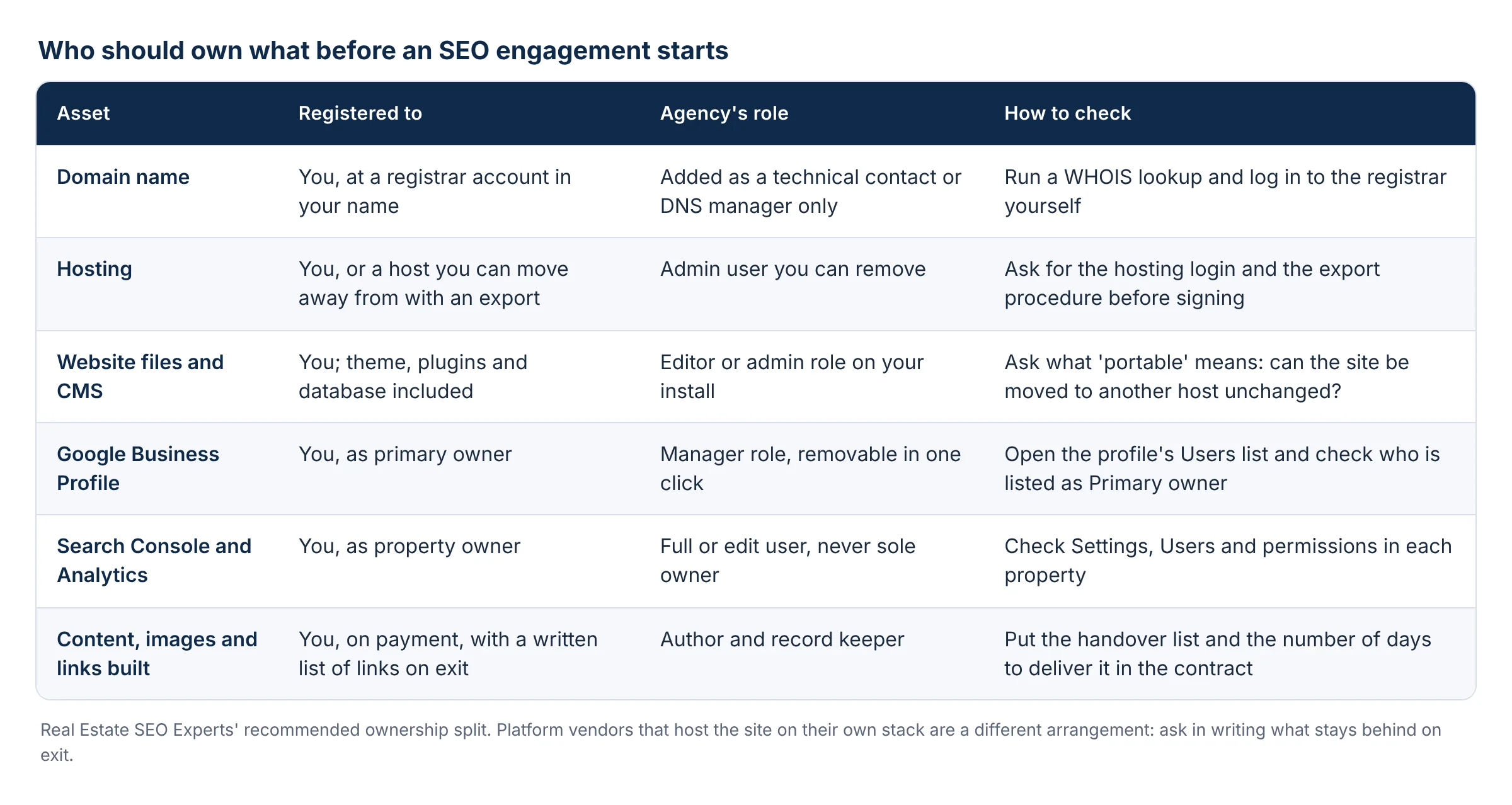
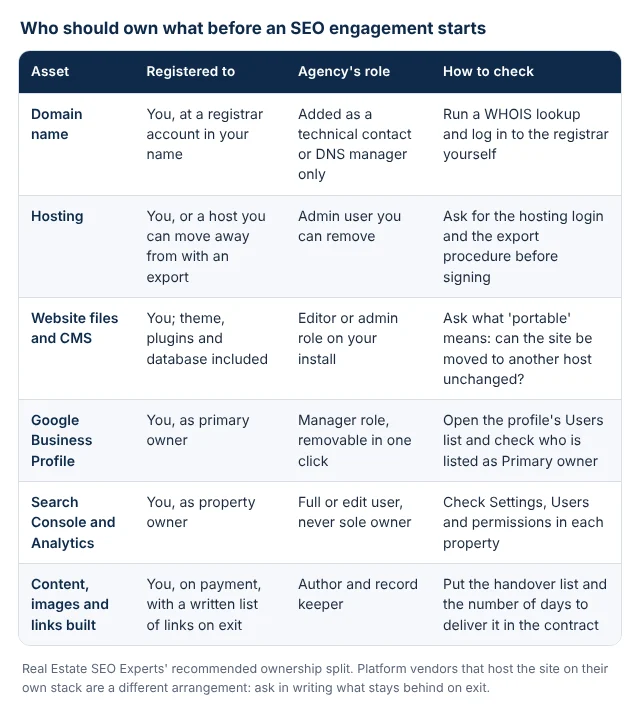
Add one more line to that agreement: on termination, the agency hands over the site files, the database, the content and a list of every link it built, within a stated number of days. If a vendor will not agree to that in writing, you have your answer before the first invoice.
3. How leads are reported, not only rankings
Rankings are an input. A real estate SEO campaign exists to produce enquiries from buyers, sellers, landlords or tenants, and the monthly report should say how many arrived, from which pages, and what happened to them. Ask to see a redacted report from a current client. You are looking for form submissions, calls and chat starts attributed to organic search, split by page type (neighborhood pages, listing pages, blog posts, the home page), and for a note on lead quality from the client’s own CRM. If the report is a ranking tracker screenshot and a traffic graph, the agency is reporting what it can measure rather than what you are paying for. The method for this is not exotic: call tracking on the site’s phone number, event tracking on forms, and a UTM or source field in the CRM. Any agency that handles leads for a living already has it set up. Ask also how often the report arrives and who walks you through it, because a PDF nobody explains is a report nobody reads.
4. Pricing you can see before the sales call
Across all industries, the most common SEO retainer band is $501 to $1,000 a month, chosen by 20.4 percent of the 439 providers Ahrefs surveyed, with agencies averaging $3,209 a month and local SEO averaging $1,557 (Ahrefs SEO pricing survey, updated August 2024). Real estate sits across that whole range depending on whether you are a single agent in one market or a brokerage that needs listing architecture and twenty suburb pages. The number itself matters less than whether the agency will tell you how it is built. A transparent quote lists the hours or deliverables in the retainer, names what is excluded (usually paid ads, major development work and link placements that carry a fee), and separates one time setup from recurring work. A quote that is a single monthly figure with “custom strategy” underneath it tells you nothing about what you will get in month four. We publish our starting point for independent agents and quote everything larger after a free audit, and how that number is built is on our pricing page, which you are welcome to use as a comparison point when reading anyone else’s. For the survey benchmarks behind all of this and a way to check a quote against the hours it should contain, see our guide to what real estate SEO costs.
5. Contract length and the exit terms
SEO needs months of uninterrupted work, so an agency asking for a six month commitment is not unreasonable. An agency asking for twelve months with automatic renewal, a cancellation window measured in days, and no ownership clause is unreasonable, because the contract then does the work that results should be doing. Read for four things: the initial term, the notice period, what happens to the site and content on exit, and whether anything is licensed rather than owned. Month to month arrangements exist in this niche, including for independent agents, and a longer term should buy you something in return, such as a lower rate or a performance review clause at month six. Our view, stated as opinion: the right length is the one you could afford to be wrong about.
6. How the links get built
Ask the agency to describe, in detail, the last five links it earned for a real estate client and how. Then compare the answer against Google’s spam policies, which define link spam as “the practice of creating links to or from a site primarily for the purpose of manipulating search rankings” and list among the examples “Buying or selling links for ranking purposes,” “Using automated programs or services to create links to your site,” “Low-quality directory or bookmark site links,” and “links with optimized anchor text in articles, guest posts, or press releases distributed on other sites” (Google spam policies). The consequence is stated on the same page: “Sites that violate our policies may rank lower in results or not appear in results at all.” In real estate, legitimate links tend to come from local press, chambers of commerce, sponsorships, neighborhood associations, market data that journalists cite, and partner businesses such as lenders and inspectors. Legitimate answers are specific and slow. Red flag answers are vague and fast: “high authority guest posts,” “our private network,” “fifty links a month.” Google’s hiring guidance adds one line to keep in mind: “You should never have to link to an SEO” (Google Search Central). What a realistic program looks like is on our real estate link building page.
7. Content a buyer would actually read
Ask who writes the content, whether that person has ever been on a listing appointment or a showing, and what the review process is before anything is published under your name. Then ask what happens to a listing page when the property sells, because the answer reveals whether the agency has handled listing churn before (the sensible options are a redirect to the closest live page or a sold page that stays useful, and the wrong option is a 404 on every closed deal). Google’s policies also describe scaled content abuse as “when many pages are generated for the primary purpose of manipulating search rankings and not helping users,” regardless of how the pages were produced, so an agency promising a hundred neighborhood pages in month one is promising a problem. One real estate specific question most agencies cannot answer: who checks the copy for Fair Housing Act language before it goes live? Phrases that describe the ideal buyer rather than the property create legal exposure, and a writer who has never heard of the issue should not be writing your pages unsupervised.
8. References, and what to ask them
Take the references the agency offers, then ask for one more: a client who left in the last year. If the agency will not provide one, weigh that. When you reach the references, skip the question about whether they are happy, because the agency chose them. Ask instead: Did your organic leads go up, and how do you know? Who owns your domain and site today? When something broke, how long did a fix take? Did the people on the sales call stay on the account? What did the report look like in month nine compared with month one? If you have left, did you keep your rankings and your content? The last question is the one that separates an agency that builds assets for clients from one that rents visibility back to them.
9. Google’s own hiring questions
Google publishes a short list of questions to ask an SEO, and they work well as the last five minutes of a sales call. Among them: “Can you show me examples of your previous work and share some success stories?”, “Do you follow the Google Search Essentials?”, “What kind of results do you expect to see, and in what timeframe? How do you measure your success?”, “What’s your experience in my industry?”, “What’s your experience in my country/city?” and “How long have you been in business?” The same page is blunt about guarantees: “No one can guarantee a #1 ranking on Google,” and “If they guarantee you that their changes will give you first place in search results, find someone else.” It also says: “Be careful if a company is secretive or won’t clearly explain what they intend to do” (Google Search Central, Do you need an SEO?). An agency that is uncomfortable with these questions is telling you something.
The scoring sheet
Opinions blur after the third sales call, so score each agency during the call rather than after it. The sheet below weights the nine checks the way we would weight them for an agent or brokerage choosing a long term partner. Ownership and link methods carry the most weight because a failure there is expensive to undo; pricing format carries the least because it is the easiest to negotiate. Score each row from 0 to 3, multiply by the weight, and add up. The weights are our judgment, not research data, so change them if your situation differs: a brokerage with an in-house marketing team might weight content lower and lead reporting higher.
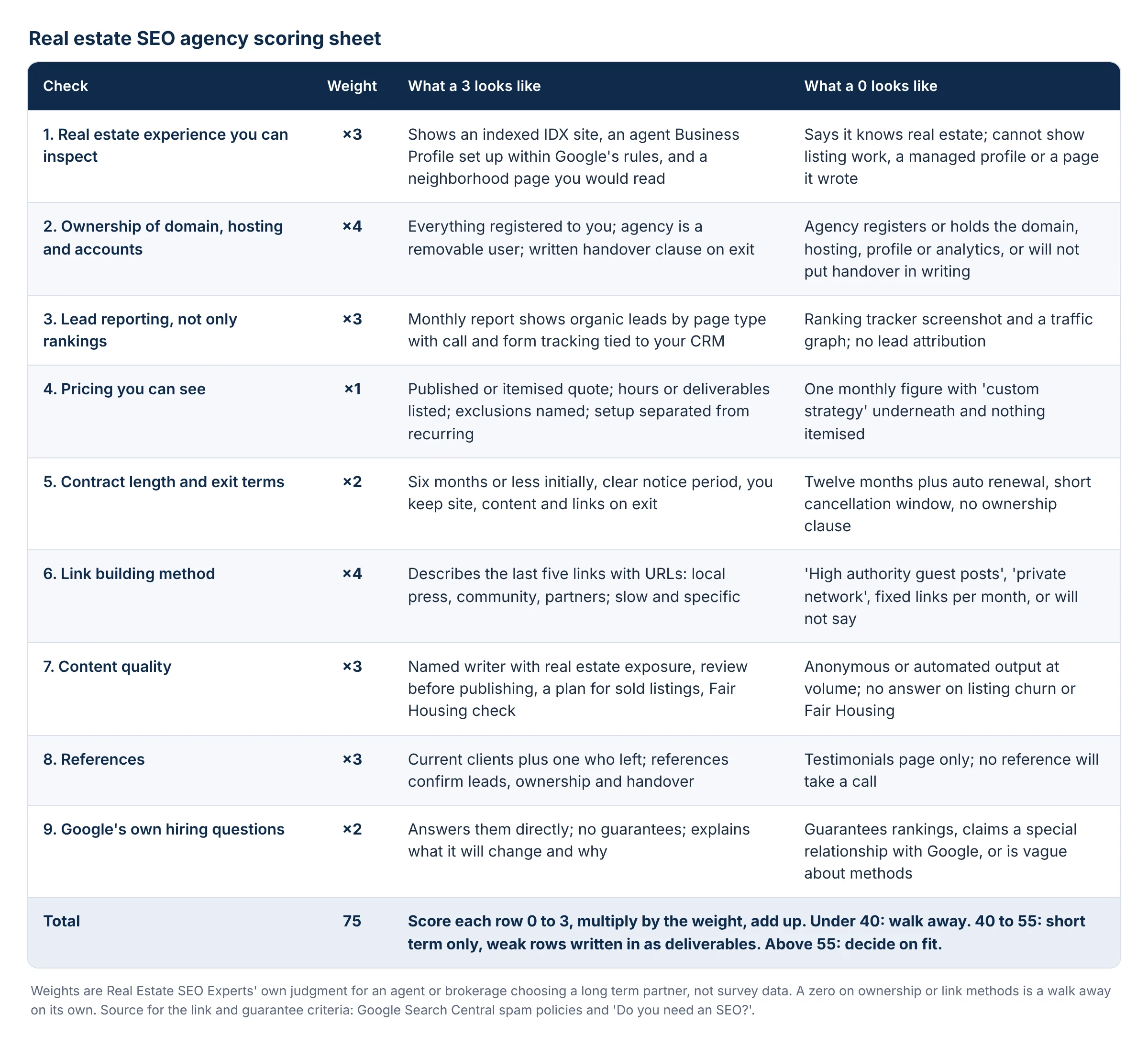
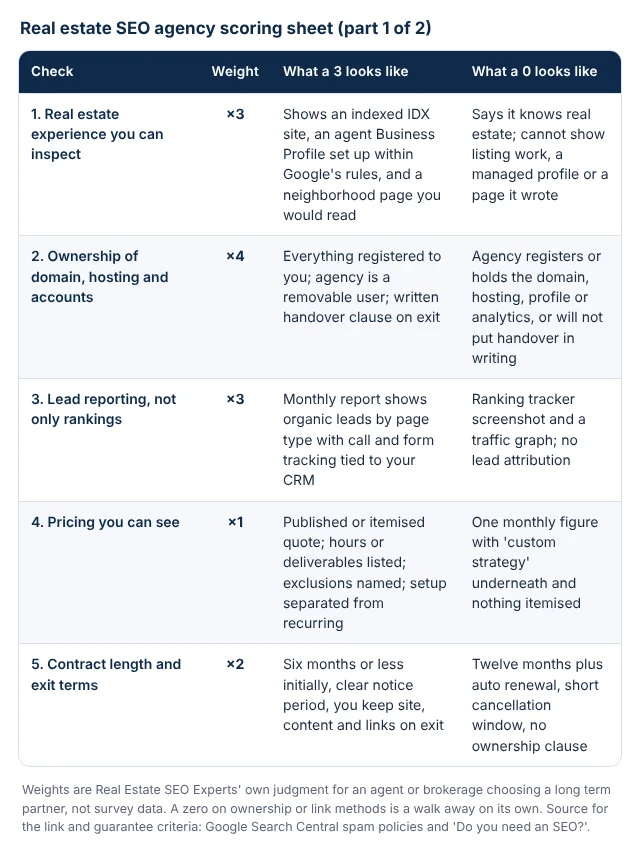
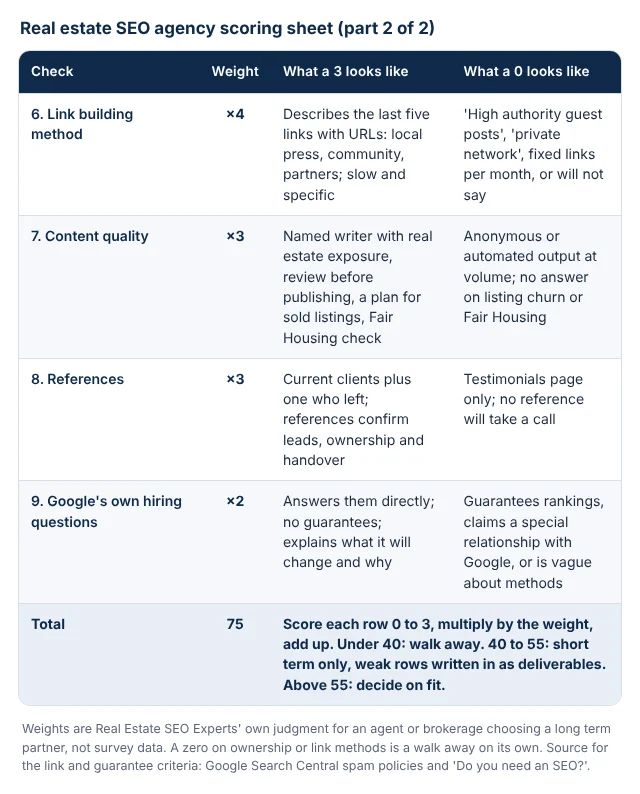
How to read the total. In our view, a score under 40 out of 75 means walk away whatever the price. A zero on ownership or on link methods is a walk away on its own, because no strength elsewhere offsets a site you do not own or a link profile that invites a manual action. Between 40 and 55, the agency can be worth hiring on a shorter term with the weak rows written into the contract as deliverables. Above 55, the remaining question is fit: whether the people on the account understand your market and whether you want to talk to them every month for two years. Keep the completed sheets. They make the renewal conversation at month twelve far easier.
Agencies that publicly specialise in real estate SEO
How this list was compiled: on 6 November 2026 we fetched each agency’s own website and recorded only what it states about itself, specifically its stated real estate focus, the services it lists, its headquarters if shown, and its founding year if shown. We included firms whose own site presents real estate as a dedicated specialism, and we excluded firms that fetched with no verifiable location or whose site did not present a real estate practice. Entries are in alphabetical order. We make no claims about any firm’s results, pricing, quality or client list, including our own, and inclusion here is not an endorsement. Prices and claims on third party sites are theirs, not ours. Verify everything with the nine checks above before you sign anything.
Agent Image describes itself as “The Leader In Real Estate Website Design & Digital Marketing” and says it “builds custom real estate websites for agents, teams, and brokerages.” Its site lists real estate website design, IDX, SEO, social media, PPC, blog writing, content development, CRM integration and lead generation, and describes “26 years of expertise.” It is a division of The Design People, Inc. Headquarters and founding year are not stated on the pages we read.
Avidon Marketing Group says it is “a nationally top-rated SEO company that specializes in SEO for real estate professionals,” and its site also lists many other industries. It lists real estate SEO, local SEO, keyword research, content creation, on-page optimization and link building, offered as a fully managed service. Its About page says the company was “established in 2018 in beautiful Los Angeles, California.”
DMR Media presents itself as a “Luxury Real Estate Marketing Agency” and “a search- and creative-led team for producing agents and teams.” Its services include real estate website design, SEO optimization, SEO consulting, Google Ads management, property marketing, analytics and reporting, luxury development marketing and MLS integrations. The company is DMR Media Specialists LLC and its footer gives an address in Appleton, Wisconsin. Founding year is not stated.
InboundREM calls itself a “Real Estate SEO Company” and says it builds “SEO-focused real estate websites” and runs “SEO and AI SEO campaigns” for realtors and agents. Its site lists SEO, AI SEO, real estate websites, lead generation, branding, video, social and consulting, and states that it builds “a website you own.” Its About page describes the founder’s sixteen years working with agents and brokers. Headquarters and founding year are not stated in the visible text.
ITllect presents a dedicated practice headed “Real Estate SEO Agency for Agents and Brokerages” and says it is “not a generic marketing agency applying cookie-cutter strategies to every industry,” while its About page also lists other industries it serves. The real estate practice lists local and hyperlocal SEO, content, web design with IDX integration, PPC, lead generation and social media, and states that “you own the site entirely.” The site says the company is headquartered in Plantation, Florida, and was founded in 2021.
Real Estate SEO Experts (this site) says “Real estate is our focus” and “We work exclusively with agents, brokerages, and property developers,” with an FAQ stating “We do one thing only: organic search for real estate.” Services listed are local SEO, content SEO, website SEO including IDX canonicals, link building and AI search optimization, with sub-pages for realtors, property consultants, apartments and property management. The pricing page states that monthly retainers start at $150 for an independent agent, with teams and brokerages quoted after a free audit, and lists the USA, Canada, the UK, India, Australia and the Gulf countries among markets served. The contact number is Indian. Founding year is not stated.
Real Estate Webmasters describes itself as “a leader in website development, software, and lead generation for real estate professionals” and says it builds “only for real estate.” Its site lists technical, local and content SEO on a retainer or project basis, SEO audits, PPC, AEO and GEO, copywriting, custom website design, custom programming and a CRM. Its head office is in Nanaimo, British Columbia, Canada, and it describes “over twenty years” in business without stating a founding year. Because the site and CRM are part of its own platform, the ownership questions in check two matter here, as they do for every platform vendor.
Firms we did not include, and why: general digital marketing agencies with a real estate page among dozens of industries, because the post is about specialists; website and CRM platforms we did not fetch during this run; and two real estate SEO sites whose pages gave no verifiable location. None of that is a judgment on their work. If you run an agency that specialises in real estate SEO and want your own published facts added, the contact page reaches us.
Mistakes we see when agents choose
Choosing by the best looking portfolio site. A beautiful site that is not indexed, or whose listings live in an iframe, is a brochure. Check indexing before design. Choosing by the lowest monthly number without asking what it buys; two hours a month of work at a low rate is still two hours. Signing a platform contract believing it is an agency contract, then discovering at exit that the content, the site and sometimes the Business Profile stay behind. Accepting a ranking report as proof of leads. Letting the agency register the domain “to make things easier.” And skipping the reference call because the testimonials page looked convincing. Each of these is cheap to avoid in week one and expensive to fix in month fourteen.
If you want a second opinion on an agency’s proposal, or on your current provider’s work, our free SEO audit reviews the site by hand and puts the findings in writing, including the ownership and indexing checks above. It can end with us telling you to stay where you are. Our real estate local SEO and real estate website SEO pages describe how we handle the Business Profile and IDX work discussed in check one, so you can hold us to the same standard.
Frequently asked questions
Is a real estate specialist better than a general SEO agency?
Usually, for agents, teams and brokerages, because the hard problems in this niche are specific: IDX and listing page indexing, Google Business Profile rules for individual practitioners, neighborhood pages that avoid doorway and scaled content problems, listing churn, and Fair Housing language. A general agency can learn these, but you pay for the learning. The exception is a large brokerage or developer with an in-house marketing team that only needs technical SEO or content production at scale, where a strong general agency can be the better fit.
What should a real estate SEO agency report every month?
Organic leads (form submissions, calls, chat starts) attributed to organic search and split by page type, the pages and queries that produced them, indexing status for listing and neighborhood pages, the links earned that month with URLs, the work completed against the plan, and what changes next month as a result. Rankings belong in the report as a diagnostic, not as the headline.
How long should the contract be?
Long enough for the work to show and short enough that you can leave if it does not. Six months is a common and defensible initial term, with month to month after that. Twelve months with automatic renewal is only reasonable if it buys a lower rate and includes a performance review clause and a clear ownership and handover section. Walk away from any term that does not say what you keep when you leave.
Should the agency own my domain or host my website?
No. The domain, hosting, Google Business Profile, Search Console and Analytics should be registered to you, with the agency added as a user or manager you can remove. If an agency insists on holding any of these, treat the engagement as a platform rental and price the exit cost into your decision.
How do I check an agency’s link building is safe?
Ask for the last five links it earned for a real estate client with the URLs, then read Google’s spam policies and compare. Bought links, automated link services, low quality directories and keyword rich anchors in distributed guest posts or press releases are all listed as link spam, and Google says sites that violate the policies “may rank lower in results or not appear in results at all.” Specific, slow answers involving local press, community organisations and partner businesses are what safe link building sounds like.
Can I use this scoring sheet for a freelancer or a website platform?
Yes, with two adjustments. For a freelancer, weight references and content higher, because you are hiring a person rather than a process. For a website platform, the ownership row becomes the whole decision: find out exactly what stays behind on exit (site, content, CRM data, Business Profile) and decide whether the convenience is worth it before you look at anything else.
Sources: Google Search Central, Do you need an SEO? (updated 5 June 2026), Google Search Central, Spam policies for Google web search, Google, Guidelines for representing your business on Google (Business Profile), Ahrefs, SEO pricing survey of 439 providers (updated 15 August 2024). Agency facts, all fetched 6 November 2026 from the agencies’ own websites: Agent Image, Avidon Marketing Group, DMR Media, InboundREM, ITllect, Real Estate SEO Experts, Real Estate Webmasters.
Want a second opinion before you sign?
Send us the proposal you are weighing, or the site you already have, and we will run the ownership, indexing and link checks above by hand and tell you in writing what we would do. No automated score, no obligation, and sometimes the answer is to stay where you are. Plans start from $150 a month.