
A real estate SEO audit is a structured review of a brokerage or agent website, its Google Business Profile, its links and its content, done to find out what is stopping it from ranking and whether fixing those things is worth the money. Ours is free, written by a person rather than a scanner, and it exists for one reason: to decide, together with you, whether SEO is the right move for your business right now. Sometimes the answer is no, and the audit says so.
Most audit checklists online start with page speed, title tags and your Google Business Profile. Those matter and we check them. But the checks that decide whether we take on a client are about ownership, indexing, listing pages, market difficulty and the lead math. This post walks through all twelve in the order we run them, with what a pass and a fail look like for each.
If you want a longer self-service list, our 44-point real estate SEO checklist covers the full on-site review. This post is the shorter, harder-nosed version: the twelve things that tell us whether a campaign can work.
Why we audit before we quote
Every real estate site has a different starting point. A brokerage with eight years of history, two hundred indexed area pages and a messy IDX setup needs different work from a solo agent on a one-year-old template site with four pages. Quoting the same monthly price to both would be guessing. The audit replaces the guess with a written list of what is broken, in the order it should be fixed, and a price that follows from that list rather than the other way round.
It also protects you. Some sites are not ready for SEO spend, because the owner does not control the domain or because rankings in that market will not move within a sensible budget. Finding that out from a free audit is cheaper than finding it out six months into a retainer.
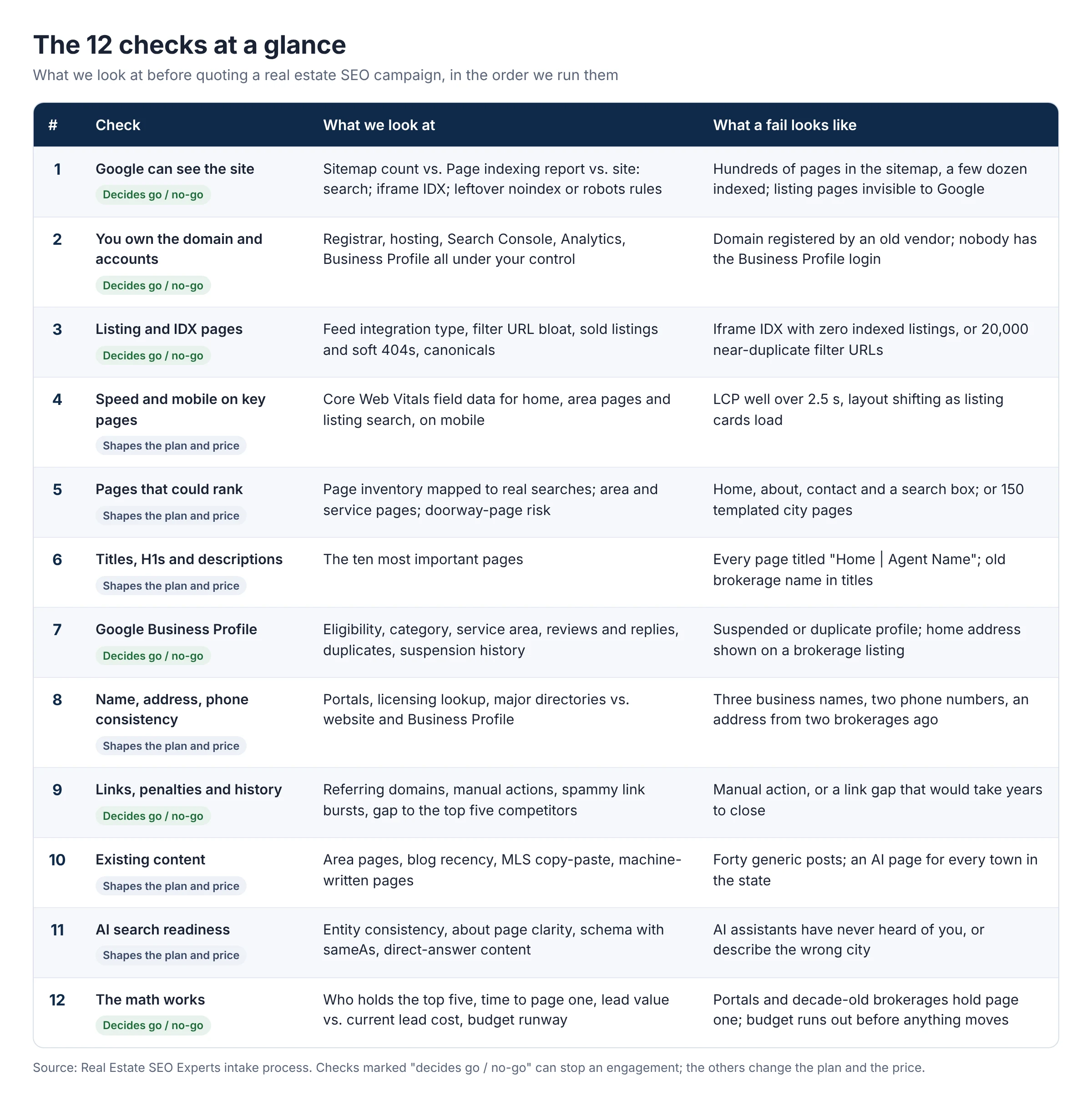
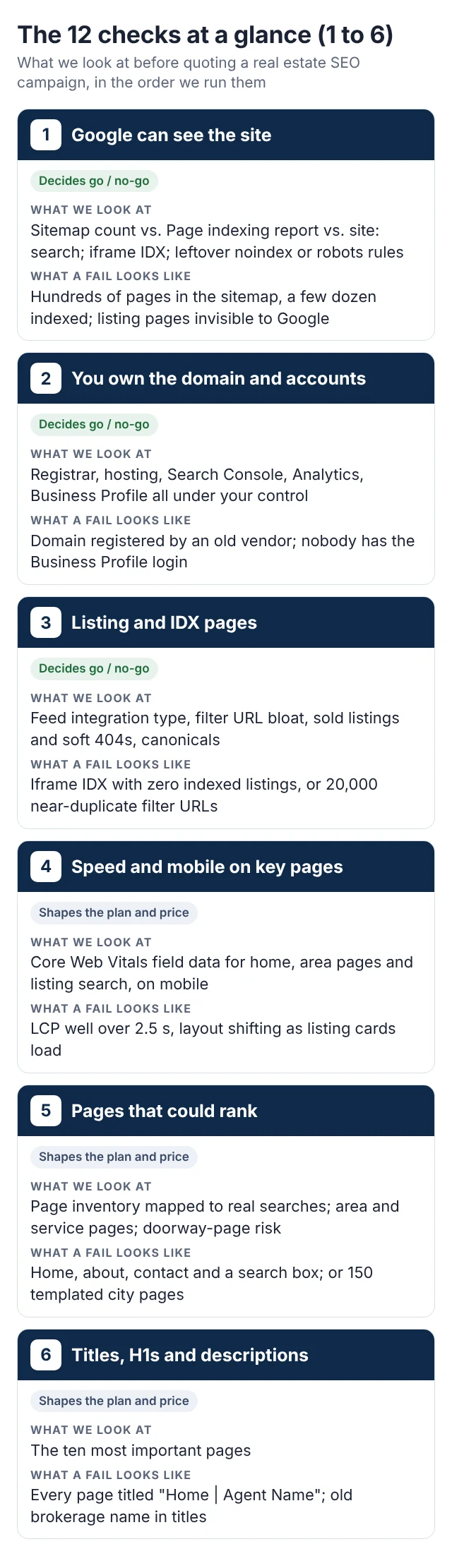
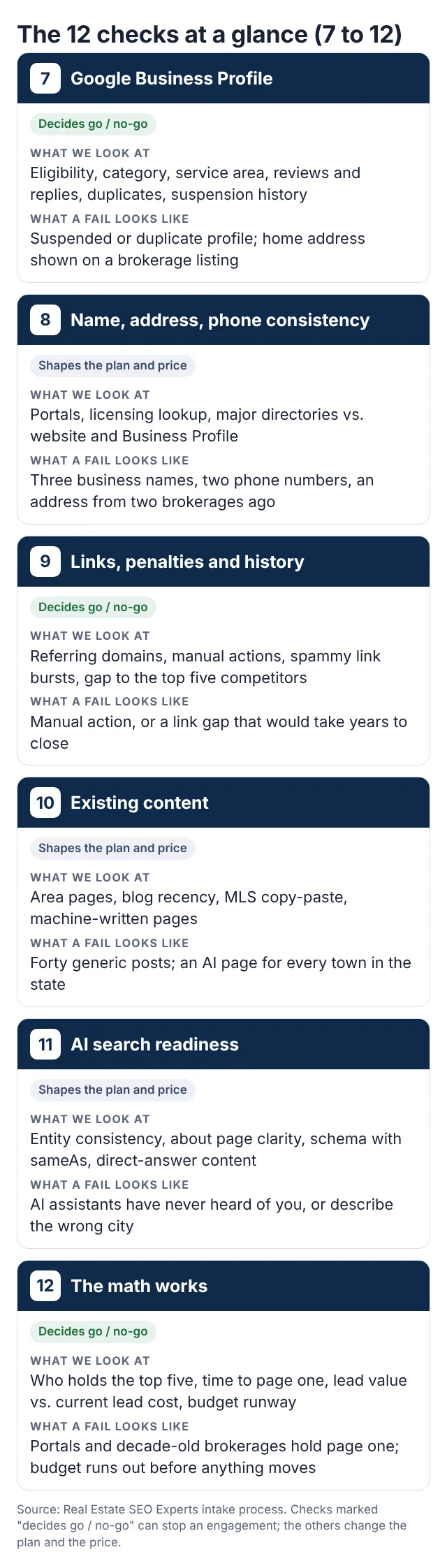
1. Does Google actually see the site?
This is the first check because everything else depends on it. We compare three numbers: pages in your XML sitemap, pages Google reports as indexed in the Page indexing report in Search Console, and pages that show up for a site: search of your domain. On a healthy site those numbers are close. On a troubled one they are miles apart.
A pass looks like: your main pages, area pages and listing pages are indexed, and nothing is indexed that should not be (staging copies, tag archives, printer-friendly duplicates).
A fail looks like: a site with 300 pages in the sitemap and 40 indexed, or an IDX search that lives in an iframe so none of the listing pages exist to Google at all. Other common causes are leftover noindex tags from the launch and robots.txt rules that block the folder the listings live in.
Why it matters: if the pages are not indexed, nothing you do to them counts. When this check fails, the technical fix has to come before any content or link work, which changes the shape of the whole first month.
2. Who owns the domain, the hosting and the accounts?
Not a technical check, but it is a go or no-go check. We ask for the domain registrar, the hosting account, Google Search Console, Google Analytics and the Google Business Profile, and we confirm that you, not a former web vendor or a franchise, hold the admin access.
A pass looks like: you can add us as a user to all of them in ten minutes.
A fail looks like: the site is on a template platform where the agent rents the domain, or the previous agency registered the domain in its own name, or nobody knows who has the Business Profile login. Agents do build rankings on domains they cannot take with them when they change brokerages, and the work is lost on the day they move.
Why it matters: SEO builds an asset, and the asset has to be yours. If the ownership is not fixable, we say so and suggest sorting that out before spending on anything else. In our view this is the most common good reason to delay an engagement, and no automated scanner will ever flag it.
3. How the listing and IDX pages are handled
Listing feeds are what make real estate sites different from other local businesses, and they are where most of the technical damage lives. We look at how the IDX or MLS feed is integrated (subdomain, subfolder, iframe or framed widget), whether filtered and sorted search views generate thousands of crawlable URLs, whether sold and expired listings return a proper 404 or a soft 404, and whether canonical tags point duplicate listing views back to one URL.
Google’s own documentation on faceted navigation is blunt about this: filter combinations can “generate infinite URL spaces which harms the website”, and the recommended fixes are to block crawling of filter URLs you do not need indexed and to return a 404 when a filter combination has no results (Google Search Central, faceted navigation guidance). Listing sites hit this problem harder than almost any other category.
A pass looks like: listing pages are on your domain, in a subfolder, with one canonical URL per property, and expired listings are either redirected or return a clean 404.
A fail looks like: an iframe IDX (no listing pages indexed at all), or the opposite, 20,000 filter URLs indexed with near-identical content that bury your real pages. Our guide to SEO for real estate listing pages goes through the fixes.
4. Speed and mobile on the pages that matter
We do not audit speed across the whole site. We check the home page, two area pages and the listing search page on mobile, using field data where it exists (the Core Web Vitals report in Search Console or the CrUX data in PageSpeed Insights), because lab scores alone can be flattering.
Google’s published thresholds are specific: Largest Contentful Paint within 2.5 seconds, Interaction to Next Paint of 200 milliseconds or less, and Cumulative Layout Shift of 0.1 or less, measured at the 75th percentile of page loads (web.dev, Core Web Vitals). Google also indexes and ranks using the mobile version of a page, which it calls mobile-first indexing (Google Search Central).
A pass looks like: all three metrics in the green on mobile for those pages.
A fail looks like: a home page with a 9 MB hero video, listing cards that shift as images load, or a map widget that blocks interaction for seconds. Worth knowing: Google’s own page experience documentation says it “always seeks to show the most relevant content, even if the page experience is sub-par”, so speed is a tiebreaker rather than a trump card. We treat it as a must-fix when it is badly broken and a later-stage polish when it is merely average.
5. Is there anything on the site that could rank?
Our analysis here is simple: Google ranks pages, not businesses. So we list every page on the site and ask which search a buyer, seller, renter or owner would type that this page could be the best answer for.
A pass looks like: dedicated pages for the neighborhoods or suburbs you work, pages for the main services (buying, selling, property management, new builds), and a few guides that answer real local questions.
A fail looks like: home, about, contact, testimonials and an IDX search. That site has nothing to rank for except the agent’s own name. The other kind of fail is 150 near-identical “homes for sale in [city]” pages generated from one template, which Google’s spam policy describes as doorway abuse: “multiple domain names or pages targeted at specific regions or cities that funnel users to one page” (Google Search Essentials, spam policies). If we find those, the plan includes consolidating or rewriting them, not adding more.
6. Titles, headings and descriptions on the money pages
A quick check, but revealing. We pull the title tag, H1 and meta description for the ten pages that matter most and look at whether they describe what the page is for and where.
A pass looks like: “Homes for Sale in Lakeview, Chicago | [Brokerage]” with an H1 that matches and a description written for a human.
A fail looks like: every page titled “Home | Jane Smith Realty”, titles stuffed with twelve city names, or H1s that are the logo image. This is also where we catch titles that still carry the old brokerage name. It is cheap to fix, so it goes in week one, but it is rarely the reason a site is stuck, which is why it is check six and not check one.
7. Google Business Profile: eligible, correct, active
For agents and small brokerages the Business Profile often produces more calls than the website does, so we check it as carefully as the site.
First, eligibility, because this is where real estate gets caught out. Google’s guidelines treat real estate agents as individual practitioners who may have their own profile, but state that “sales associates or lead generation agents for corporations aren’t individual practitioners and aren’t eligible”, and that rental or for-sale properties such as model homes are not eligible, while sales or leasing offices are (Google Business Profile help, representing your business and eligibility guidelines). A profile that breaks these rules can be suspended at any time, taking its reviews with it.
Then the basics: primary category, whether the address is shown or hidden correctly for a service-area business (Google says the service area should not extend beyond about two hours’ drive from the base), review count and recency, whether reviews get answered, photos, and whether there are duplicate profiles for the same agent at two brokerages.
A pass looks like: one verified, correctly categorised profile per agent or office, with reviews arriving most months and getting replies.
A fail looks like: a suspended profile, a duplicate from a previous brokerage still ranking, or a brokerage profile listing the agent’s home address. Our real estate local SEO service page explains how we handle the fixes.
8. Name, address and phone across the directories
Agents move. When they do, Zillow, Realtor.com, Yelp, the state licensing lookup and fifty smaller directories keep the old brokerage name and office phone for years. We pull the current listings and check them against the Business Profile and the website footer.
A pass looks like: the same name, address and phone everywhere that matters, including the brokerage pages and the portal profiles.
A fail looks like: three versions of the business name, two phone numbers and an old address on the directories Google trusts most. This is tedious rather than difficult to fix, so it affects the price more than it affects the decision.
9. Links, penalties and history
We look at how many referring domains point to the site, where they come from, and whether anything in the history will hold the site back. That means checking the Manual actions report in Search Console, looking for bursts of low-quality links from a previous vendor, and comparing the link profile to the five sites currently outranking you for your main area terms.
A pass looks like: a modest, natural profile (local press, brokerage pages, sponsorships, a few portals) with no manual action.
A fail looks like: a manual action, a link profile full of foreign directory spam, or a gap so large against the competitors that closing it would take years. Backlinks are not the whole game, but over half of sites with no backlinks never reach page one, according to Semrush’s analysis of its own data (Semrush, 2023). What a realistic link programme involves is covered on our real estate link building page.
10. The content that already exists
Before recommending new content we read the old content. We check whether the area pages say anything a buyer could not get from Wikipedia, whether the blog has been updated in the last year, whether listing descriptions are copied from the MLS word for word, and whether there are obviously machine-generated pages with no local detail.
A pass looks like: a smaller number of pages written by someone who knows the market, with specifics (school boundaries, commute times, price bands, what changed this year).
A fail looks like: forty blog posts about “tips for first-time buyers” that could be on any site in the country, or an AI-written page for every town in the state. Both get the same treatment: consolidate, improve the pages with potential, and remove the rest.
11. AI search readiness
More of the searches your clients run now get an answer from Google’s AI Overviews, ChatGPT or Perplexity before they ever see a list of websites. We check whether your business is described clearly enough to be picked up: a consistent business name and description across the site, the Business Profile and the portals; an about page that says who you are, where you work and what you do in plain sentences; Organization or RealEstateAgent schema with sameAs links to your profiles; and question-and-answer content that gives a direct answer in the first sentence.
One correction to a lot of older advice: FAQ rich results are gone. Google’s documentation changelog states the feature “will no longer appear in Google Search starting May 7, 2026”, and the documentation was removed in June 2026 (Google Search Central, documentation updates). FAQ sections are still worth having because the content is easy for AI systems and people to extract, but there is no longer a rich result to chase.
A pass looks like: when you ask an AI assistant for a real estate agent in your area, your name is at least in the conversation, and what it says about you is accurate.
A fail looks like: the assistant has never heard of you, or describes you as working in a city you left in 2019. Our AI SEO for real estate page covers what the work involves.
12. Does the math work?
The last check is the one that decides. We take the main terms in your market, look at who holds the top five positions and how strong they are, estimate how long it would realistically take to get onto page one, and set that against what a lead is worth to you and what you are paying for leads today.
Some reference points we use, all from published sources. Zillow’s own published averages put a Premier Agent lead at about $223 in major metros and $139 elsewhere (as reported by Clever Real Estate, updated September 2026, citing Zillow). Purchased-lead conversion rates are widely reported in the 1 to 3 percent range, though the most cited figure is from a 2020 HousingWire piece and should be treated as a rough guide. On the organic side, the top three Google results take about 68.7 percent of clicks and fewer than 1 percent of searchers click through to page two (First Page Sage 2023 and Backlinko 2023, as compiled by Semrush). Our own position, stated as an opinion: organic rankings for area terms are worth building in almost every market, but the time it takes to reach them ranges from four months to two years, and your budget has to cover that runway.
A pass looks like: a market where page one is held by sites you can realistically match within six to twelve months, at a monthly cost that is a fraction of what the leads would cost from a portal.
A fail looks like: a metro where the top five are national portals and two hundred-agent brokerages with decade-old domains, and a budget that would run out before anything moved. In that case we say so and suggest a narrower target (a suburb, a niche, a property type) or a different channel for now. Our pricing page explains how the number you get after the audit is built.
What you get back, and what it leaves out
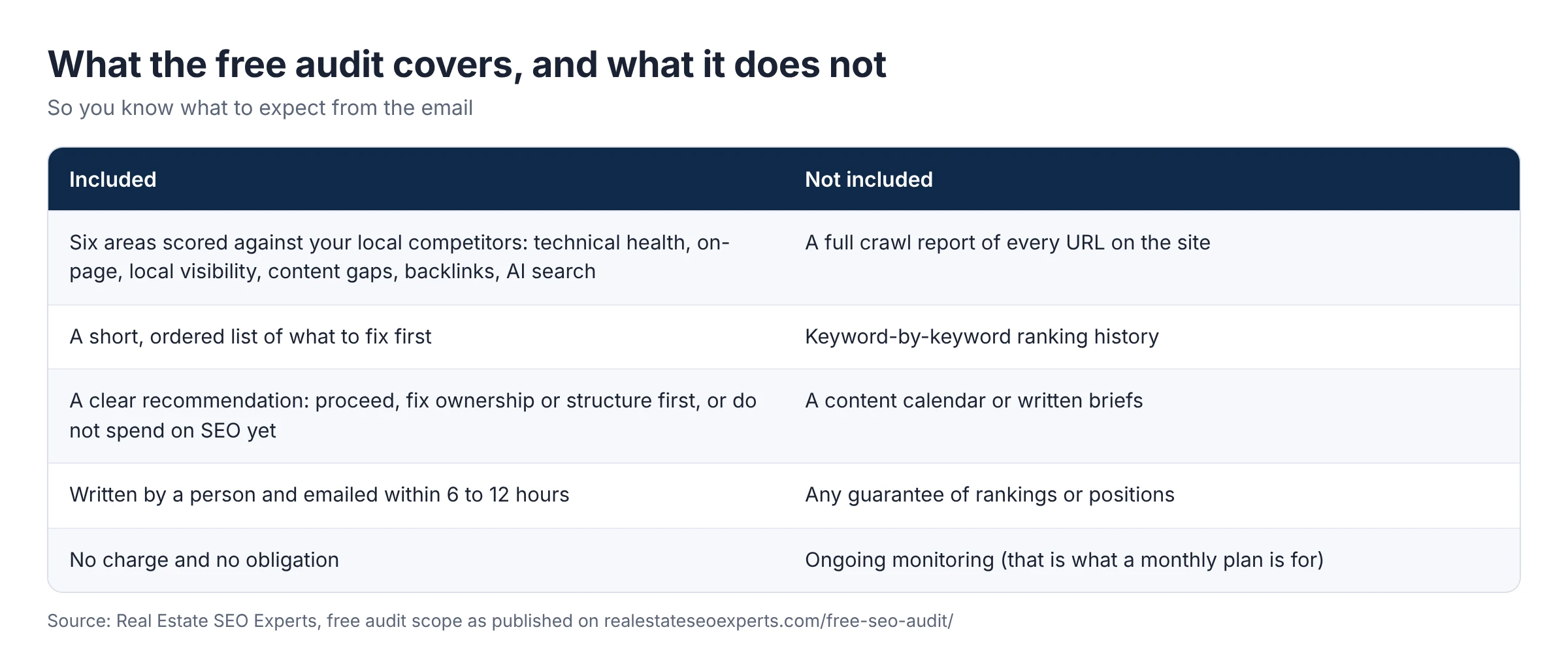
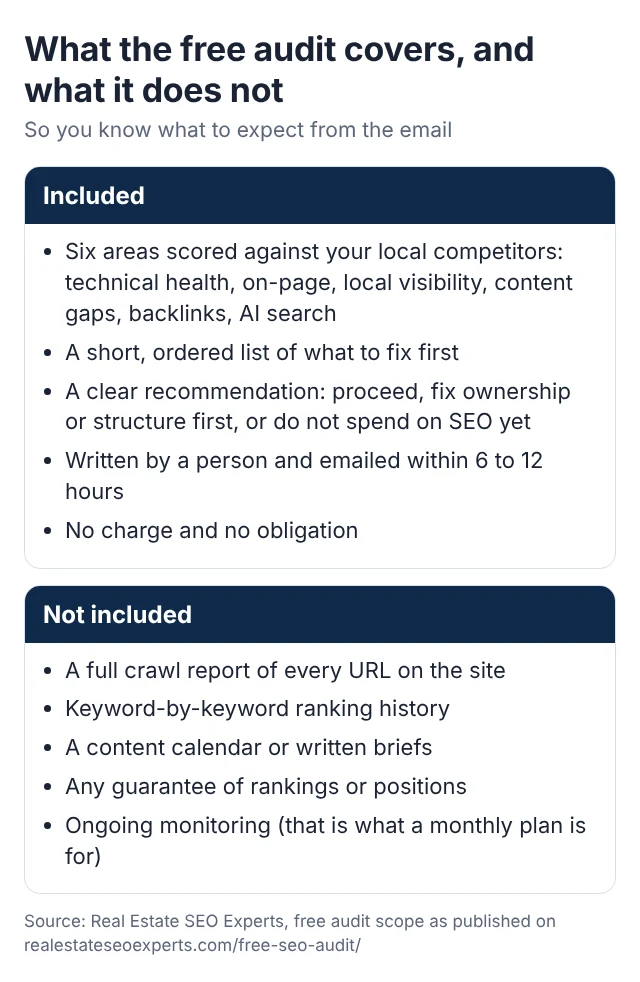
The audit is written, not a dashboard export. You get the six areas (technical health, on-page, local visibility, content gaps, backlinks, AI search) scored against your local competitors, a short list of what to fix first, and a recommendation: proceed, fix ownership or structure first, or do not spend on SEO yet. It is emailed within 6 to 12 hours of your request, and there is no obligation attached. You can request it on the free real estate SEO audit page.
It does not include a full crawl report of every URL, a keyword-by-keyword ranking history, or a content calendar. Those are the first weeks of an engagement, not a free email. It also does not include guarantees of positions, because nobody can offer those in good faith. What it does include is the reasoning, so if you take the list to another agency or do the work yourself, it still holds up.
How to get the most from it
Give access before the audit, not after. Read-only access to Search Console and Analytics is the difference between “your listing pages look thin” and “your listing pages got 212 impressions last month and three clicks”. Tell us which areas and property types actually pay your bills, because ranking for the wrong suburb is a pass on every technical check and a fail on the only one that matters. And if you have had an agency before, send whatever reports they left; the links and content they produced are part of the audit.
Frequently asked questions
What does a real estate SEO audit include?
A proper one covers indexing and crawlability, how the IDX or listing pages are handled, speed and mobile performance on key pages, the page inventory against the searches in your market, on-page titles and headings, the Google Business Profile, directory consistency, the link profile and any penalties, the existing content, AI search visibility, and an assessment of whether the market and budget make SEO worthwhile. The twelve checks above are that list.
How long does an SEO audit take?
A manual intake audit of the kind described here takes a few hours of work and we return it within 6 to 12 hours. A full technical crawl and content audit at the start of an engagement takes longer, typically the first one to two weeks, because it covers every URL rather than the ones that matter most for the decision.
Is a free SEO audit really free, or is it a sales call?
Ours is a written document delivered by email with no obligation. It is also, openly, how we decide whether to quote, so it serves both sides. The test of any free audit is whether it would still be useful if you never spoke to the agency again. If it is a login screen that produces a score out of 100 and a calendar link, it is a lead form, not an audit.
Can I audit my own real estate website?
You can do most of checks 1, 4, 6, 7, 8 and 10 yourself with Search Console, PageSpeed Insights and a careful hour, and the checklist post walks through it. Checks 3, 9 and 12 are harder without crawling software, link data and experience of what the competition in your market takes.
How often should a real estate site be audited?
Fully, once a year or whenever you change website platform, IDX provider or brokerage. Lightly, every month: indexing numbers, Core Web Vitals, Business Profile status and new reviews. The monthly check is what catches a suspended profile or a plugin update that added noindex to every listing page.
Sources: Google Search Central, Core Web Vitals thresholds, Google Search Central, Understanding page experience, Google Search Central, Mobile-first indexing, Google Search Central, Faceted navigation, Google Search Central, Spam policies (doorway abuse), Google Search Central, Documentation updates (FAQ rich result deprecation, May and June 2026), Google Business Profile, Guidelines for representing your business, Google Business Profile, Business eligibility and ownership guidelines, Google Search Console Help, Page indexing report, Clever Real Estate, How much are Zillow leads (updated 14 September 2026), Semrush, SEO statistics (compiling First Page Sage 2023, Backlinko 2023 and Semrush 2023).
Want it checked for you?
Send us your website and we will run these twelve checks by hand. The written audit comes back within 6 to 12 hours, with no obligation, and plans start from $150 a month.