
Using Zillow’s own published averages and the most widely quoted conversion range for purchased leads, one closing from Zillow Premier Agent costs between about $4,600 and $22,300 in connection fees: $139 to $223 per connection, divided by a close rate of 1 to 3 percent. Set that against a net commission of roughly $7,300 on a median-priced US home and the major-metro figure only breaks even above a 3 percent close rate. SEO has no per-lead price, so its cost per closing is your total spend divided by the closings it produces over a long enough window. In the mid case we work through below ($750 a month for 24 months producing six closings) that is $3,000 per closing, but for the first six months it is effectively infinite, because nothing has closed yet. Both figures move a long way when you change the inputs, so this article shows every step of the arithmetic and ends with a blank worksheet you can fill in with your own numbers.
Two things this post is not. It is not a guide to competing with Zillow in Google results; that is covered in our Zillow SEO strategy post. And it is not a DIY versus agency argument, which has its own breakdown. This one does a single job: it puts a portal closing and an organic closing on the same line of the same spreadsheet. We are an SEO agency, so read our assumptions with that in mind. Every sourced figure is linked, every assumption is labelled as one, and the Zillow numbers come from Zillow’s pages, checked on 9 November 2026.
Cost per closing: the definition, and why cost per lead misleads
Cost per closing is the total amount you spend on a lead channel divided by the number of closed transactions that channel produces in the same period. For a pay-per-lead channel it simplifies to cost per lead divided by close rate. For a channel with fixed costs, such as SEO, it only becomes meaningful over a window long enough for closings to arrive, which is why the two channels have to be compared over the same number of months.
Cost per lead on its own tells you almost nothing. A $20 lead that closes at 0.5 percent costs $4,000 per closing ($20 divided by 0.005). A $139 connection that closes at 4 percent costs $3,475 ($139 divided by 0.04). The cheaper lead is the more expensive channel. The second trap is comparing cost per closing with gross commission. The number that has to cover the lead cost is what reaches your account after the brokerage split, and in the Preferred programme after Zillow’s success fee as well.
What Zillow charges, taken from Zillow’s own pages
Zillow sells agents two different products, and they produce two different cost-per-closing formulas. The first is Premier Agent advertising, where you pay in advance for connections in the ZIP codes you choose. Zillow’s page says the price varies by market, home values and expected connections, and that the average cost per connection is $223 in major metro areas and $139 in non-major metros. Contracts are not required, but Zillow offers six-month contracts as what it calls the minimum recommended time to see value. Its help center adds that cost depends on share of voice at the ZIP code level and that the minimum is $50 per ZIP code.
Third-party figures sit lower and higher than Zillow’s averages. HousingWire (updated September 2025) puts the typical range at $20 to $60 per lead, with Premier Agents spending $300 to $500 a month outside metros and $1,000 a month or more inside them, and notes an early termination fee of twice the monthly minimum spend. Clever Real Estate (updated September 2026) reports agents in the most competitive markets paying $450 to $500 for a single lead. Our reading: the HousingWire range describes leads, Zillow’s figure describes connections, and the two are not the same unit. Plan with Zillow’s number, because it is current, it is Zillow’s own, and it is the higher one.
The second product is Zillow Preferred, the pay-at-close programme that Clever’s guide says absorbed the older Flex programme in October 2025. You pay nothing up front. When you transact with a Preferred connection, Zillow is owed a percentage of the full commission you expect to earn. Zillow’s pricing page states that the fee for every seller-originated connection is 40 percent in all markets, that buyer-originated fees vary by market, transaction price and connection delivery date, and that Zillow may change the fee at any time with 15 days’ notice. Clever reports the buyer-side range as 15 to 40 percent; Zillow’s page does not publish a range, so treat that span as reported rather than official.
What a closing is worth after the 2024 changes
The lead cost only means something next to the commission it has to earn. NAR’s latest existing-home sales release, published 13 October 2026, puts the median existing-home price at $417,500 for September 2026, up 1.3 percent on the year. We use that as the sale price throughout, and your worksheet should use your own market’s typical price instead, because a $900,000 coastal market and a $240,000 Midwest market give completely different answers from the same lead cost.
On the commission rate, NAR publishes no percentage and we are not going to invent one. Since the practice changes that took effect on 17 August 2024, NAR says that real estate professionals nationwide require a written agreement before touring a home, and its consumer guides describe negotiating compensation with the agent. The rate on your side of the deal is whatever your written agreement says. For the worked example we assume 2.5 percent per side. That is our assumption for illustration, not an NAR figure. Demand for agents has not gone anywhere: NAR’s 2026 Profile of Home Buyers and Sellers, released 5 November 2026, found that 90 percent of buyers and 92 percent of sellers used an agent or broker.
Gross commission in the example is $417,500 multiplied by 0.025, which is $10,437.50. We then assume a brokerage split in which the agent keeps 70 percent, giving a net commission of $7,306.25. Your split may be 50/50 in your first year or 100 percent less a desk fee if you are on a cap model; change line F of the worksheet and everything downstream moves with it. Every cost per closing below is compared with that $7,306.25, and anything above it is a closing you paid to lose money on.
The worked example: Premier Agent cost per closing
Take an agent in a major metro paying Zillow’s average $223 per connection and closing 2 percent of connections. Cost per closing is $223 divided by 0.02, which is $11,150. Against a net commission of $7,306.25 that is a shortfall of $3,843.75 on every closing before any other expense. At 3 percent the cost per closing falls to $7,433.33, still $127.08 short. The break-even close rate is the cost per connection divided by the net commission: $223 divided by $7,306.25 is 3.05 percent. A metro agent on these assumptions needs to close better than one connection in 33 just to stop losing money on the channel.
The non-metro agent paying $139 is in a different position. At 2 percent the cost per closing is $6,950, which leaves $356.25 of margin. At 3 percent it is $4,633.33 and the margin is $2,672.92. Break-even is $139 divided by $7,306.25, or 1.90 percent. This is the single most important thing the table below shows: the same programme is a loss-maker in one market and a workable channel in another, and the difference is Zillow’s price in your ZIP code, not your skill.
A word on the close rate, because everything hangs on it. The 1 to 3 percent figure traces to a HousingWire piece from September 2020, in which the CEO of a lead generation vendor said agents should expect 1 to 3 percent of purchased leads to do some sort of transaction within 120 days. In the same article a realtor.com executive put industry conversion at about 0.5 to 1 percent, while two individual agents said they converted 7 to 15 percent of their leads. The range is wide, the definitions are loose, and the data is six years old. We have found nothing more recent that is both public and measured, which is why the sensitivity table runs from 1 to 5 percent and why your own CRM figure should replace it the moment you have one.
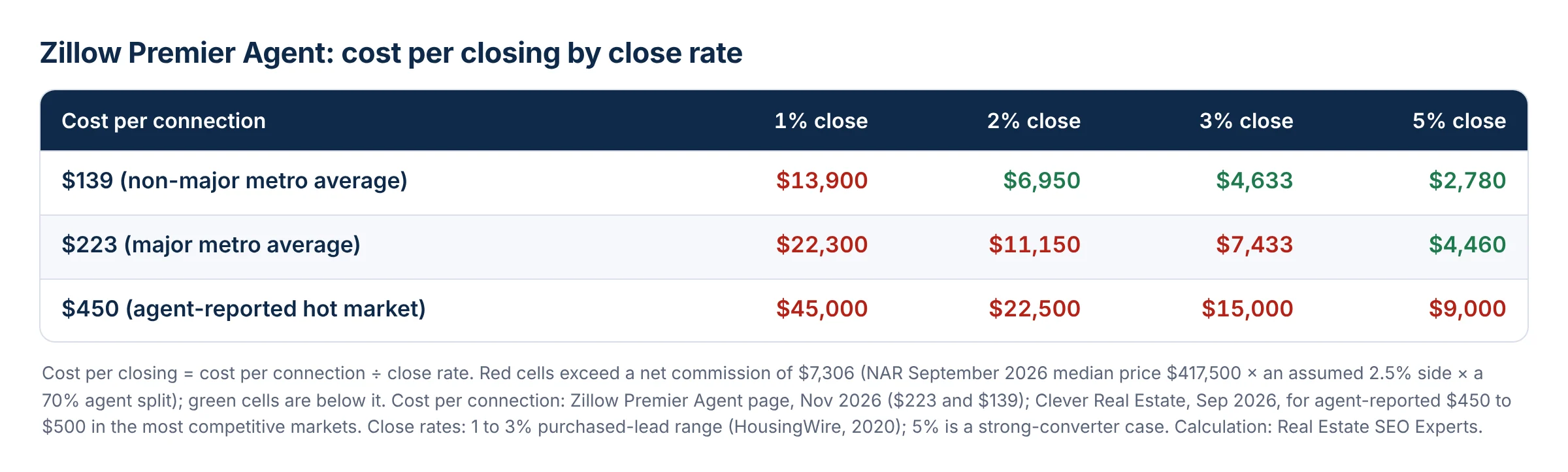
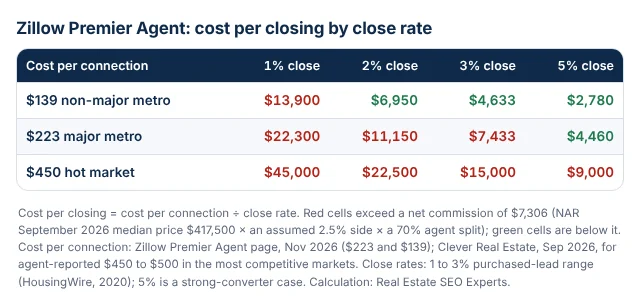
Read the table by row. The $139 row turns green at 2 percent. The $223 row needs 5 percent, or a close rate just above 3 percent on these commission assumptions. The $450 row never turns green within the range, which means an agent paying hot-market prices on a median-priced home needs either a much higher sale price, a much higher close rate, or a different channel.
Zillow Preferred: the pay-at-close version of the same math
Preferred removes the cash risk and replaces it with a share of the outcome. Cost per closing is simply the success fee multiplied by the gross commission on the deal. On the example deal, a seller-originated connection at Zillow’s flat 40 percent costs 0.40 multiplied by $10,437.50, which is $4,175. A buyer-originated connection at the 15 to 40 percent range Clever reports would cost between $1,565.63 and $4,175. Whether your brokerage split is applied before or after the fee depends on your brokerage; if it is applied to what is left, the agent in the 40 percent case keeps ($10,437.50 less $4,175) multiplied by 0.70, which is $4,383.75.
Notice what that does to the comparison. Preferred’s cost per closing is lower than Premier Agent’s in every metro cell of the table, and it can never exceed the commission, because it is defined as a fraction of it. The price you pay for that safety is control. You cannot buy more volume by raising a budget, Zillow decides who receives connections, the fee applies to every closing for as long as you are in the programme, and the fee itself can change on 15 days’ notice. For an agent with no cash and no pipeline, that trade is often the right one, and we come back to it below.
The SEO side: what it costs and what it has to produce
SEO has no price per lead because you are not buying leads; you are paying for work on pages you own, and the enquiries arrive through those pages at no marginal cost. So the cost side is a monthly figure. Ahrefs surveyed 439 SEO providers (updated August 2024) and found the most common monthly retainer was $501 to $1,000, charged by 20.4 percent of respondents, with 42.8 percent charging between $501 and $2,000 a month. Agencies in that survey averaged $3,209 a month and freelancers $1,348. At the other end, our own independent agent plan starts at $150 a month, month to month, and we quote teams and brokerages after a free audit. If you do the work yourself, the cost is your tools plus your hours at whatever rate you value them, and the DIY post linked above is honest about how many hours that is.
The production side is where we have to assume, and we want to be plain about it. We know of no public, measured benchmark for how many enquiries an agent website generates from organic search or how many of them close, so the scenarios below are ours. We use a 24-month window, because that is a fair test of a channel that compounds, and we assume the first six months produce no closings at all, which is realistic for a new or neglected site and pessimistic for a domain with history. That leaves 18 producing months. The low case produces 2 closings in those 18 months, the mid case 6, and the high case 12.
If you prefer to think in enquiries and a close rate, here is the same thing expressed that way. At an assumed 4 percent close rate on organic enquiries, the low case needs 50 enquiries over 18 months (about 3 a month), the mid case 150 (about 8 a month) and the high case 300 (about 17 a month). We assume a higher close rate than for purchased leads because an organic enquiry usually comes from someone who searched for a neighborhood, a property type or an agent by name and chose to contact you, rather than being routed to whichever advertiser bought their ZIP code. That is our reasoning, not a sourced fact. If you think 2 percent is right, double the enquiry counts; the cost per closing in the table does not change as long as the closings do not.
Now the arithmetic. In the mid case, $750 a month for 24 months is $18,000. Divided by 6 closings, that is $3,000 per closing, and the margin against the $7,306.25 net commission is $4,306.25. The low case is $18,000 divided by 2, which is $9,000 per closing and a loss of $1,693.75 on each. The high case is $18,000 divided by 12, or $1,500. On the $150 plan the same three cases are $1,800, $600 and $300 per closing. At the $3,209 agency average they are $38,508, $12,836 and $6,418, which is why a solo agent should not buy an enterprise retainer and why a brokerage buying one needs the volume to justify it.
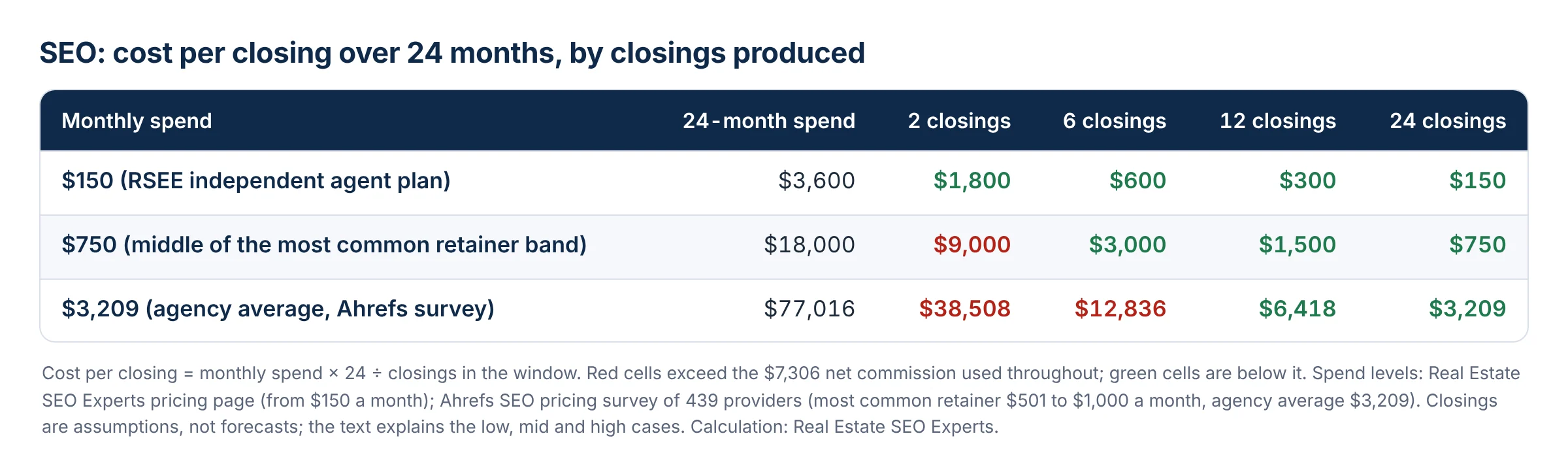
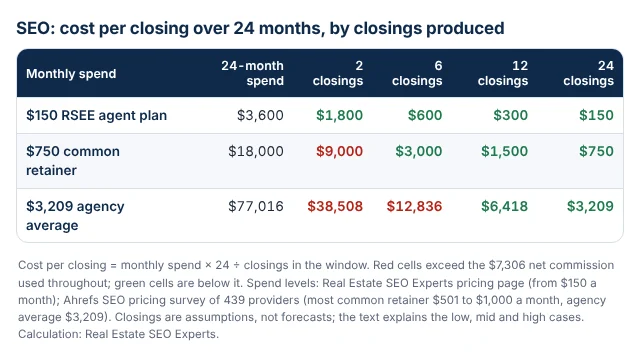
The uncomfortable part of this table is the window. Cut it to 12 months and the mid case becomes $9,000 of spend against perhaps one closing, because most of the production falls in months 13 to 24. Judged at month six, SEO always loses to Zillow, because its cost per closing is a number divided by zero. That is not a reason to avoid it; it is the reason to fund it from somewhere other than this quarter’s commissions, and to decide the window before you start rather than at the first slow month. Our month-by-month real estate SEO timeline sets out what should be moving in each of those months, long before a closing arrives. If you want the SEO line of this worksheet filled in for your market rather than with our averages, the pricing page explains what the $150 plan covers and the free audit comes back with a written quote within 6 to 12 hours.
Time horizon: a rented pipeline and an owned one
Portal connections stop the day the payment stops. That makes Premier Agent perfectly predictable and perfectly flat: your fiftieth closing costs what your first one did, and nothing you did last year lowers this year’s price. SEO behaves the other way round. The neighborhood and local pages that rank in month 18 keep ranking in month 30 with maintenance rather than rebuilding, so the spend per closing in year three is typically lower than in year two, provided the work was done properly and the site is still yours. This is our analysis from running both kinds of budget rather than a published statistic, and it holds only if the ranking is earned on pages you control.
There is a cash flow consequence worth stating plainly. Premier Agent converts money into closings inside a quarter; SEO converts money into an asset and the asset into closings over years. An agent who needs three closings by March should not expect SEO to deliver them. An agent who wants to pay less per closing in 2028 than in 2026 cannot get there by buying connections.
Ownership and risk, in both directions
The portal risks are contractual. Zillow sets the price per connection by ZIP code and can change the Preferred success fee on 15 days’ notice. The programme itself has changed shape, with Flex becoming Preferred, and the reviews, profile and connection history you build live on Zillow’s platform, not yours. HousingWire describes an early termination fee of twice the monthly minimum spend on Premier Agent contracts, so a six-month commitment is a real one.
The SEO risks are different but not smaller. Google changes its results, and AI answers now sit above many of the searches agents used to win, which is one reason we no longer treat broad city-level terms as the goal (the Zillow SEO post explains where agents can still win). An agency can take your money for a year and leave you with nothing, and even a good one cannot guarantee a ranking; our own pricing page says so, and commits to the work rather than a position. The ownership checks matter more here than anywhere: the domain, the hosting, the Google Business Profile and the analytics must be registered to you, which is check two in what we look at before quoting. If a provider will not agree to that, the cost per closing is irrelevant because the asset is not yours.
When buying Zillow leads is the right call
We would be a poor guide if the answer were always SEO, and it is not. A new agent with no sphere, no reviews and no site history has an SEO cost per closing that is undefined for at least six months and a Preferred cost of exactly nothing until a deal closes. For that agent, a Preferred seat or a modest Premier Agent budget in one ZIP code is the rational way to get the first closings, learn to convert, and fund everything else. The same is true of an experienced agent entering a new market cold.
Cash-rich teams with a dedicated inside sales function are the other clear case. In the 2020 HousingWire article, a Zillow executive said a customer connected live to an agent is four times more likely to work with that agent, and the two agents quoted with 7 to 15 percent conversion were the ones with disciplined follow-up. A team that answers every connection in minutes, calls back for months and tracks every outcome can push its close rate toward the top of our table, where even the $223 row turns green. If your team already runs like that, Premier Agent is a volume dial, and the only question is whether each additional ZIP code still clears the break-even rate.
The pattern we think works for most established agents is neither pure. Buy connections for volume now, build the organic asset so you can turn the budget down later, and run both through the worksheet below every quarter using lead source data from your CRM. The channel that is cheaper per closing gets next quarter’s increment. That is an opinion, but it is one the arithmetic supports in every market we have modelled.
Run your own numbers
The worksheet below has fifteen lines. Nine are inputs and six are results, and the formulas are written out so you can rebuild it in any spreadsheet in a few minutes. Use your Zillow quote for line A, your CRM for lines B and M, your market’s typical price for line D, and your written agreement for line E. If you do not yet have a close rate of your own, run it three times at 1, 2 and 3 percent and look at which answers survive all three.
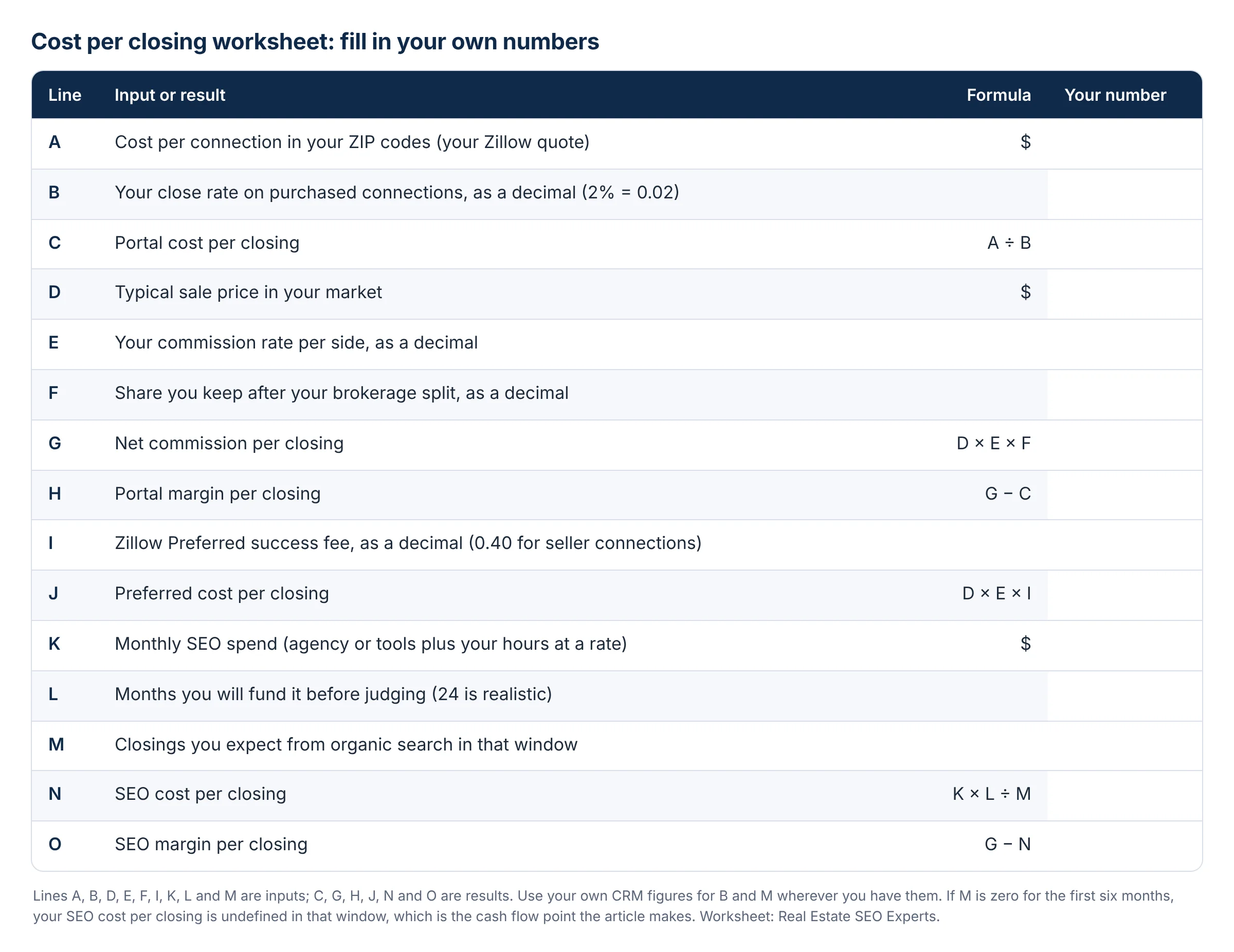
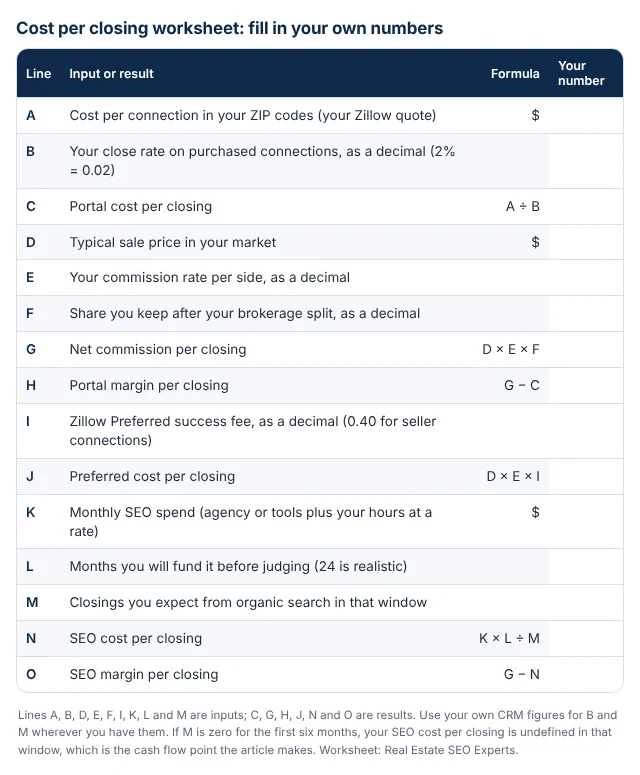
A few mistakes we see when agents run this. They compare cost per closing with gross commission instead of net. They count leads or appointments as the output instead of closings. They judge SEO at month four and Zillow at month one, which flatters both in opposite directions. They leave their own hours out of the SEO cost, which makes DIY look free. They compare Zillow’s per-connection average with a per-lead figure from a different product and conclude Zillow got cheaper. And they never tag lead source in the CRM, which means line B and line M are guesses forever. Fix the last one first; it is the input that makes every other number in this article yours instead of ours.
Frequently asked questions
How much does one Zillow lead cost in 2026?
Zillow’s Premier Agent page gives an average cost per connection of $223 in major metro areas and $139 in non-major metros, and says the price varies by market, home values and expected connections, with a minimum of $50 per ZIP code. HousingWire reports a typical range of $20 to $60 per lead and monthly budgets of $300 to $500 outside metros and $1,000 or more inside them, and Clever Real Estate reports agents in the most competitive markets paying $450 to $500 for a single lead. Your own quote from Zillow for your ZIP codes is the only number that matters for your worksheet.
What percentage of Zillow leads turn into closings?
There is no current public dataset. The most quoted figure, 1 to 3 percent, comes from a lead generation vendor quoted by HousingWire in September 2020 and refers to leads doing some sort of transaction within 120 days. In the same article a realtor.com executive cited 0.5 to 1 percent as the industry norm, while individual agents reported 7 to 15 percent. Treat the range as a starting assumption and replace it with the close rate in your own CRM as soon as you have thirty or more connections to measure.
What is the Zillow Preferred success fee?
Zillow’s Preferred pricing page says the success fee is a percentage of the full commission you expect to earn on a transaction with a Preferred connection. For seller-originated connections it is a flat 40 percent in all markets. For buyer-originated connections it varies by the property’s location, the transaction price and the connection delivery date; Zillow does not publish the range, and Clever Real Estate reports it as 15 to 40 percent. Zillow states it can change the fee with 15 days’ notice.
Is SEO cheaper than Zillow leads per closing?
Over a long enough window and with the work done properly, usually yes; in the first six months, no. In our worked example a major-metro Premier Agent closing at a 2 percent close rate costs $11,150, while the mid SEO case ($750 a month for 24 months producing six closings) costs $3,000 per closing. The same SEO budget judged at month six has produced nothing and so has an undefined cost per closing. The honest comparison is over 24 months with your own inputs.
How many closings does SEO have to produce to beat Premier Agent?
Divide your SEO spend over the window by the portal cost per closing. At $750 a month for 24 months ($18,000) against the metro example of $11,150 per closing, SEO wins if it produces more than 1.6 closings in two years. Against the non-metro example at a 3 percent close rate ($4,633 per closing), it needs more than 3.9 closings. The lower Zillow’s price in your ZIP code and the better you convert, the more organic closings SEO has to deliver to come out ahead.
Should a new agent buy Zillow leads or invest in SEO first?
Buy first, in a small way, and start the organic work as soon as there is any cash to spare. A new agent has no close rate, no reviews and no pipeline, and Zillow Preferred costs nothing until a deal closes, which makes it the lower-risk way to get early transactions and learn to convert. SEO should start within the first year because its payback is measured in years, and the sooner the asset exists the sooner its cost per closing falls below the portal’s.
Sources: Zillow, Premier Agent advertising page (checked 9 November 2026), Zillow, Zillow Preferred pricing, Zillow Help Center, minimum and maximum cost to participate in Premier Agent Advertising (updated June 2025), HousingWire, Is Zillow Premier Agent worth the cost? (updated 3 September 2025), HousingWire, What conversion rate should real estate agents expect when they purchase leads? (18 September 2020), Clever Real Estate, How much are Zillow leads? (updated 14 September 2026), NAR, Existing-Home Sales Increased 1.5% in September (13 October 2026), NAR, The Facts: settlement practice changes and consumer guides, NAR, Top 10 takeaways from the 2026 Profile of Home Buyers and Sellers (5 November 2026), Ahrefs, SEO Pricing: How Much Does SEO Cost? 439 People Polled (updated August 2024). Close rates, the 2.5 percent commission rate, the 70 percent split and the organic closing scenarios are the authors’ assumptions and are labelled as such in the text.
Want the SEO line of this worksheet filled in for your market?
Send us your site and the ZIP codes you work. We will tell you what the organic side would cost, how long it would take to produce closings there, and whether it beats what you are paying Zillow. If buying connections is the better call for you right now, we will say so. Plans start from $150 a month.