
SEO advice for real estate usually arrives as theory. This is a list of things to check, in the order we check them when we audit an agent’s or a brokerage’s website.
There are 44 items in eight groups. You won’t finish them in a day, and you don’t need to. Work from the top, because the early groups hold up the later ones. Good content on a site Google can’t read properly is wasted effort.
Each item is written so you can answer yes or no. Wherever the answer is no, you have your to-do list.
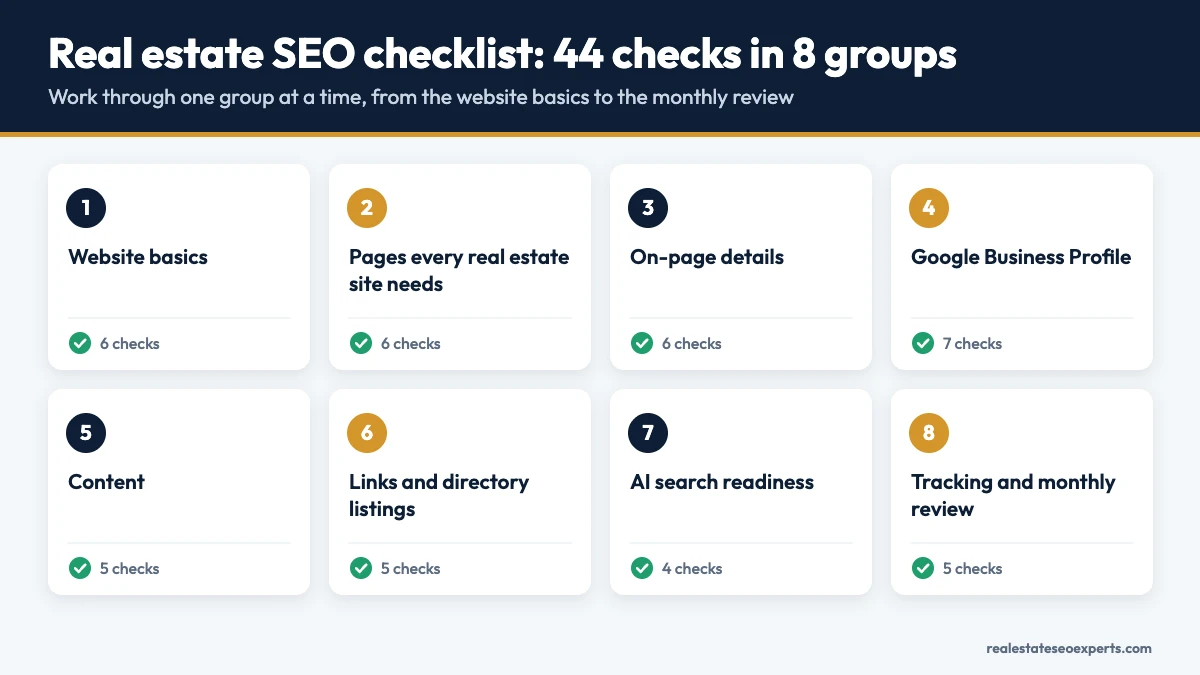
How to use this checklist
Go through it once with your website open in one tab and a Google search in another. Mark each item yes, no, or not sure. “Not sure” counts as a no until you’ve checked.
Don’t try to fix everything at once. Finish a group before you move to the next, and recheck the whole list every few months. Sites drift. A plugin update slows the pages down, an agent leaves and their profile page breaks, a listing feed starts creating duplicates.
1. Website basics
These decide whether Google can read your site at all.
- The site loads over HTTPS, with no security warning.
- Pages load quickly on a phone. Test a listing page and a neighborhood page, and not only the home page.
- The layout works on a small screen without pinching or sideways scrolling.
- Google is allowed to index the site. Check that no “noindex” tag or “discourage search engines” setting was left on after launch.
- An XML sitemap exists and has been submitted in Google Search Console.
- There are no broken links in the main menu, the footer or the home page.
The indexing item sounds too obvious to list. We include it because it happens: a new site goes live with the “do not index” switch still on from development, and nobody notices for months.
If you use an IDX feed, add one more test. Search Google for a full sentence from one of your listing descriptions, in quotation marks. If dozens of other sites show the same text, your listing pages are duplicates, and they need content of their own to rank. Our real estate website SEO service deals with this.
2. Pages every real estate site needs
- A home page that says who you are, where you work and who you help, on the first screen.
- An about page with your real name, photo, license details and the areas you cover.
- A separate page for each service you offer: buying, selling, rentals, property management.
- A page for each neighborhood or town you actively work, with local detail that isn’t copied from elsewhere.
- A contact page with your phone number, email and office address written as text, and not inside an image.
- A page for sellers that explains how you price and market a home.
Most agent sites have the first, second and fifth. Neighborhood pages are where they fall short, and those are the pages that bring in search traffic. One strong page per area does more than a single “areas we serve” list.
A quick test for the home page: show it to someone outside the business for five seconds, then close it. Ask them where you work and what you do. If they can’t say, Google probably can’t either.
3. On-page details
Run these on every important page.
- The page has one main heading (H1) that says what the page is about.
- The title tag is under about 60 characters and includes the place and the topic.
- The meta description was written by a person and gives a reason to click.
- The URL is short and readable: /homes-for-sale-oakwood/ and not /page?id=4471.
- Images have descriptive file names and alt text.
- The page links to at least two other relevant pages on your site.
Titles deserve the most care of these six. The title is the blue line people see in search results, and it is the strongest hint on the page about its topic. “Home | Smith Realty” wastes it. “Homes for Sale in Oakwood | Smith Realty” doesn’t.
Alt text is the item most often skipped. Describe what is in the photo in one short sentence, such as “Kitchen with island in a three-bedroom home on Maple Street”. Don’t stuff it with keywords.
4. Google Business Profile
For “realtor near me” searches, your profile matters more than your website.
- The profile is claimed and verified.
- The name is your real business name, with no extra keywords added.
- The primary category is right. For most agents that is “Real estate agent”.
- Your name, address and phone number match your website exactly.
- Service areas list the towns you work.
- There are recent photos, and at least one post in the last month.
- You have a routine for asking clients for reviews, and you reply to every review.
Individual agents can have their own profile alongside the brokerage’s. Set it up carefully, because a profile that looks like a duplicate of the office listing can be merged or suspended. Our guide to local SEO for real estate agents goes through the setup.
Reviews are the part of this group you can’t fix in an afternoon. Ask at closing, when the client is happiest, and send the link by text so it takes them a minute. A steady trickle of recent reviews looks better to a reader than a burst from two years ago.
5. Content
- Each neighborhood page has been updated in the last six months.
- You publish something useful on a schedule you can keep, even if that is twice a month.
- Your posts answer questions buyers and sellers ask you in person.
- No two pages target the same keyword.
- Old posts with outdated prices, rates or rules have been corrected or removed.
A common mistake is writing for other agents. Posts about commission splits or CRM tools attract people in the industry, and they aren’t your clients. Write down the last ten questions a client asked you. Those are your next ten posts.
You can check the fourth item with a simple search. Type site:yourdomain.com followed by a keyword, and see how many of your pages come up. If three pages all answer the same search, merge them into one good page and redirect the others to it.
If you need ideas for what to target, our list of real estate SEO keywords is sorted by who is searching.
6. Links and directory listings
- Your details are correct on Zillow, Realtor.com, Homes.com and your brokerage’s agent page.
- Profiles from a previous brokerage have been updated or closed.
- You are listed with your local chamber of commerce or business association.
- At least a few local websites link to you: a school you sponsor, a charity, a local news piece.
- You have not bought links in bulk.
Links from your own town carry more weight for local rankings than a stack of general directories. They are also slower to earn, which is why most agents skip them. Our real estate link building page explains what we look for.
7. AI search readiness
People now ask ChatGPT, Gemini and Google’s AI Overviews for agent recommendations. You can’t control the answer, but you can make your site easy to quote.
- Your home and about pages state plainly who you are, what you do and where.
- Your key pages include a short FAQ with direct answers.
- Structured data (schema) is in place for your business, and for FAQs where you have them.
- You have asked two AI tools “who are good real estate agents in [your area]” and noted what they say and which sources they cite.
That last one takes five minutes and tells you a lot. If the tools name competitors and cite review sites, you know where to put your effort. There’s more on our real estate AI SEO page.
8. Tracking and monthly review
- Google Search Console is set up, and you look at it at least once a month.
- Google Analytics, or another analytics tool, is recording visits.
- Calls and form enquiries from the website are counted separately from other sources.
- You track rankings for a short list of keywords by neighborhood, and not for one city-wide term.
- Once a month you compare leads from search with leads from portals and ads.
Rankings are the easiest number to watch and the least useful when taken alone. A page can move from position 30 to position 9 and bring you nothing. What you want to see is calls and enquiries from search rising over a few months.
If you have never opened Search Console, start with the Performance report. It lists the searches your site appeared for and how often people clicked. Agents are often surprised by what is on it.
If you only have one hour
Do these five things, in this order.
- Search your own name plus your city, and look at what a client would see.
- Check that your site is indexed. Search Google for site:yourdomain.com and confirm your pages appear.
- Open your Google Business Profile and fix the category, phone number and service areas.
- Load your home page on your phone over mobile data and count the seconds.
- Ask your most recent happy client for a Google review, with a direct link.
None of this needs a developer or an agency, and the first two will tell you whether you have a serious problem.
What this checklist doesn’t cover
A list like this checks whether the foundations are in place. It can’t tell you which keywords are worth chasing in your market, or how strong the agents ranking above you are. That takes research specific to your area.
It also says nothing about time. Even with every box ticked, most sites need three to six months before search brings steady enquiries, and longer in a competitive city. Our real estate SEO strategy guide covers how the pieces fit together over that period.
Frequently asked questions
How often should I go through this checklist?
Every three to four months is enough for most agents. Go through it once more after any big change, such as a new website, a new IDX provider or a move to a different brokerage.
Can I do real estate SEO myself?
Much of it, yes. The Business Profile, reviews, neighborhood pages and blog posts are all work an agent can do. Technical fixes and link building are where most people run out of time or patience.
Which item matters most?
If the site isn’t indexed, nothing else counts, so check that one first. After that, for most agents, it is the Google Business Profile, because it drives the map results where ready clients are looking.
Does a brokerage need a different checklist?
The same items apply, with more of everything: a profile for each office, a page for each agent, and rules to stop agents’ pages copying each other.
Want it checked for you?
If you’d like someone else to run through this, our free SEO audit covers the same ground and is emailed to you within 6 to 12 hours. If you’d like the fixes handled as well, plans start at $150 a month. The details are on our pricing page.
Want a second pair of eyes on your site?
Send us your website and we will check it by hand. The free audit comes back within 6 to 12 hours, and plans start from $150 a month.