
SEO in real estate is the work of getting your website and your business listing to show up when people search Google for homes, agents or property advice in your area. SEO stands for search engine optimization. You don’t pay Google for the position. You earn it by having pages and a profile that answer what people are searching for better than the alternatives do.
That is the whole idea. Everything else is detail about how to do it. This post goes through that detail in plain terms, for agents, brokers and developers who have heard the word many times and never had it explained without jargon.
What SEO means for a real estate business
When someone looks for a home or an agent, three kinds of result appear on Google.
At the top there are often ads, marked “Sponsored”. Businesses pay for each click on those.
Below the ads, for local searches, there is a map with three businesses. Those come from Google Business Profiles.
Then come the ordinary results, a list of web pages. Nobody pays for those positions.
SEO is about the second and third kinds: the map and the ordinary list. In real estate that means two things in practice. One is appearing on the map when someone nearby searches for an agent. The other is having pages on your website that rank for the areas and questions you care about.
It helps to be clear about what SEO isn’t. It isn’t advertising, although it sits next to ads on the page. It isn’t social media. And it isn’t a trick. Methods that try to fool Google tend to work briefly and then get a site pushed down.
How Google decides who shows up
Nobody outside Google knows the exact formula, and it changes. The broad logic has been stable for years, though, and Google describes much of it publicly. It comes down to three questions.
Is the page about what the person searched for? Google reads your page: the title, the headings, the text, the images. A page titled “Homes for Sale in Oakwood” that talks about Oakwood is a candidate for that search. A home page that says “Welcome to our website” is a candidate for nothing.
Can the site be trusted? Google looks at who links to you, how long the site has been around, and whether your business details are consistent across the web. For local results it also looks at your reviews.
Is the page pleasant to use? A page that loads slowly, breaks on a phone or buries the content under pop-ups is less likely to be shown.
For searches with a place in them, there is a fourth question: how close are you? Someone searching “realtor near me” sees agents near where they are standing. You can’t change your location, which is why local SEO starts with the area around you.
Here is how that plays out. Say a couple types “three bedroom house near Lincoln Elementary” into Google. One site has a page about that exact school zone, with current homes, typical prices and a note on the morning traffic. Another has a general page that says the agent “serves the whole city”. The first page answers the search. The second only mentions it. Google will nearly always put the first one higher, even if the second belongs to a much bigger company. Size helps with broad searches. For specific ones, the page that fits the question wins.
The main parts of real estate SEO
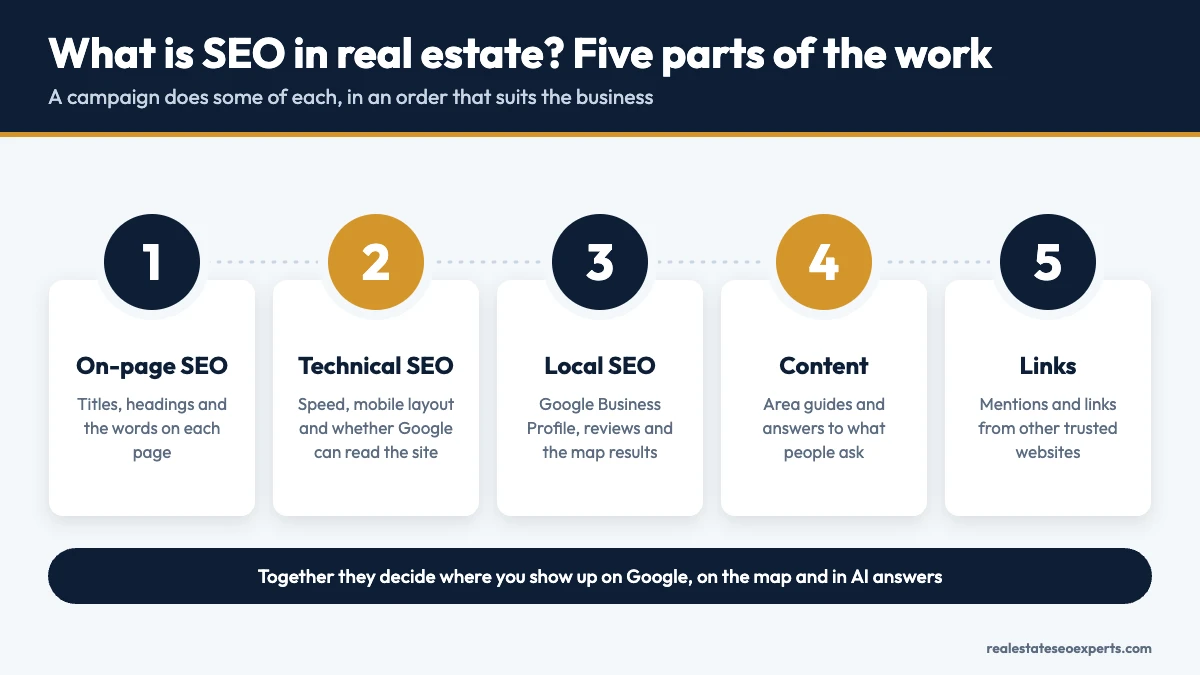
SEO is usually split into five kinds of work. A decent campaign does some of each.
On-page SEO
This is the content and the labels on each page: the title, the headings, the text, the image descriptions and the links between your pages. It tells Google what each page is about, and it is the part you control most directly.
A quick test: read only the title and the main heading of a page. If you can’t tell which town and which kind of property it covers, Google can’t tell either.
Technical SEO
This is the plumbing. Does the site load quickly? Does it work on phones? Can Google reach every page? Are duplicate pages confusing things? Real estate sites have a technical problem of their own, which is listing feeds that create thousands of near-identical pages. There is more on that in our post on SEO for real estate listings.
Local SEO
This is everything that affects the map: your Google Business Profile, your reviews, and your name, address and phone number matching on every site where they appear. For an individual agent it is often the most valuable part. Our real estate local SEO page goes deeper.
Content
These are the pages and posts that answer what people search for: neighborhood guides, seller guides, market updates, answers to common questions. Without content there is nothing to rank. See real estate content SEO.
Links
When another website links to yours, Google treats it a little like a recommendation. Links from local and relevant sites count most: the chamber of commerce, a school you sponsor, the local paper. Buying links in bulk is the classic shortcut that backfires. Our real estate link building page explains the safe way.
How SEO differs from ads and portal leads
Agents usually compare SEO with the two things they already pay for.
Google Ads. You pay each time someone clicks. Results start the day you switch the campaign on and stop the day you switch it off. Ads are good for speed and for testing.
Portal leads. You pay a portal such as Zillow for enquiries in an area. This is fast as well. The enquiry may be shared with other agents, and the portal owns the relationship with the visitor.
SEO. You pay in time or fees to build pages and a profile that rank. Not much happens in the first weeks. Once pages rank, visits don’t cost anything per click, and the enquiries come straight to you.
None of the three is right for everyone. Many agents run ads or portal leads for income now and build SEO for later. What matters is knowing which one you are buying. We go through the trade-offs with portals in our Zillow SEO strategy post.
Where AI search fits
A growing number of people skip the list of links and ask an AI tool: ChatGPT, Gemini, or the AI Overviews that Google shows above its results. “Who is a good real estate agent in Oakwood?” “Is now a good time to sell?”
These tools assemble an answer from pages they consider reliable, and they sometimes name or link the sources. Getting your business into those answers has picked up names of its own. AEO means answer engine optimization. GEO means generative engine optimization.
In practice it is the same good habits with more discipline. Say plainly who you are and where you work. Answer questions directly near the top of the page. Keep your facts consistent everywhere. Collect real reviews. We have pages on AEO and GEO for real estate if you want the detail.
Nobody can promise you a place in an AI answer. The tools change quickly and don’t publish their rules.
How long it takes
Longer than anyone would like. A fair expectation for most real estate businesses is three to six months before search brings steady enquiries, and more than that in a large, competitive city.
The order is usually the same. Your own name and your map listing improve first. Neighborhood pages follow. Broad city terms come last, if at all.
There are reasons for the wait. Google needs time to find new pages, compare them with what already ranks, and see whether people who click stay or leave. A new website has no history to lean on, so it starts slower than an established one.
Be wary of anyone who guarantees a number one ranking by a certain date. They can’t control Google, and neither can we.
What you can do yourself, and when an agency makes sense
A fair amount of real estate SEO needs no special skill, only time. You can do these yourself:
- Claim and complete your Google Business Profile
- Ask every client for a review
- Write a page for each neighborhood you work
- Answer common client questions in short posts
- Keep your details correct on the portals and directories
Our real estate SEO checklist lists these step by step, and our keyword list shows what to write about.
An agency earns its fee on the parts that are technical, slow or easy to get wrong: fixing site speed and duplicate listings, structured data, link building, and keeping all of it going every month when you are busy with clients. If you have more time than budget, start alone. If you have more budget than time, get help. Our post on how we audit a site before quoting shows the twelve checks that decide whether SEO is worth it for a given business. Our plans start at $150 a month, and the scope is on our pricing page.
Common myths
“SEO is a one-time job.” Competitors keep publishing, Google keeps changing, and your own listings and details change. A site left alone slides.
“More keywords on the page means better rankings.” Repeating a phrase twenty times makes a page worse to read, and Google has discounted that for many years.
“I need to rank number one for my city.” Most agents get more business from their name, their neighborhoods and the map than from a city-wide term.
“SEO is dead because of AI.” AI tools still draw on web pages and business profiles. The work has widened. It hasn’t gone away.
“Paying for Google Ads improves my organic ranking.” It doesn’t. Ads and ordinary results are separate systems.
Frequently asked questions
What does SEO stand for in real estate?
Search engine optimization. In real estate it means improving your website and Google Business Profile so they appear when people search for homes, agents or property advice in your area.
Is SEO worth it for a solo agent?
Usually, if you plan to work the same area for years. The map listing and a few neighborhood pages can bring enquiries without a cost per lead. If you need clients this month, ads will be quicker.
How is real estate SEO different from normal SEO?
It is more local, and it has to deal with listing feeds and with large portals at the top of many searches. The principles are the same. The priorities are different.
How much does real estate SEO cost?
It varies with your market and the number of areas you cover. Ours starts at $150 a month with flexible payment terms.
Where to start
Search your own name and your town, and look at what a client would see. That one search shows you most of what needs fixing.
For a fuller picture, our free SEO audit is done by a person and emailed within 6 to 12 hours. You can also read about our real estate SEO services to see how the parts fit together.
Want a second pair of eyes on your site?
Send us your website and we will check it by hand. The free audit comes back within 6 to 12 hours, and plans start from $150 a month.